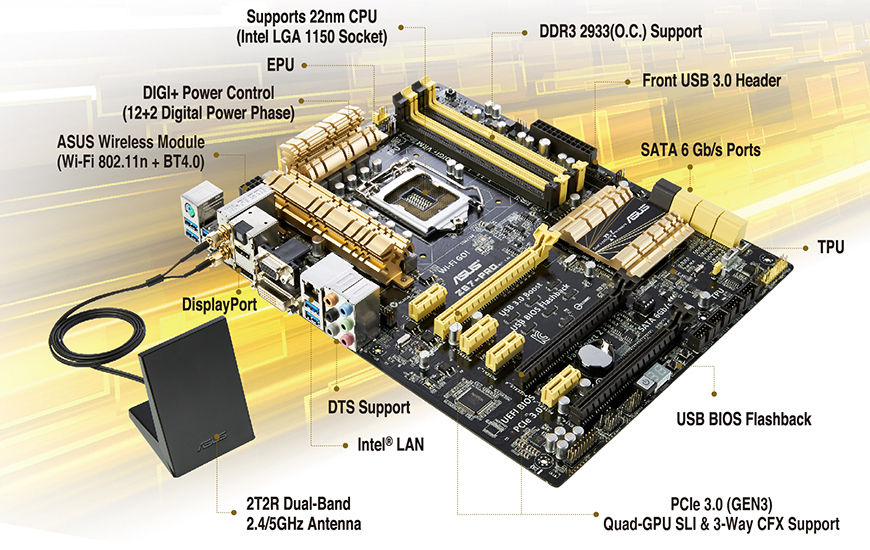
I'm slightly frustrated by the lack of motherboards with what I consider to be a sensible mix of features. There are only so many ways you can weave the various IOs supplied by the CPU and chipset. My preference is to avoid crowding the motherboard with additional SATA and USB3 controllers that add hardware and driver complexity and are a poor second in performance to the stock controllers anyway.
MUX chips are used on a lot of midrange boards to allow switching PCIe slots between x16/x0 and x8/x8 modes. I'd love to see more inventive use of MUX chips as seen for example on the ASRock Z87E-ITX. It has a full six SATA 6G ports for internal drives (hello NAS box and it also has an eSATA port on the rear and an mSATA slot. It makes 8 SATA interfaces available from the total of 6 available from the chipset by rerouting ports 4 and 5 if an eSATA or mSATA device is connected.
Sometime soon I'd like to see a board with a proper m.2 (NGFF) key M support. Using a MUX it could have a BIOS option to run PCIe 3.0 x4 to the m.2 using the CPU's x8/x4/x4 mode or alternatively switch to PCIe 2.0 x4 from the chipset.
MUX chips are used on a lot of midrange boards to allow switching PCIe slots between x16/x0 and x8/x8 modes. I'd love to see more inventive use of MUX chips as seen for example on the ASRock Z87E-ITX. It has a full six SATA 6G ports for internal drives (hello NAS box
and it also has an eSATA port on the rear and an mSATA slot. It makes 8 SATA interfaces available from the total of 6 available from the chipset by rerouting ports 4 and 5 if an eSATA or mSATA device is connected.Sometime soon I'd like to see a board with a proper m.2 (NGFF) key M support. Using a MUX it could have a BIOS option to run PCIe 3.0 x4 to the m.2 using the CPU's x8/x4/x4 mode or alternatively switch to PCIe 2.0 x4 from the chipset.