• Some users have recently had their accounts hijacked. It seems that the now defunct EVGA forums might have compromised your password there and seems many are using the same PW here. We would suggest you UPDATE YOUR PASSWORD and TURN ON 2FA for your account here to further secure it. None of the compromised accounts had 2FA turned on.
    Once you have enabled 2FA, your account will be updated soon to show a badge, letting other members know that you use 2FA to protect your account. This should be beneficial for everyone that uses FSFT.

Need Advice from WC pros!

Spazilton

2[H]4U
Joined
Feb 25, 2005
Messages
2,802
I am getting ready to buy a watercooling system for the first time, I am sick and tired of air cooling and I have done a lot of research and have picked the following components for my system.

I am more than willing to take suggestions, I just want to get the best system possible for my situation. I would also like to know if the system I want to buy will be able to handle the heat load I am going to throw at it.

Ok to start it off.
The components I have in my current system.

DFI SLI-DR Expert
Opteron 170 DualCore @ 2.4 240x10 4xHTT 1.475v (Trying to CPU Burn in a higher OC)
Mushkin Redline XP-4000 1024MBx2 3-2-3-8 2.67v
2 XFX 7800GT @490/1150 in SLI.

Lian Li V2000 case

Now I do not want to do any cutting on my case in any way. I just got it and I love it and don't want to hack it up quite yet.

As you might or might not know the V2000 has 3 exhaust fans 1 x 120mm and 2x80mm in the Power Supply compartment, I want to use these for my rads.

The components I have picked out are:

(All 1/2" Fittings)
Swiftech Storm G4
DD A8N Chipset Block (I think this will fit on the new SLI-DR Expert)
Black Ice Extreme 1x120mm Rad
Black Ice Micro 2
MAZE4GPU-SLI
DD-D5 Pump

I am going to be using Tygon 1/2" ID 3/4"OD Tubing for the whole system.
Misc Odds and ends, such as coolant additives, hose clamps, etc.

My plan is to run a T-Line instead of a Res. I dont want to screw with em.

Now for plumbing I am planning on placing the pump probally a few inches twoards the front of the case from where the brace is (Its removed on mine).

The system flow Im planning on (Need suggestions, I only want to do 1 loop, cant afford 2 pumps)

-->Pump---->>CPU->>>GPU1--->GPU2--->Chipset--->120MM Rad--->Dual 80mm Rad---Pump..

The other option I have been thinking about is,

Pump---->CPU----> Dual 80mm Rad-->GPU1-->GPU2--->Chipset--->120MM Rad--->Pump.


How will this setup work, are the 2 rads going to be enough to cool the amount of heat I am putting out. I am probally going to use Meduim speed Panaflows, then adjust their speed based on the total system temps once I get it set up..

Just need some inputs, suggestions, advice.. etc.. Any help welcome.. Thanks!
 
Others who use the stuff you want to cool with can better answer your questions. However, my V2000B case has a 120 fan in the front bottom and another 120 fan in the back MB compartment. It also has the provision to add two 80mm fans above the PSU if you are so inclined.


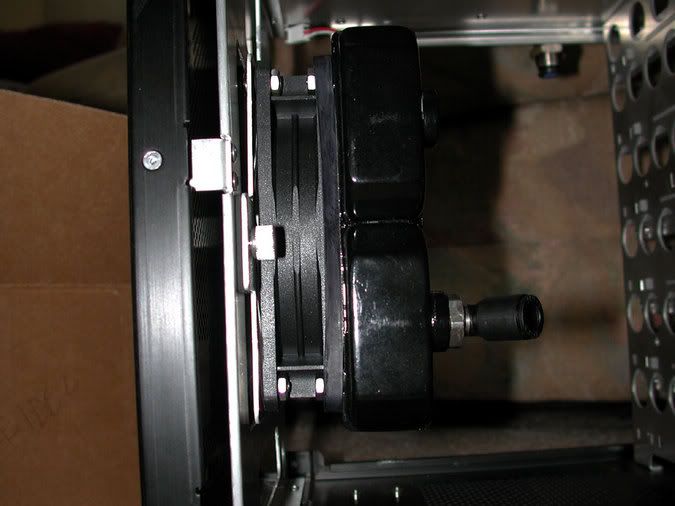
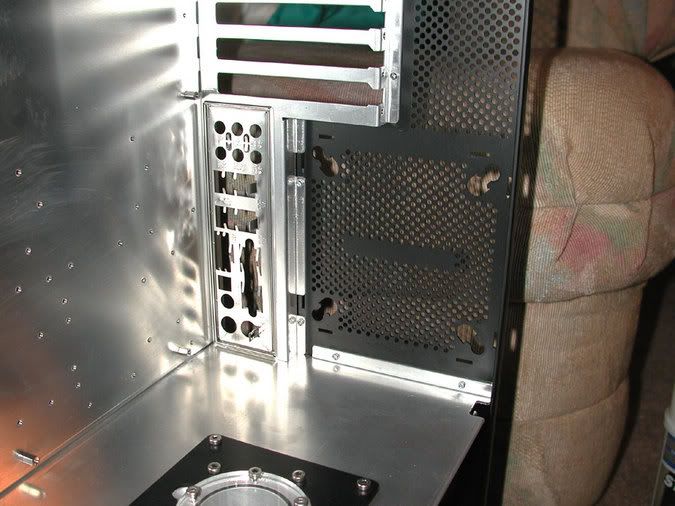
CPU_PSU3.jpg


Rad_Fan_Final_6.jpg


Rad_3.jpg
 
Top Nurse said:
Others who use the stuff you want to cool with can better answer your questions. However, my V2000B case has a 120 fan in the front bottom and another 120 fan in the back MB compartment. It also has the provision to add two 80mm fans above the PSU if you are so inclined.

Yea I have the 120 intake fan also, I can't get rid of it its cooling 6 HDDs.
 
If you do something like this you can put a rad up front and the fan will move air over the HD's. I actually had at one time both HD racks in and a BI Pro with a 120mm fan sitting right there. :D I wouldn't be any more difficult to use 1/2: tubes so long as you leave the fittings in the same place shown here.
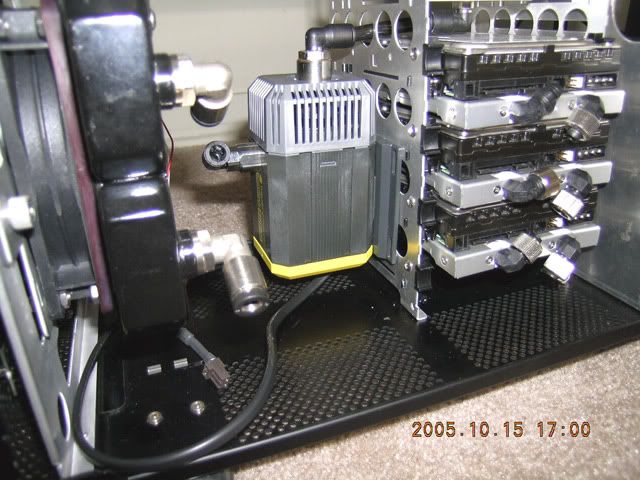


HDMockup1.jpg
 
awesome choices, the first thing that jumped out to me was the tubing. get 7/16 ID tubing instead. you still get all 1/2" barbs like you normally would but stretch the tubing over. i'll go find the post to tell you why, brb (i use it and love it)

----edit here we go, taken from: http://www.hardforum.com/showthread.php?t=930098&page=3&pp=20

Cathar said:
Okay, the recommendation goes like this:

Instead of using 1/2" ID tubing, people should really be using 7/16" ID tubing with a 3/32" wall thickness for a 5/8" OD, and stretching the 7/16" ID tubing over 1/2" OD barbs.

The physical benefits for 7/16" ID over 1/2" ID are these:

- 7/16" is more slender (5/8" OD as opposed to 3/4" OD). Less bulk equals better case air-flow.
- 7/16" is just as kink resistant as 1/2" ID (3/4" OD) tubing. It will turn just as tight radii, but consume less space when doing so because it is not as bulky
- 7/16" tubing takes about 2/3's the effort to bend as 1/2". This is important for waterblock mounting. Tubing that requires less effort to bend won't be applying as much torque against the waterblock mount against the CPU, resulting in better mount consistency, and therefore better temperatures.
- 7/16" tubing, when filled with water, is 2/3's the weight per unit of tubing length as 1/2" tubing. This means that there is less weight dragging off fittings. This is specifically important again for reducing the rotational torque that tries to tilt the waterblock away from the CPU, again helping to improve waterblock mounting.
- 7/16" tubing costs about 2/3's as much per unit length as 1/2" tubing.

Now people will want to know about how to use 7/16" ID tubing and the flow-rate penalties associated with it. The thing here is that it is quite easy to stretch 7/16" ID tubing over regular 1/2" OD hose fittings, and this is how it should be used. Do not attempt to source 7/16" OD hose fittings, it MUST be used by stretching it over your standard 1/2" OD fittings, and here's why.

This is where we get into the flow-rate effects of 7/16" ID tubing as opposed to 1/2" ID tubing. Aside from the flow-resistance effects of waterblocks, radiators and reservoirs, there are two main types of tubing based flow resistance in a water-cooling loop.

1. The resistance offered by the tubing itself
2. The resistance offered by the fitting interfaces where the ID of the tubing has to step-down to the ID of the hose barb.

Now 7/16" ID tubing is going to be more restrictive than 1/2" ID tubing naturally, however point 2) above is important to consider. When the ID's between the tubing and the host barb more closely match, then the flow resistance offered by the step-down in side is reduced. What this means is that 1/2" ID tubing will offer more flow resistance at barb fitting interfaces than 7/16" ID tubing. How much more? Let's explore that using a good pressure drop calculator.

First let's define what a typical water-cooling setup looks like. Let's assume 2.0m of total tubing length, and a cooling loop that has a radiator, a CPU waterblock, a pump and a reservoir. There is a total of 4 tubing-to-fitting step-down transitions in such a setup. 1/2" OD barbs will have an ID of 9.5-10.5mm, so let's assume a middling value of 10.0mm ID for the barb.

So using our calculator, and 26C water, we arrive at the following flow resistance values:

4LPM
2m x 1/2" tubing resistance = 0.09mH2O
4 x 1/2" ID tubing to 10mm ID fitting resistance = 0.12mH2O
2m x 7/16" tubing resistance = 0.18mH2O
4 x 7/16" ID tubing to 10mm ID fitting resistance = 0.07mH2O

Total 1/2" loop tubing/fitting resistance = 0.21mH2O
Total 7/16" loop tubing/fitting resistance = 0.25mH2O

6LPM

2m x 1/2" tubing resistance = 0.20mH2O
4 x 1/2" ID tubing to 10mm ID fitting resistance = 0.28mH2O
2m x 7/16" tubing resistance = 0.39mH2O
4 x 7/16" ID tubing to 10mm ID fitting resistance = 0.16mH2O

Total 1/2" loop tubing/fitting resistance = 0.48mH2O
Total 7/16" loop tubing/fitting resistance = 0.55mH2O

8LPM

2m x 1/2" tubing resistance = 0.33mH2O
4 x 1/2" ID tubing to 10mm ID fitting resistance = 0.49mH2O
2m x 7/16" tubing resistance = 0.68mH2O
4 x 7/16" ID tubing to 10mm ID fitting resistance = 0.28mH2O

Total 1/2" loop tubing/fitting resistance = 0.82mH2O
Total 7/16" loop tubing/fitting resistance = 0.96mH2O

10LPM

2m x 1/2" tubing resistance = 0.52mH2O
4 x 1/2" ID tubing to 10mm ID fitting resistance = 0.77mH2O
2m x 7/16" tubing resistance = 1.04mH2O
4 x 7/16" ID tubing to 10mm ID fitting resistance = 0.44mH2O

Total 1/2" loop tubing/fitting resistance = 1.29mH2O
Total 7/16" loop tubing/fitting resistance = 1.48mH2O

Now what we're looking at here is the resistances being offered by the tubing and fittings, and not the additional resistances being offered by the waterblock, radiator and reservoir. Let's now add on the resistance of a waterblock and radiator. We'll use a medium pressure drop like the White Water (reviewed by Bill Adams here), and the Thermochill 120.2 radiator (also reviewed by Bill Adams here). We'll assume that the pressure drop offered by the reservoir is neglibible.

Total System Resistance

1/2"
4LPM 0.82mH2O
6LPM 1.80mH2O
8LPM 3.10mH2O
10LPM 4.80mH2O

7/16"
4LPM 0.86mH2O
6LPM 1.87mH2O
8LPM 3.25mH2O
10LPM 5.00mH2O

Now flow-resistance is proportional to the flow rate squared. Therefore with the slightly higher flow resistances offered by the 7/16" ID tubing we can predict what the flow rate impact would be, which is the square root of the pressure ratios:

4 LPM => -2.5%
6 LPM => -2.0%
8 LPM => -2.5%
10 LPM => -2.0%

Now in all of that there has been some approximations by eyeballing graphs, but it's working out that there is about a 2.25% reduction in flow rates by going from 1/2" to 7/16" ID tubing. If we then factor in that centrifugal pumps actually push higher pressures as flow rates are reduced, then we can pretty safely assume that we'll see a net 2% reduction in flow rates.

So basically what we're seeing here is that we'll get 98% of the system flow rates with 7/16" ID tubing stretched over 1/2" OD barbs, as we would get with 1/2" ID tubing over 1/2" OD barbs.

In terms of an actual performance difference, we're talking about around a 0.02-0.05C performance loss at the CPU waterblock due to the decreased flow rates, but this is typically offset by the waterblock being able to make better contact against the CPU due to 7/16" ID tubing's benefits as noted at the start of this post.

In all of this, we can conclude that 7/16" ID tubing, for all intents and purposes, is the performance equal of 1/2" ID tubing, but offers a host of other benefits that makes it much more suited for a top-end performance rig than 1/2" ID tubing.
 
Back
Top