• Some users have recently had their accounts hijacked. It seems that the now defunct EVGA forums might have compromised your password there and seems many are using the same PW here. We would suggest you UPDATE YOUR PASSWORD and TURN ON 2FA for your account here to further secure it. None of the compromised accounts had 2FA turned on.
    Once you have enabled 2FA, your account will be updated soon to show a badge, letting other members know that you use 2FA to protect your account. This should be beneficial for everyone that uses FSFT.

Mini-ITX build or not?

Joined
May 4, 2014
Messages
12
Hi all,

I'm in the market for a new desktop. My primary use is as a gaming PC and I have a budget of $1,300 (AU). I'll happily admit I'm totally out of my depth working out what parts I want having just recently begun learning about the different hardware types out there. You guys across the forums have been a huge help to me so far and I hope you can help me a bit more in making a choice on a new PC.

I really like the look of this Mini-ITX BitFenix Prodigy build. From my limited knowledge of hardware I think it suits my needs well, and it fits my budget.

http://www.pccasegear.com/index.php?main_page=product_info&cPath=1411&products_id=27644

There is however what looks like a very similar prebuild for the same price, but in (IMO) a less attractive case. It has a SSD which would be nice, but what sacrifices have been made as far as other hardware to maintain the price?

http://www.pccasegear.com/index.php?main_page=product_info&cPath=1411&products_id=27469

tl;dr
Which PC should I buy and why?

EDIT:
When looking at the $$$ remember to consider the "Australia Tax". Fellow Aussies will know what I mean by that. For others I should explain:

Australia experiences a strange phenomenon where almost all electronic goods are inexplicably priced much higher than in other western countries. This inflation is usually in the region of 30%. This is partially explained by shipping and import tax costs, but this 30% price hike is still much higher than can be explained by anything other than a (nearly) captive market.

In short, if when considering the builds above the prices are no more than a third higher than you would expect them to be, don't be concerned - that's perfectly normal pricing for Australia.

Also, I'm not going to import a PC - that leads to even higher taxing and I'd be worse off, but thanks in advance for the suggestion.


EDIT 2:
3rd option? http://www.pccasegear.com/index.php?...ducts_id=27648
 
Last edited:
Why not build your own? I think you could do a lot better with your budget!
Also, I wouldn't buy a Seagate drive if my life depended on it.
 
Why not build your own? I think you could do a lot better with your budget!
Also, I wouldn't buy a Seagate drive if my life depended on it.

No confidence to is the first part of the answer. Time is the second - I can't remember the last time I had a weekend that wasn't packed.

Also, what's wrong with Seagate? (genuine question)
 
Also, what's wrong with Seagate? (genuine question)

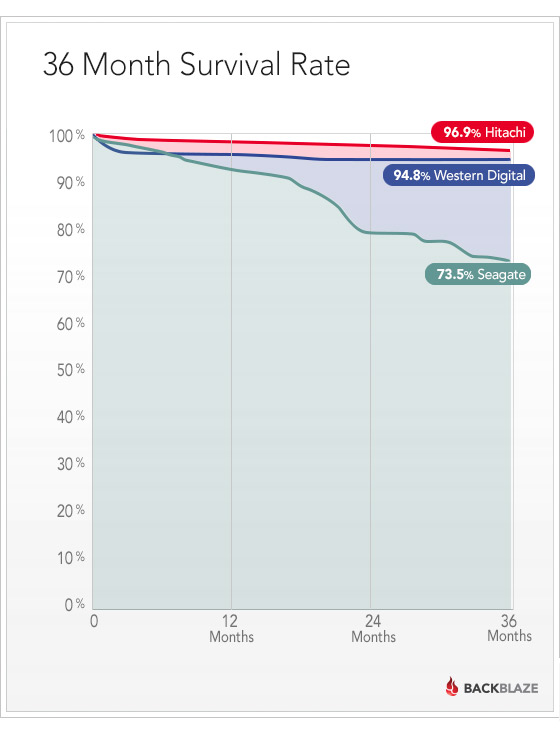
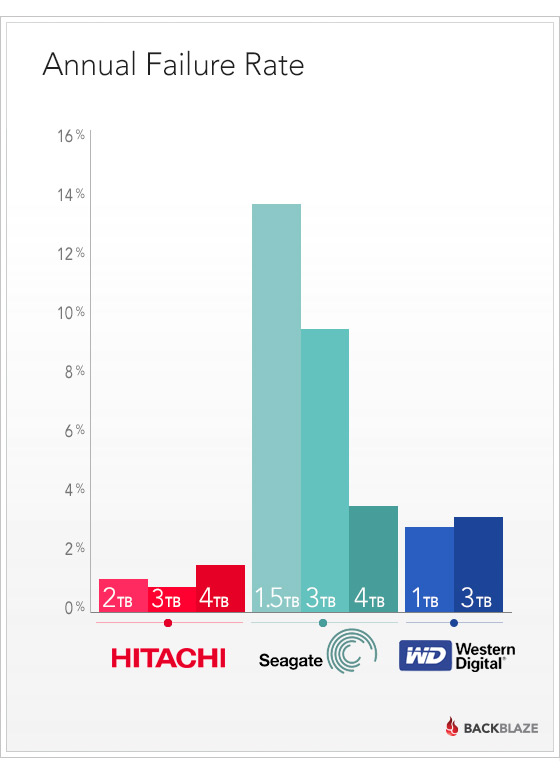
Their hard drives have a reputation of being unreliable compared to the likes of Western Digital, Hitachi, and others. This graph illustrates as such quite nicely:

blog-fail-drives-manufacture.jpg


Note that those results come from a company that uses desktop (non-server grade) drives in a demanding, near constant-on environment, so those failure rates are exaggerated compared to typical use.

Still, it's clear that Seagate's drives are more susceptible to failure. Never hurts to avoid their use, even if it's a few dollars more up front.

EDIT: Here's another graph that's a bit more useful:

blog-survival-drives-by-month.jpg
 
Last edited:
First time I've seen these charts... ROFL! Thanks, I'll be avoid Seagate until I hear something.
 

That's really interesting.

I suppose there is a difference in this anecdote as the drives were not in constant use, but the last two companies I've worked for have both relied on Seagate ext-HDDs for backing up their records every afternoon. Unsure if there was ever a failure but I'm sure if they were aware of this data they might consider a different brand.

Apart from the Seagate drives are there any other obvious (to the educated!) points of concern with those builds?
 
I should also note, and will edit the post to note the "Australia Tax". Fellow Aussies will know what I mean by that. For others I should explain.

Australia experiences a strange phenomenon where almost all electronic goods are inexplicably priced much higher than in other western countries. This inflation is usually in the region of 30%. This is partially explained by shipping and import tax costs, but the 30% inflation is still much higher than can be explained by economics.

In short, if the prices aren't more than a third higher than you would expect them to be don't be concerned - that's perfectly normal pricing.

Also, I'm not going to import a PC - that leads to even higher taxing and I'd be worse off...:(
 
Is the pricing on the website USD or AUD?

...In any case, other than that HDD, there isn't anything that's glaringly bad. I would say that, for that amount of money, I would hope to at least have a small SSD as a boot/application drive, because the performance (and perceived) boost is significant.

Also, the Prodigy is among the largest ITX cases around, so if you want portability, I'd keep looking. Though some people like the look and the handles.
 
Pricing is AUD.

I've just noticed on clicking through the links again that the second PC has been taken down from the website. I guess that solves my problem by eliminating the choice!

Regarding portability, that isn't an issue. The smallish form factor however is important as I do want it to be displayed in some way, as I think it is a good looking case, but I don't want the tower to consume a huge amount of space.

I guess I can only ask, should I buy the Prodigy GTX 760 build or keep looking? I'm leaning to buying it.
 
Last edited:
Their hard drives have a reputation of being unreliable compared to the likes of Western Digital, Hitachi, and others. This graph illustrates as such quite nicely:

blog-fail-drives-manufacture.jpg


Note that those results come from a company that uses desktop (non-server grade) drives in a demanding, near constant-on environment, so those failure rates are exaggerated compared to typical use.

Still, it's clear that Seagate's drives are more susceptible to failure. Never hurts to avoid their use, even if it's a few dollars more up front.

EDIT: Here's another graph that's a bit more useful:

blog-survival-drives-by-month.jpg

Please stop posting those graphs on the Internet.
Dispelling Backblaze's HDD Reliability Myth: http://www.tweaktown.com/articles/6...bility-myth-the-real-story-covered/index.html

Latest RMA statistics says that Seagate drives has the best reliability.
http://www.hardware.fr/articles/920-6/disques-durs.html
 
Please stop posting those graphs on the Internet.
Dispelling Backblaze's HDD Reliability Myth: http://www.tweaktown.com/articles/6...bility-myth-the-real-story-covered/index.html

Latest RMA statistics says that Seagate drives has the best reliability.
http://www.hardware.fr/articles/920-6/disques-durs.html

Wow! They bought thousands of the cheapest drives they could find, including old stock and refurbs from Costo. Then mounted them without sufficient vibration damping, without adequate cooling. No wonder.
 
Wow! They bought thousands of the cheapest drives they could find, including old stock and refurbs from Costo. Then mounted them without sufficient vibration damping, without adequate cooling. No wonder.

Over the years they added dampers to reduce vibration. Guess which brand of drives is the one that they had been using the longest without dampers?

In any experiment there is always controls, constants(all drives must be subject to the same conditions - ambient temperature, level of vibration control, drive sourcing, workload) and the variable(different brands of drives). Their constants are so varying that the validity of the results is laughable.
 
Last edited:
Please stop posting those graphs on the Internet.
Dispelling Backblaze's HDD Reliability Myth: http://www.tweaktown.com/articles/6...bility-myth-the-real-story-covered/index.html

Good catch, thanks for sharing! I wasn't aware of the generational issues with the various chassis and vibration problems - that does throw the results off. I wish they had reported how each drive was mounted, since with that you could at least control for it... Or, even, reverse things and use failure rates to determine how many drives were effectively killed by the older racks :rolleyes:


You're getting a slightly better CPU and slightly worse GPU, as well as a 120GB SSD and a 100W more headroom the PSU. And it's $100 less. Albeit in a larger case.

I think it's more balanced, and the small graphics hit is worth everything else you get in return, especially with that SSD.
 
OP, it doesn't seem like portability is a priority? Imho, I think itx is for being portable and although there are some larger itx cases such as the Prodigy and.... for e.g., the Corsair 250D, I think these are compromises. Imho, it is for those that want an easier time building and want more space to work with. Of course, there is usually more room for longer video cards and adding more drives, larger rads, etc., too.

Many itx cases are pretty small and it's a challenge to manage cables etc.

If you want portable, I'd go smaller and if it's not a big priority, then any of these cases that can fit an itx mobo will do. If you want it 'pre-built', you could always buy the components separately and then take it to a computer shop and pay a fee for them to assemble it for you?
 
I'll add a suggestion. Look at comparable matx rigs. Generally matx parts like cases and mobos can be had cheaper than mitx parts so you can save some money there usually. Going smaller can get pricier.

As far as the Seagate discussion goes I would get a WD over a Seagate. There was a time when Seagate was king but they have fallen in quality over recent years. If you can get a Caviar Black that is what I would get.
 
OP, it doesn't seem like portability is a priority? Imho, I think itx is for being portable and although there are some larger itx cases such as the Prodigy and.... for e.g., the Corsair 250D, I think these are compromises.

This. I kinda assumed that your suggestion of the larger option implied that portability wasn't of great concern, but it would be best if you could elaborate on that.

Also, this:

Generally matx parts like cases and mobos can be had cheaper than mitx parts so you can save some money there usually. Going smaller can get pricier.

It's counterintuitive, but it's true. And if you're ok with a larger case you might as well embrace mATX for both the reduced cost and added flexibility that comes with it.
 
When looking at the $$$ remember to consider the "Australia Tax". Fellow Aussies will know what I mean by that. For others I should explain:

Australia experiences a strange phenomenon where almost all electronic goods are inexplicably priced much higher than in other western countries. This inflation is usually in the region of 30%. This is partially explained by shipping and import tax costs, but this 30% price hike is still much higher than can be explained by anything other than a (nearly) captive market.

We suffer this in the UK. For something that costs $1 or €1, we pay £1.
 
This. I kinda assumed that your suggestion of the larger option implied that portability wasn't of great concern, but it would be best if you could elaborate on that.
Well, if it is a concern, it's just natural, the larger you go, the less portable it is and/or the less likely you will want to lug it around.

It just depends on priorities and one has to make concessions based on what one chooses? For e.g., the smaller you go, the less options you have in terms of hardware. Mobo, PSU, coolers, video card etc. needs to be smaller unless you include a plan of modding.

Also, cost is involved. Building a mini-itx system is more expensive, generally, besides the limited options - which is most unfortunate - at least for me. :) I value the portability benefits, however. Less space on your desk or wherever you place your case. If you did want to move it, it is lighter and over all, more convenient.

That doesn't mean other, larger itx cases aren't good. Both the Corsair 250D, Prodigy and Fractal Node 304 among other cases get good reviews and are liked by buyers. The slim form cases also have fans although the footprint is a bit larger than the smaller ones. It just depends how much portability and size is a factor and preference, I guess?

These links were interesting and informative (to me): (especially, the first link)
http://hardforum.com/showthread.php?t=1717132
post #20

http://media.bestofmicro.com/8/L/281541/original/dtx_cases.jpg

http://www.tomshardware.com/reviews/lian-li-pc-q08-silverstone-sst-sg07-cubitek-mini-tank,2864.html

The larger cases are easier to work with, obviously. I think that is their main advantage. The smaller cases, you need to plan out and are limited to what hardware you can use with them, for the most part. But, I think that restriction is worth it since I prefer a smaller case. I have a mid tower and I actually prefer something even smaller. Even if it sits on a desk most of the time.
 
Seagate enterprise [ES] have a good track record, their desktop versions have gone cheap, made in China and certainly not designed for 24/7.
I'm sure if backblaze actually spent the coin for ES drives that chart would not look as bad.
 
I enjoy my Prodigy but it is rather big for a ITX. I don't need a ton of internal 3.5 drives so I think I'm going to move my existing setup into a CoolerMaster 110
 
Hi all,

Sorry for the absence - I've been run off my feet at work unfortunately and haven't pressed any further with this.

Regarding portability, that's not a huge issue for me. However, it is important that the case is of a small(ish) form factor. I absolutely hate the idea of a giant case sitting on my desk or on the floor - I want a minimal impact case which the Prodigy seems to deliver.

Being a noob it is unlikely I will look to do any major modding, but will obviously look to upgrade parts as they age.
 
Back
Top