LCD vs CRT black level

polonyc2

Fully [H]
2FA
Joined
Oct 25, 2004
Messages
30,537
my main question is will black levels of an lcd EVER reach top end CRT levels and why is it so difficult to achieve?...I thought H-IPS levels offered the best 8 bit color reproduction and if so why does it still suck in comparison to CRT's?

I still own a very high end Sony GDM-F520 21' CRT monitor which looks absolutely beautiful in terms of color quality...I've had it over 9 years and have been reluctant to give it up for an LCD for many reasons but some of them include the fact that LCD's do not offer black levels anywhere near that of a high end CRT...that along with the input lag and ghosting issues have kept me far away from LCD's...I'm a big time gamer and these factors are critical for me

I've researched tons of LCD's over the years and they all have fallen short but I recently started looking into the NEC LCD2490WUXi (H-IPS) abd it sounds really good...it still has most of the same drawbacks as all other LCD's but it sounds like the best option...should I just jump on this NEC LCD and accept it as being the best LCD on the market or should I wait for some new technology coming out soon which will drastically improve the black levels of an LCD?
 
While an LCD doesn't have black levels that are as good, you have other issues on a CRT such as reflection of ambient light in the room off the glass screen, etc, which is why many CRT's in art, design, etc have come with a mini overhang thing to block out light.
 
There are two recent threads which discuss this topic, one of which is positioned just above your topic at the moment.
 
my main question is will black levels of an lcd EVER reach top end CRT levels and why is it so difficult to achieve?

Let me oversimplify LCD technology: you have a light behind the pixels, and to make black, you have to block that light with liquid crystal shutters. The first problem is that liquid crystals allow some light through, even when they are completely turned off.

The second problem is that these shutters have a structure around them to hold them there, so a lot of the light from the backlight is wasted, which means the backlight has to be extremely bright - so bright that you could light your entire house with the light that backlight emits.

For these reasons, no matter what, LCDs can never approach the black levels of a CRT.

IPS monitors have been particularly expensive because the structure of the shutters required that the backlight be much brighter than other LCD panel types. The brighter the backlight, the more expensive it is. The new e-IPS technology (of which there is currently only one example, the Dell 2209WA) uses a new shutter structure that allows a much dimmer backlight, which makes the monitor much cheaper.
 
my main question is will black levels of an lcd EVER reach top end CRT levels and why is it so difficult to achieve?...

LCDs have gotten a lot better in recent years at reproducing a deeper black than they did in the old days (mainly some of the newer LED HDTV models, PC LCDs still have a ways to go), but they still cannot match what a CRT (or Plasma, DLP) does. It's an inherent limitation of the technology.

A big contributor to the problem is the fact LCD's have a constant light source (back light) which is always on, this prevents a true black level from occurring.. Especially noticeable when viewing in a darker room.
 
For these reasons, no matter what, LCDs can never approach the black levels of a CRT.

LCDs have gotten a lot better in recent years at reproducing a deeper black than they did in the old days (mainly some of the newer LED HDTV models, PC LCDs still have a ways to go), but they still cannot match what a CRT (or Plasma, DLP) does. It's an inherent limitation of the technology

so is it best to just pick up the best available LCD now since they will never reach CRT levels?...I was hoping that some new LCD technology was in the works (even 2-3 years down the road)...the ONLY lcd I would even consider is the expensive NEC LCD2490WUXi...or maybe buying a refurbished CRT would be a good option as well
 
I believe polarizers play the lead role in determining the color and emission intensities of displayed black for each LCD.

The new e-IPS technology (of which there is currently only one example, the Dell 2209WA) uses a new shutter structure that allows a much dimmer backlight, which makes the monitor much cheaper.

Gossip.
 
Minimal absolute black level (full black screen) for an LCD monitor (0.05 cd/m2 - HP 2480zx) is now very close to the best CRTs of the past (0.01 cd/m2).
In real applications LCDs surpassed CRTs in CR (Display Contrast) and the quality of black long ago.

The NEC 2490WUXi will provide overall better image quality than any CRT in all aspects except for responsiveness in some games.
Other CRT-like monitors: NEC 2690WUXi, LaCie 526, HP 2480zx.
If you are really thinking about the 2490 - hurry up! The updated version (2490WUXi2) lacks A-TW polarizer that is a step back in picture quality.

P.S. Please don't ask why Europe is larger than America.
 
If you care about contrast, wait for the Samsung F2380. It's supposed to have a static contrast ratio of 3000:1, which is pretty much unheard of right now. I don't know any LCD monitor that can even reach 2000:1. Most are under 1000:1, with viewing angles making them worse.

Samsung PVA monitors have a history of high lag though, so we'll have to wait and see if there's any improvement there.
 
That's still better ANSI contrast than a CRT, but I don't like the way they did the test. It lets the ambient light from the surrounding pixels affect the results when in reality the black level hasn't changed like it would have on a CRT.

They measured a true static contrast ratio of 2469:1: http://publish.it168.com/2009/0428/20090428058905.shtml

Another review shows 2388:1: http://ifeng.pconline.com.cn/display/0904/1636371_7.html

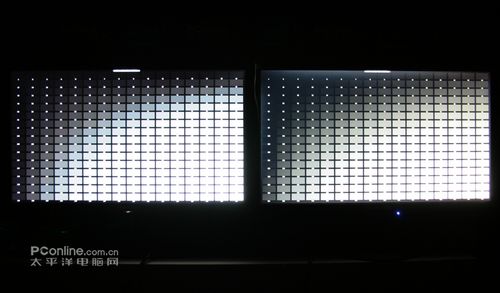
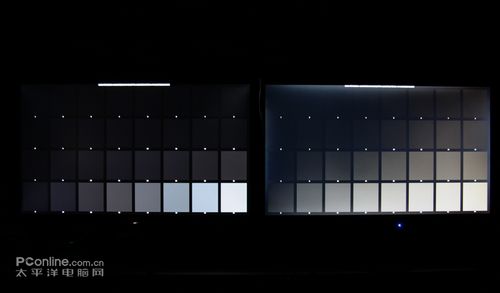
They also have pictures that corroborate the high contrast: http://ifeng.pconline.com.cn/display/0904/1636371_4.html
 
Nicely spotted!

Wow, that black level is phenomenal. If it scales linearly with the backlight It should be around 0.05cd/m2 at 140cd/m2!

edit: looks like VA is up to its old tricks though, judging by those pictures.
 
Last edited:
If you care about contrast, wait for the Samsung F2380. It's supposed to have a static contrast ratio of 3000:1, which is pretty much unheard of right now. I don't know any LCD monitor that can even reach 2000:1. Most are under 1000:1, with viewing angles making them worse.

Samsung PVA monitors have a history of high lag though, so we'll have to wait and see if there's any improvement there.

When I refer to LCD monitors CR I talk about up to 1000:1 for real LCDs (IPS) for fair general comparison with the best CRTs.
For video and most games - yes, even PVAs do better and sometimes much better.
 
Minimal absolute black level (full black screen) for an LCD monitor (0.05 cd/m2 - HP 2480zx) is now very close to the best CRTs of the past (0.01 cd/m2).
If You'd put a black picture in it could you still tell it's on? I like to use black screen saver (but no auto off) and often forget my monitors on because it is impossible to tell if tey're on or not no matter how dark room. Now I'd imagine that they have infinite contrast ratio because isn't that what CR is about? But honestly backlight bleeding is much bigger issue than CR in the cheapest LCDs.
 
Poor black levels is an inherent problem for any device that uses a backlight. There are workarounds of course, but no true fixes. Without a backlight, you get good black levels, like with OLED (black pixels actually shut off but I won't get into that).
 
Last edited:
That's still better ANSI contrast than a CRT, but I don't like the way they did the test. It lets the ambient light from the surrounding pixels affect the results when in reality the black level hasn't changed like it would have on a CRT.

They measured a true static contrast ratio of 2469:1: http://publish.it168.com/2009/0428/20090428058905.shtml

Doesn't look like static contrast to me. Translation is:
Contrast (ANSI) 812:1
Full-contrast full-Kwan 2469:1

I think we need english reviews. There might be some interpretations issues. But generally speaking. Full contast is done with Full white and full black screens. Lots of room for cheating. ANSI is true static contrast with a checkerboard.

The trustworthy number is the ANSI number. I got no indication on the others how contrast testing was carried out.

Pictures do look good though.
 
polonyc:

I have a pair of GDM-F520s that I've loved since new. I was planning on using them until smoke poured from them. Last December I stumbled on a slightly used 2490 I could not pass up.

If anything can talk you out of your -F520s, it's probably an NEC 90 series. The 2490 is, simply, a fantastic piece of work. The panel and picture is part of it, the feature-set, SpectraView, fit and finish complete it. Other displays have H-IPS panels, but the NEC 90 series is far more than just the panel.

In my home office, sunlight never comes directly in the room and the windows are off to one side. If the sun is up, I don't have any black level problems on the 2490 to speak of. Only when it's dark outside I can notice that black isn't as good as the GDM-F. I have a Monaco DTP-94 colorimeter and Monaco EZColor suite which I used on the CRT set up. Based on correctly tracking the colour space, my GDM-F blackpoint wasn't as low as it could have been, but accuracy was important to me and the software determined where my blackpoint should be. (Joe gamer would have probably lowered the contrast more to get the blackest blacks, at the expense of accuracy)

I should mention that despite using a good calibration/profiling system which uses the video card LUT, I still found that some gammas still were quite right while the 2490 is absolutely perfect. All of the monitor tests at http://www.lagom.nl/lcd-test/ are flawless on the 2490. Gamma is bang on, all 8-bits of colour are perfectly visible etc... On my GDM-F I would noticed in Source-engine games the gamma needed a little help ("CLEARLY VISIBLE" "SLIGHTLY VISIBLE" "BARELY VISIBLE") - not on the 2490.

Overall, I'm extremely jazzed about being able to use a digital interconnect (my GDM suffered from the typical input board interconnect issue where there is some horizontal "ringing" of high contrast edges requiring you to wiggle the inputs or power cord to clear it up. I don't miss that at all. I love perfectly square geometry and sub-pixel perfect sharpness. I also like having desk space back, a modern look, and much lower power consumption. When I first switched, I did notice a pronounced screen-door effect because the dot pitch of the 2490 is so much larger than on the -F520. I don't notice it anymore. I'm also loving finally having widescreen aspect.

Playing something dark like Doom3 or Bioshock really shows the shortcomings of LCD. including the 2490. Web browsing, photography post processing and other, brighter games show off what a tremendous display the 2490 is. I still have to use inferior LCDs at work (laptop displays, Dell 1907FP, HP L2245w) and they are absolutely pathetically painful by comparison.

I came from GDM-F520s, and used their accuracy and performance for imaging work. I absolutely adore my 2490 and my -F520s remain in their boxes in the basement.
 
Doesn't look like static contrast to me. Translation is:
Contrast (ANSI) 812:1
Full-contrast full-Kwan 2469:1

I think we need english reviews. There might be some interpretations issues. But generally speaking. Full contast is done with Full white and full black screens. Lots of room for cheating. ANSI is true static contrast with a checkerboard.

The trustworthy number is the ANSI number. I got no indication on the others how contrast testing was carried out.

Pictures do look good though.
It says the ANSI contrast ratio is 812:1, and the static contrast ratio is 2469:1, while with other displays, those two values are typically around 500:1 and 900:1. Then it says after turning on the dynamic contrast, the all-white screen brightness is 292.1 cd/m², and with an all-black screen, the instrument couldn't pick up anything, the value being 0 cd/m², which is equivalent to a dynamic contrast ratio of infinity.

Based on that and the pictures I've seen, it looks like the real thing to me.

The previous page shows how the ANSI test was done: http://publish.it168.com/2009/0428/20090428058904.shtml

They make no attempt to block out the ambient light caused by the white pixels, which affects the results of their measurements.
 
Playing something dark like Doom3 or Bioshock really shows the shortcomings of LCD. including the 2490. Web browsing, photography post processing and other, brighter games show off what a tremendous display the 2490 is. I still have to use inferior LCDs at work (laptop displays, Dell 1907FP, HP L2245w) and they are absolutely pathetically painful by comparison.

but in most recent (and upcoming) games darkness and shadows play a major role and an accurate display is pivotal--S.T.A.L.K.E.R. series (including the upcoming Call to Pripyat due to be released this September), Fallout 3, F.E.A.R. series, Crysis series, Dead Space, Alan Wake, Bioshock 2 etc etc...I'm not into bright, sunny games like The Sims or anything like that so having an LCD would be a letdown of sorts

seems like LCD's were not made with gamers in mind
 
It says the ANSI contrast ratio is 812:1, and the static contrast ratio is 2469:1, while with other displays, those two values are typically around 500:1 and 900:1. Then it says after turning on the dynamic contrast, the all-white screen brightness is 292.1 cd/m², and with an all-black screen, the instrument couldn't pick up anything, the value being 0 cd/m², which is equivalent to a dynamic contrast ratio of infinity.

Toasty.

ANSI is how you measure static contrast.
Full On/Full Off is how you measure dynamic contrast.

Clearly from the translations, they got the high number measuring Full on/Full off contrast, which is all but meaningless. Clearly even with "Dynamic Contrast mode" disabled on this panel, it is still patially active. There is no other way to explain the massive discrepancy between Full On/OFF contrast and ANSI Contrast. Here is one source, but you can find similar anywhere.

http://www.firstglimpsemag.com/editorial/article.asp?article=articles/2007/f0407/02f07/02f07.asp
Manufacturers also may measure a fully white screen and then a completely black screen (called full-on/off contrast), which will make the contrast ratio seem higher than it would with both white and black objects on-screen simultaneously (called ANSI contrast). Full-on/off contrast is also called dynamic, as it takes into account the brightest white and darkest black an HDTV can produce over a period of time as the set adapts to lighter and darker parts of the video. ANSI contrast is sometimes called static because it describes the contrast ratio a TV can produce in a single frame of video.
 
I know what ANSI contrast is. They're the ones that posted different results for ANSI and static contrast, not me. I already explained the discrepancy. They made no attempt to prevent the ambient light from the white pixels from skewing the results of the ANSI test.

Dynamic contrast can't produce results like this:

contrast1.jpg

contrast2.jpg
 
I know what ANSI contrast is. They're the ones that posted different results for ANSI and static contrast, not me. I already explained the discrepancy. They made no attempt to prevent the ambient light from the white pixels from skewing the results of the ANSI test.

OK. Missed that on the methodology. So their methodology sucks. That could account for it. But if they have such terrible methodology, they could have also messed up the TN panel during this test, because that is what is most striking here. How bad the TN image is. It is hard to get much out of camera image.

They should have done ANSI (or ANSI like checkerboard) with a measuring puck and took both ambient light and cheating out of the equation. Oddly when talking about the X shaped backlight bleed on the panel, they talk about measuring its impact. Clearly they could have only done this with a puck or similar screen colorimeter. Reading user reviews on Samsungs latest 1000000:1 contrast dynamic TVs, even when the dynamic function is supposedly shut down, it still has some dynamic effects. You need an ANSI like test to ensure no cheating.

Though it is clearly possible they have delivered a real 2500:1 contrast ratio(they have done so for TVs), which would be quite impressive for a desktop LCD, ~double the best desktop LCD, it should be pretty great in any normal lighting except darkness. My ~1700:1 (ANSI checkerboard with puck measurement) TV still looks like crap watching dark movies or movies with black bars in the dark.
 
Last edited:
How is it possible that VA panels may calibrate so cleanly and yet still display such awfully delineated Grayscale?
 
Back
Top