• Some users have recently had their accounts hijacked. It seems that the now defunct EVGA forums might have compromised your password there and seems many are using the same PW here. We would suggest you UPDATE YOUR PASSWORD and TURN ON 2FA for your account here to further secure it. None of the compromised accounts had 2FA turned on.
    Once you have enabled 2FA, your account will be updated soon to show a badge, letting other members know that you use 2FA to protect your account. This should be beneficial for everyone that uses FSFT.

Intel’s Unveils 7th Gen Intel Core Processor

You know, I don't drink (habitually) or do drugs. I geek out, spend time with my family and friends and try to be happy. That being said, of course I am going to upgrade to kaby lake. I have a 6700k that I will sell and do a drop in upgrade on my z170 extreme4 board. We are all going to die one day. Can't take the money with us. Why not. And since I just upgraded, I'd rather get the best cpu my socket can handle.

I wonder what, if any gains this will give to VR. Now just to wait and see how long ASRock takes to release bios updates to their socket 1151 boards.
 
Is coffee lake fake or ? I have a 2500k at 4.5ghz, All i do is play csgo, I get 150min fps and average 200fps. the thing is I wait since 4790k and still im not sure to upgrade, I planned to do this year but I tought kaby would be better like an AWESOME refresh, do you think coffee lake will be that AWESOME refresh or January 2017 I buy a 7700K ???

I'm so lost, Intel is messing with my mind
 
Is coffee lake fake or ? I have a 2500k at 4.5ghz, All i do is play csgo, I get 150min fps and average 200fps. the thing is I wait since 4790k and still im not sure to upgrade, I planned to do this year but I tought kaby would be better like an AWESOME refresh, do you think coffee lake will be that AWESOME refresh or January 2017 I buy a 7700K ???

I'm so lost, Intel is messing with my mind

Coffee Lake may actually be the proper tock instead of the double tick that is Kaby and Skylake.
 
Last edited:
When do you think notebook manufactures (dell) will start using these new cpus in their laptops?

I just ordered a really beefed up XPS 13 a few days ago :<
 
When do you think notebook manufactures (dell) will start using these new cpus in their laptops?

I just ordered a really beefed up XPS 13 a few days ago :<

They are already producing the laptops now. So maybe in a month or 2 tops you should see them on the market. However there can be a huge difference between models in terms of launch. Specially for some OEMs. Lenovo T series tends to be a classic example of one you have to wait extra long for.
 
There hasn't been a real, true reason to upgrade since the i920 days. Why is this different?
I have to pretty much agree here. Three years ago I went from an overclocked i7-920 at 4.0 ghz with 12gb of tri channel ram to a i7 4770k overclocked to 4.5ghz with 16GB of dual channel ram. I could scarcely notice the difference.

The friend that bought my i7 920 setup still has it, and brought it to a 12 person LAN party I hosted a couple weeks back. At the LAN party that machine was still snappy and performing admirably. I'm sure here or there I might have had a bit less fps performance if I had held onto it, but I'm not sure i'd notice except for benchmark numbers. At any rate it was still clearly a quite usable machine when I poked around on it for a while helping him install a few games to join in.

It's just hard being a PC enthusiast not to want to start fresh every few years with new tech. But at this junction I see no reason to upgrade my 4770k setup and I'll pretty easily fight the urge no matter how fast next gen was because I have zero noticeable performance concerns with what I have - for what I do. I get greater than 90fps, it seems, on everything with my single fury X. I open task manager and watch my CPU idle at 2-3 % utilization 99% off the time. CPU utilization seems to cap at about 50% on new games.

So where's the drive to upgrade ----- apart from new and shiny? I can't feel, or clearly see any performance bottlenecks.

I recently built a Xeon x5660 system on a eBay'ed Dell Precision T7500 for another buddy who attended the last LAN party too. I didn't overclock it because the mainboard didn't allow. That's the same generation as the i7 920 but a hex core. That machine was a beast with the addition of a nvidia 970 graphics card. It played every game we played during the two day LAN in league with any other computer there at his 1080p resolution and exhibited 0 concerns for being several generation old CPU and RAM. FWIW I HIGHLY recommend a T7500 precision workstation for a budget gaming system even today. Throw in a current graphics card and go to town. The base system with a hex core Xeon or fast Xeon quad core can be as little as a couple hundred bucks on eBay with a decent config, OS, and basically a full system including the standard 87% efficient silver rated 1,100 watt power supply. Beats the pants off a budget "all in one gaming machine" like the Alienware alpha for comparable money. That older Xeon X5660 hex core is faster than a new i7 6700k on multithreaded apps according to cpuboss.com.

It seems hardware is ahead of software for these last several generations.
 
Last edited:
It seems hardware is ahead of software for these last several generations.

Or Intel's just been holding back because they have no competition. Not like we haven't seen them do that before.
 
Prove it, else its just BS.

AMD announces dualcore on a die. Intel releases two separate cores on a package but not before then.

AMD announces native x86 64 bit support. Intel pushes Itanium before then with significantly worse performance per clock until AMD makes headway.

AMD releases APUs, Intel doesn't attempt to improve iGPU performance until then.

When it became clear that AMD wasn't going to be able to catch up after Haswell, Intel promised a 5% IPC improvement with Broadwell and barely exceeded 1.5%

Likewise, all previous generation IPCs were nowhere near the jump from Core2 to the first i7s... When AMD last had processors that could compete in performance AND price.

The Haswell Review: Intel Core i7-4770K & i5-4670K Tested

Intel five generation IPC test: Broadwell, Haswell, Ivy Bridge, Sandy Bridge and Nehalem

And, of course, we're still only seeing quadcores for the highest performing i7s and Xeons are being sold for less and locked out of the consumer market chipsets.

Anyone paying attention long enough can see that Intel is clearly doing the least they need to do to keep the cash flowing.
 
AMD announces dualcore on a die. Intel releases two separate cores on a package but not before then.

AMD announces native x86 64 bit support. Intel pushes Itanium before then with significantly worse performance per clock until AMD makes headway.

AMD releases APUs, Intel doesn't attempt to improve iGPU performance until then.

When it became clear that AMD wasn't going to be able to catch up after Haswell, Intel promised a 5% IPC improvement with Broadwell and barely exceeded 1.5%

Likewise, all previous generation IPCs were nowhere near the jump from Core2 to the first i7s... When AMD last had processors that could compete in performance AND price.

The Haswell Review: Intel Core i7-4770K & i5-4670K Tested

Intel five generation IPC test: Broadwell, Haswell, Ivy Bridge, Sandy Bridge and Nehalem

And, of course, we're still only seeing quadcores for the highest performing i7s and Xeons are being sold for less and locked out of the consumer market chipsets.

Anyone paying attention long enough can see that Intel is clearly doing the least they need to do to keep the cash flowing.
You still have not provided a single piece of evidence that Intel actually has something big in the store. The fact they have to resort to creating BS like Turbo Boost 3.0 spells out a big red sign: "Intel is running out of ideas to improve stock performance".
By the way, it's well known that AMD did not quite have performance competitor since Penryn.

So, please, try again.

intel 128 core - Google Search
For starters --- Look at some of those article publish dates.
Yet we are still getting quad core CPUs released for desktop enthusiasts. IE i7 6700k
Quick look at those articles leads to them being mostly bad journalism.
So, try again.
 
intel 128 core - Google Search
For starters --- Look at some of those article publish dates.
Yet we are still getting quad core CPUs released for desktop enthusiasts. IE i7 6700k

Yes, because the 99% dont want "slow 3Ghz 10 core CPUs" at 140W that serves nothing but idle cores. ST performance matters and always will.

In servers Intel isnt holding back either.

You can always buy a 72 core Xeon Phi if you feel the need. It can run standalone with full OS support. Then you can reap the super multithreading performance you seem to desire.
 
Last edited:
AMD announces dualcore on a die. Intel releases two separate cores on a package but not before then.

AMD announces native x86 64 bit support. Intel pushes Itanium before then with significantly worse performance per clock until AMD makes headway.

AMD releases APUs, Intel doesn't attempt to improve iGPU performance until then.

When it became clear that AMD wasn't going to be able to catch up after Haswell, Intel promised a 5% IPC improvement with Broadwell and barely exceeded 1.5%

Likewise, all previous generation IPCs were nowhere near the jump from Core2 to the first i7s... When AMD last had processors that could compete in performance AND price.

The Haswell Review: Intel Core i7-4770K & i5-4670K Tested

Intel five generation IPC test: Broadwell, Haswell, Ivy Bridge, Sandy Bridge and Nehalem

And, of course, we're still only seeing quadcores for the highest performing i7s and Xeons are being sold for less and locked out of the consumer market chipsets.

Anyone paying attention long enough can see that Intel is clearly doing the least they need to do to keep the cash flowing.

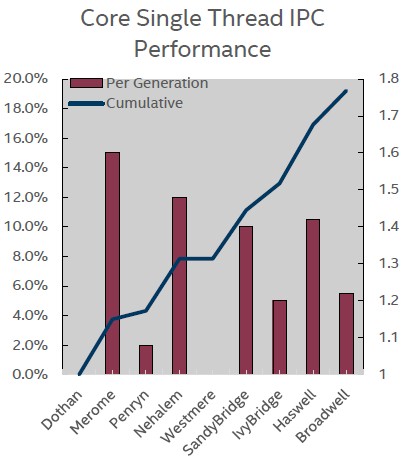
So much wrong. But for IPC.

intel-xeon-ipc-chart.jpg


If you want to play the "in the old days everything was much better". Then you need to go all the way back to the PPro. It was the last time with "easy" IPC gains.
 
If you want to play the "in the old days everything was much better". Then you need to go all the way back to the PPro. It was the last time with "easy" IPC gains.

My PPro 200MHz was such a beast - it ran quake at ~50fps in early 1997.
 
Back
Top