• Some users have recently had their accounts hijacked. It seems that the now defunct EVGA forums might have compromised your password there and seems many are using the same PW here. We would suggest you UPDATE YOUR PASSWORD and TURN ON 2FA for your account here to further secure it. None of the compromised accounts had 2FA turned on.
    Once you have enabled 2FA, your account will be updated soon to show a badge, letting other members know that you use 2FA to protect your account. This should be beneficial for everyone that uses FSFT.

Intel Core i9-7980xe

Boy you guys like tossing around that worn out term Bottleneck. The days of CPU bottlenecks are long the hell gone in anything high end.

Even if a cpu has a lower IPC it doesnt mean a bottle neck. Show me ANY and I mean ANY example of an AMD ryzen running at 100% in a game and its GPU running at like 50% .... its impossible so stop acting like a whopping few extra % of IPC makes brand A superior in every possible way to brand B.

It shows us that you are either misi formed or just blindly biased like a sheep stuck to some companies jock strap.

Its like honda guys who swear nothings faster than a turboed VTEC hamster on a wheel for an engine.... they are complete doafs.
So you just make up your own convoluted crap as you go along? The nonsense you just posted changes nothing about the fact that overall an oced 7700k will let you squeeze the most use out of a high end gpu. And as you were just shown, even AMD is smart enough to use the fastest cpu for gaming when trying to show their gpus in the best light.
 
Whoa dude, nothing beats VTEC!!! Fast and the Furious has proven this :p

Unless AMD was showcasing max frame at 1080p in lower settings, I can't see a reason for AMD using Intel.

Anyone?
 
If anything HBM cards do better at higher resolutions. Perhaps Ryzen would of "hidden" those benifits for a few games that are cpu bound at resolutions higher than 1080p.
 
A couple of examples of where AMD has no cpu that can even hold 60 fps. I know these two games well as my 4770k at 4.3 cant quite hold 60 fps for minimums in some spots too.

Dishonored 2 https://tpucdn.com/reviews/AMD/Ryzen_3_1200/images/dishonored2_1920_1080_min.png

1800x 48.9 fps
7700k 64.2 fps

Fallout 4 https://tpucdn.com/reviews/AMD/Ryzen_3_1200/images/fallout4_1920_1080_min.png

1800x 47.8 fps
7700k 67 fps

Yes AMD is very competitive for the most part but there are some cases like I showed where they just cant keep up. Personally I would accomplish nothing upgrading to Ryzen for most games as it would provide little to no increase in the few games where I actually need an increase such as the two above.
 
Boy you guys like tossing around that worn out term Bottleneck. The days of CPU bottlenecks are long the hell gone in anything high end.

Keep telling yourself that. Its the old mantra in new clothes, slower but smoother. I didn't need that performance anyway. Prescripted benchmarks is everything and so forth.
 
If anything HBM cards do better at higher resolutions. Perhaps Ryzen would of "hidden" those benifits for a few games that are cpu bound at resolutions higher than 1080p.

Utter rubbish. But looking forward to see you prove it.
 
Ok well buy Intel then. I love how this thread went from discussing the 7980xe to minimum FPS and Amd vs. NVidia GPUs. Yes I have contributed in part to the entropy of this thread but getting back on topic would be aggreeable? Yes?
 
Last edited:
Boy you guys like tossing around that worn out term Bottleneck. The days of CPU bottlenecks are long the hell gone in anything high end.

Even if a cpu has a lower IPC it doesnt mean a bottle neck. Show me ANY and I mean ANY example of an AMD ryzen running at 100% in a game and its GPU running at like 50% .... its impossible so stop acting like a whopping few extra % of IPC makes brand A superior in every possible way to brand B.

It shows us that you are either misi formed or just blindly biased like a sheep stuck to some companies jock strap.

So you first ignore game benchmarks as that given in post #66, where 7980X is 49% faster than the 1950X, then you ignore the slide posted in #80, which shows that even AMD uses Intel CPUs for gaming demos, and finally you call us biased/missinformed. :rolleyes:


Unless AMD was showcasing max frame at 1080p in lower settings, I can't see a reason for AMD using Intel.

Anyone?

Check #83.
 
Ok well buy Intel then. I love how this thread went from discussing the 7980xe to minimum FPS and Amd vs. NVidia GPUs. Yes I have contributed in part to the entropy of this thread but getting back on topic would be aggreeable? Yes?
Because CPU's can now give smooth game play no matter the brand. Some people can not handle it and have to defend Intel.

But Intel's FPS is higher, doesn't matter that AMD is still just as smooth since FPS on both are at acceptable and above on FPS.
 
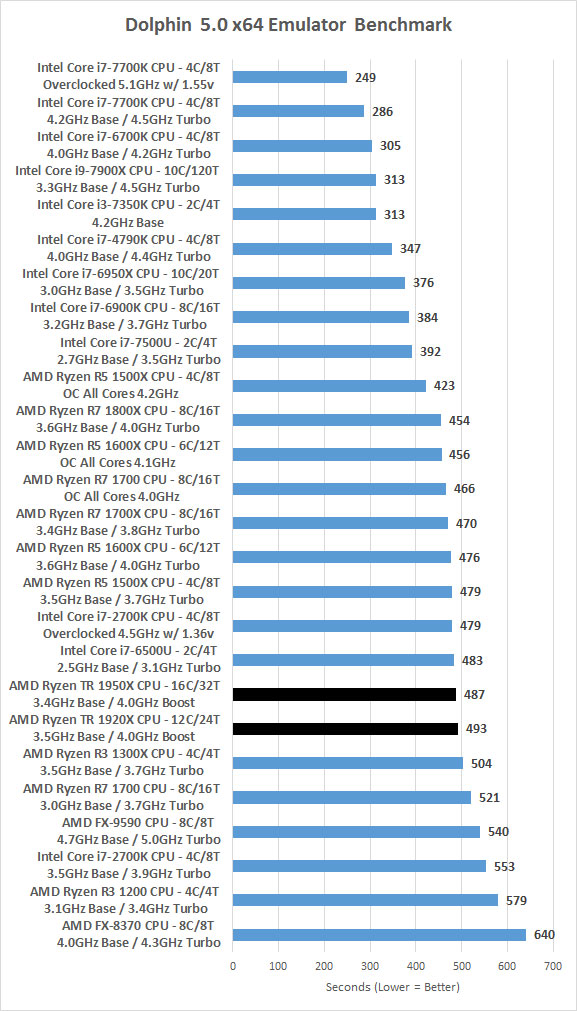
dolphin-1950x.jpg
 
Does Threadripper yield as much performance as Intel in Cemu, Dolphin, Citra, etc?
Those only use I believe less than 4 cores. Most companies do not want to spend the money to update their old software. Also most companies don't want to spend the extra money to buy it.
 
Does anyone actually use Dolphin.
I think it was more of showing Intel's single core power. Some people need it since there is lots of old software running around and/or lazy programmers.
 
Those only use I believe less than 4 cores. Most companies do not want to spend the money to update their old software. Also most companies don't want to spend the extra money to buy it.

As mentioned before not everything can be parallelized, and part of the stuff that can be parallelized is hard to parallelize. Dolphin is not Blender.

Does anyone actually use Dolphin.

Yes. I have a friend that uses it.
 
As mentioned before not everything can be parallelized, and part of the stuff that can be parallelized is hard to parallelize. Dolphin is not Blender.


Yes. I have a friend that uses it.
It can't or is not cost effective?
 
It can't or is not cost effective?

There are three cases:

1) Stuff that cannot be parallelized.
2a) Stuff that can be parallelized and parallelization is hard.
2b) Stuff that can be parallelized and parallelization is simple.
 
There are three cases:

1) Stuff that cannot be parallelized.
2a) Stuff that can be parallelized and parallelization is hard.
2b) Stuff that can be parallelized and parallelization is simple.
I was wondering more of the why on #1. Why can't it be done. Just weird with all this technology that we can't make a program use more cores.
 
I don't care for the VROC license key nonsense

Well come on man! How's Intel supposed to keep us on the upgrade hamster wheel if they don't put spiked speed tables in as roadblocks to maximal overall system throughput performance?
 
I was wondering more of the why on #1. Why can't it be done. Just weird with all this technology that we can't make a program use more cores.

Okay, I want you to simultaneously play Monopoly, Solitaire, Chess, Go, Shogi, and Flaming Jenga while working your way through a Tomb Raider game without dying and talking on the phone with your mother.

Not all tasks are free-floating. A lot of them are serialized, procedural tasks.

Sometimes because that's simply the most efficient way.
Sometimes because its' the ONLY way.
Sometimes because it's simply the way that makes sense to the programmer.
 
Okay, I want you to simultaneously play Monopoly, Solitaire, Chess, Go, Shogi, and Flaming Jenga while working your way through a Tomb Raider game without dying and talking on the phone with your mother.

Not all tasks are free-floating. A lot of them are serialized, procedural tasks.

Sometimes because that's simply the most efficient way.
Sometimes because its' the ONLY way.
Sometimes because it's simply the way that makes sense to the programmer.
http://www.cruxis.com/chess/houdini.htm
I can use up to 8 threads. So my question still stands.

I can have WCG on 80% and still play VR just fine. :) Does that count?
 
Does anyone actually use Dolphin.

The Dolphin platform holds some of the best games on the PC so I should certainly hope so.

Unfortunately as long as we still have to deal with the complete and utter cancer that is Nintendo's business model, <4 core CPU performance will always be a critical element to any gaming PC because otherwise it means losing out on a huge number of PC games.
 
I was wondering more of the why on #1. Why can't it be done. Just weird with all this technology that we can't make a program use more cores.

Because you end with negative scaling. 8 cores for example can be slower than 6 etc. And that's even assuming it can be somewhat multithreaded.

And plain cases where you need the result from a calculation before you can move on to the next. Then you can obviously try speculative threading, but that's like driving a Hummer with extremely limited performance uplift.

The subject have been covered for ages.
 
Last edited:
http://www.cruxis.com/chess/houdini.htm
I can use up to 8 threads. So my question still stands.

I can have WCG on 80% and still play VR just fine. :) Does that count?

I'm not sure how else to say it.

Some things just are NOT parallelizable.
You can run the SAME process in parallel, but you can't break the process down into parallel steps, because each step builds on the one before it.
 
I believe they already did that with TR 1950X.

If you did mean 32 cores, I wouldn't believe so much. Why would AMD modify the SP3 socket to make TR4 socket and then return back to support 32 cores again?

English isn't your first language is it? "If you did mean 32 cores, I wouldn't believe so much." I'm not trying to be a grammar Nazi, but holy shit this stuff is hard to understand. I'll take a stab at this post anyway. It's clear that Threadripper can be equipped with four dies given that we know that some of them (if not all of them) have in fact, four dies in them as it is. Two are simply non-functional. Secondly, SP3 and socket TR4 are physically the same. Their pin outs are evidently incompatible, but the number is the same. Why is that? It's done for product segmentation. Server parts usually have a high price associated with them and significantly greater margins than their desktop counterparts. Not only that, but server parts tend to support more features, lack significant overclocking capabilities and tend to be clocked higher. In AMD's case it seems many of the 16 core Epyc CPU's are actually a little cheaper than the 16 core Threadripper, but are clocked significantly lower by default.

AMD doesn't want us buying 16-core Epyc CPU's at $800 and overclocking them to Threadripper levels. (This assumes that many Epyc CPU's would be capable of achieving those clocks, which seems like it would be a rarity.) Afterall, that's $200 less than Threadripper 1950X's go for. They also don't want people installing Threadripper CPUs in servers and going from 2.4GHz to 3.4GHz. So why is this? Why would AMD care what we do with their products once we have handed over our money? There are multiple reasons for this. First and foremost, Threadripper CPU's are supposedly the top 5% of all Ryzen silicon. With semi-conductors, it's not as if they are all identical. It's somewhat like baking cookies. You go through the process, add ingredients, mix, bake and serve. Cookies may vary slightly from batch to batch in appearance taste, texture etc. Semi-conductor engineering is more exact than that, but variances in thermal behavior, clock speed range and so on are discovered during testing. CPUs which are "better" than others, that is have superior characteristics for clock speeds, temperature or more desirable voltage characteristics may be used for higher performance applications. These CPU's are more valuable, because fewer CPUs built by the company are good enough to become those higher end / higher performance CPUs.

So, AMD charges a premium for it's Threadripper parts. Not only is it due to the rarity of qualified silicon, but these CPUs are marketed towards gamers and enthusiasts who built HEDT systems. The biggest take away from this is that Threadripper CPUs cost the same to manufacture at a die level as Epyc CPUs do. Therefore the extra money is pure profit for AMD. This is one reason for the segmentation.

Another reason for segmentation is this: Epyc CPUs have a lower TDP than Threadripper parts do. Using Threadripper CPUs in 1P server systems is potentially problematic as an increased TDP means more demand on voltage hardware and greater heat dissipation needs. Another problem with Threadripper comes down to microcode. Usage in OEM systems from Dell and HP means months in advance of testing, development and certification. Threadripper was an after thought by AMD's own admission. Being newer, there may be differences or improvements in microcode which weren't or haven't been tested on server platforms. It's very likely that the socket difference is a safety measure to make sure that we don't put Threadripper CPUs in servers which won't support that microcode and can't handle the higher clocks and power demands. People think of server hardware as being beefier, but it isn't. Passive cooling on server motherboards isn't what it is on enthusiast class hardware. Server hardware is designed for reliability above all else. Overbuilding is one way to do that, but it doesn't maximize margins. Instead, ensuring that everything works within a certain temperature and power ranges with adequate cooling under specific datacenter conditions is how this is achieved. Servers can also depend more on active fans for cooling as noise is less of a concern in datacenters. The voltage hardware is built specifically for the task with an outlined upgrade path from the CPU maker. They aren't built to be pushed 30+ watts over their processor's TDP. Server hardware often lacks the hardware that gives us the adjustments for frequency switching, base clock and other adjustments. Server chassis don't have the option to house massive cooling hardware, water blocks and all of that as a general rule.

Next there is the fact that Threadripper and Epyc differ in that the latter has support for 128 PCIe lanes and 8 memory channels. It's likely that the changes to the socket are designed to address this for compatibility reasons. X399 isn't designed for 8 memory channels and 128 PCIe lanes. In other words, Threadripper and Epyc are very similar, but their sockets are different for market segmentation purposes. Some purposes are technical, others may simply be about profit and simple market segmentation. Intel does the same thing, although at a glance it seems AMD doesn't differentiate the hardware as much as Intel does in that they don't lock out as many server / workstation features such as ECC. All of that said, there is probably no technical reason why Threadripper couldn't have 32 cores. The reason it doesn't now is because they'd have to drop the clock speeds of the CPU's significantly, which wouldn't benefit customer's for the processors intended purpose. The purpose of Threadripper is gaming and general workstation use where only 4-16 cores are needed. The clock speeds are much more important to gaming and desktop application performance than core count is. On the server side, this is usually reversed.

I can almost guarantee AMD designed TR4 to support 32 core CPUs. If for no other reason than as a potential counter to Intel down the line if they determine it's necessary. AMD also likes to stick with sockets for longer periods of time and this was no doubt in the plan. I would wager the changes to socket TR4 vs. SP3 are due to the reasons, either all or some of them I've listed above. Core count has nothing to do with it.
 
English isn't your first language is it? "If you did mean 32 cores, I wouldn't believe so much." I'm not trying to be a grammar Nazi, but holy shit this stuff is hard to understand. I'll take a stab at this post anyway. It's clear that Threadripper can be equipped with four dies given that we know that some of them (if not all of them) have in fact, four dies in them as it is. Two are simply non-functional. Secondly, SP3 and socket TR4 are physically the same. Their pin outs are evidently incompatible, but the number is the same. Why is that? It's done for product segmentation. Server parts usually have a high price associated with them and significantly greater margins than their desktop counterparts. Not only that, but server parts tend to support more features, lack significant overclocking capabilities and tend to be clocked higher. In AMD's case it seems many of the 16 core Epyc CPU's are actually a little cheaper than the 16 core Threadripper, but are clocked significantly lower by default.

AMD doesn't want us buying 16-core Epyc CPU's at $800 and overclocking them to Threadripper levels. (This assumes that many Epyc CPU's would be capable of achieving those clocks, which seems like it would be a rarity.) Afterall, that's $200 less than Threadripper 1950X's go for. They also don't want people installing Threadripper CPUs in servers and going from 2.4GHz to 3.4GHz. So why is this? Why would AMD care what we do with their products once we have handed over our money? There are multiple reasons for this. First and foremost, Threadripper CPU's are supposedly the top 5% of all Ryzen silicon. With semi-conductors, it's not as if they are all identical. It's somewhat like baking cookies. You go through the process, add ingredients, mix, bake and serve. Cookies may vary slightly from batch to batch in appearance taste, texture etc. Semi-conductor engineering is more exact than that, but variances in thermal behavior, clock speed range and so on are discovered during testing. CPUs which are "better" than others, that is have superior characteristics for clock speeds, temperature or more desirable voltage characteristics may be used for higher performance applications. These CPU's are more valuable, because fewer CPUs built by the company are good enough to become those higher end / higher performance CPUs.

So, AMD charges a premium for it's Threadripper parts. Not only is it due to the rarity of qualified silicon, but these CPUs are marketed towards gamers and enthusiasts who built HEDT systems. The biggest take away from this is that Threadripper CPUs cost the same to manufacture at a die level as Epyc CPUs do. Therefore the extra money is pure profit for AMD. This is one reason for the segmentation.

Another reason for segmentation is this: Epyc CPUs have a lower TDP than Threadripper parts do. Using Threadripper CPUs in 1P server systems is potentially problematic as an increased TDP means more demand on voltage hardware and greater heat dissipation needs. Another problem with Threadripper comes down to microcode. Usage in OEM systems from Dell and HP means months in advance of testing, development and certification. Threadripper was an after thought by AMD's own admission. Being newer, there may be differences or improvements in microcode which weren't or haven't been tested on server platforms. It's very likely that the socket difference is a safety measure to make sure that we don't put Threadripper CPUs in servers which won't support that microcode and can't handle the higher clocks and power demands. People think of server hardware as being beefier, but it isn't. Passive cooling on server motherboards isn't what it is on enthusiast class hardware. Server hardware is designed for reliability above all else. Overbuilding is one way to do that, but it doesn't maximize margins. Instead, ensuring that everything works within a certain temperature and power ranges with adequate cooling under specific datacenter conditions is how this is achieved. Servers can also depend more on active fans for cooling as noise is less of a concern in datacenters. The voltage hardware is built specifically for the task with an outlined upgrade path from the CPU maker. They aren't built to be pushed 30+ watts over their processor's TDP. Server hardware often lacks the hardware that gives us the adjustments for frequency switching, base clock and other adjustments. Server chassis don't have the option to house massive cooling hardware, water blocks and all of that as a general rule.

Next there is the fact that Threadripper and Epyc differ in that the latter has support for 128 PCIe lanes and 8 memory channels. It's likely that the changes to the socket are designed to address this for compatibility reasons. X399 isn't designed for 8 memory channels and 128 PCIe lanes. In other words, Threadripper and Epyc are very similar, but their sockets are different for market segmentation purposes. Some purposes are technical, others may simply be about profit and simple market segmentation. Intel does the same thing, although at a glance it seems AMD doesn't differentiate the hardware as much as Intel does in that they don't lock out as many server / workstation features such as ECC. All of that said, there is probably no technical reason why Threadripper couldn't have 32 cores. The reason it doesn't now is because they'd have to drop the clock speeds of the CPU's significantly, which wouldn't benefit customer's for the processors intended purpose. The purpose of Threadripper is gaming and general workstation use where only 4-16 cores are needed. The clock speeds are much more important to gaming and desktop application performance than core count is. On the server side, this is usually reversed.

I can almost guarantee AMD designed TR4 to support 32 core CPUs. If for no other reason than as a potential counter to Intel down the line if they determine it's necessary. AMD also likes to stick with sockets for longer periods of time and this was no doubt in the plan. I would wager the changes to socket TR4 vs. SP3 are due to the reasons, either all or some of them I've listed above. Core count has nothing to do with it.

So when do we get a 32 core TR? Lol
 
Kind of interesting for comparison

i9-7980xe at launch - $2000
Pentium II 300 MHz at launch - $1981 (over $3500 in today's dollars)
 
So when do we get a 32 core TR? Lol

Probably not until they can produce a version of it with TDP's that are somewhat reasonable while maintaining clock speeds that are close to what the current parts have. My guess is, not until Zen+ / Ryzen 2, or whatever the fuck they end up calling it.
 
Game on!
 

Attachments

  • 2E350CF0-290B-4948-A045-3C616F6F7056.jpeg
    2E350CF0-290B-4948-A045-3C616F6F7056.jpeg
    139.2 KB · Views: 20
  • BFE5B35C-5A1B-43A5-8818-D1358488CB27.jpeg
    BFE5B35C-5A1B-43A5-8818-D1358488CB27.jpeg
    212.3 KB · Views: 21
Probably not until they can produce a version of it with TDP's that are somewhat reasonable while maintaining clock speeds that are close to what the current parts have. My guess is, not until Zen+ / Ryzen 2, or whatever the fuck they end up calling it.

So there is no 32 core ThreadRipper, because 12LP (aka 14LPP+) cannot reduce TDP to one half. Not to mention the need for a new socket, new mobos, and the problem with memory channels.
 
So there is no 32 core ThreadRipper, because 12LP (aka 14LPP+) cannot reduce TDP to one half. Not to mention the need for a new socket, new mobos, and the problem with memory channels.

New motherboards, very likely. New sockets, I don't think so. TR4 is a modified SP3 socket which does support 32 cores. I believe AMD actually left in 32 core capability with this socket. Now, the memory question is interesting. One of two things is happening here: 1.) Either TR4 is incapable of supporting processors with eight memory channels. 2.) It is capable of handling eight memory channels. I'm inclined to believe the former, but that doesn't preclude the possibility of having a 32 core processor. It does preclude such a processor being a current Epyc CPU modified for socket TR4. Such a chip would have to be built differently than Threadripper and Epyc CPU's are today. This isn't impossible by any means using the existing socket.

I don't think the TDP needs to come down to half what it is today. It needs to come down within a range that's acceptable in terms of thermal and power limits for the socket, VRD specifications and the packaging of the processor itself. The TDP's also need to come down to a level that not only fits this maximum threshold, but comes in below it enough to allow for a comfortable operating margin. I haven't studied the white papers for Ryzen or Threadripper, and desing guidelines for X399 or socket TR4. Intel makes these available to the general public, but I don't know if AMD does or not. I can ask, but I don't know that they will give them to me.

In any case, the short version is that AMD needs to get the TDP's down to where the VRM's can power the thing and the processor can be cooled with an AIO at stock speeds without frying itself. It's reasonable to assume that they would bring the clock speeds down, but the lower clock speeds of Epyc parts in the server market won't cut it in the HEDT mareket segment. It's not about cutting the TDP in half and doubling the cores, it's about making the right compromises and adjustments necessary to provide a 32 core part that the target market would want.
 
New motherboards, very likely. New sockets, I don't think so. TR4 is a modified SP3 socket which does support 32 cores. I believe AMD actually left in 32 core capability with this socket. Now, the memory question is interesting. One of two things is happening here: 1.) Either TR4 is incapable of supporting processors with eight memory channels. 2.) It is capable of handling eight memory channels. I'm inclined to believe the former, but that doesn't preclude the possibility of having a 32 core processor. It does preclude such a processor being a current Epyc CPU modified for socket TR4. Such a chip would have to be built differently than Threadripper and Epyc CPU's are today. This isn't impossible by any means using the existing socket.

I don't think the TDP needs to come down to half what it is today. It needs to come down within a range that's acceptable in terms of thermal and power limits for the socket, VRD specifications and the packaging of the processor itself. The TDP's also need to come down to a level that not only fits this maximum threshold, but comes in below it enough to allow for a comfortable operating margin. I haven't studied the white papers for Ryzen or Threadripper, and desing guidelines for X399 or socket TR4. Intel makes these available to the general public, but I don't know if AMD does or not. I can ask, but I don't know that they will give them to me.

In any case, the short version is that AMD needs to get the TDP's down to where the VRM's can power the thing and the processor can be cooled with an AIO at stock speeds without frying itself. It's reasonable to assume that they would bring the clock speeds down, but the lower clock speeds of Epyc parts in the server market won't cut it in the HEDT mareket segment. It's not about cutting the TDP in half and doubling the cores, it's about making the right compromises and adjustments necessary to provide a 32 core part that the target market would want.

TR4 = SP3r2, which is electrically incompatible with SP3 socket. EPYC CPUs don't work on Threadripper mobos and ThreadRipper CPUs don't work on EPYC mobos.

TR4 only supports quad-channel. A hypothetical 32-core CPU for TR4 would have a pair of dies accessing memory thought the channels of the other two dies. The latency and bandwidth penalty would be huge and kill performance on all workloads.

My remark about TDP was based in the goal of duplicating throughput. Imagine that 12LP reduces power by 15%. That is not enough to double the number of cores, unless we reduce drastically clocks. We can take a look at 1P EPYC processors. The 7551P has 32C @ 2GHz. Even considering the advantages of 12LP node clocks couldn't hit 2.5GHz. And I consider that is too low clocks for general desktop usage.

So, I don't expect any 32-core ThreadRipper. I expect a refresh of current Threadripper models coming next year in 12LP with the same IPC and same number of cores than current models, but with 7% higher clocks. I then expect new 12/16/24 core Threadripper models for 2019--2020 (Zen2 and 7LP).
 
TR4 = SP3r2, which is electrically incompatible with SP3 socket. EPYC CPUs don't work on Threadripper mobos and ThreadRipper CPUs don't work on EPYC mobos.

I am well aware of this. I said nothing to the contrary.

TR4 only supports quad-channel. A hypothetical 32-core CPU for TR4 would have a pair of dies accessing memory thought the channels of the other two dies. The latency and bandwidth penalty would be huge and kill performance on all workloads.

Yes, a hypothetical 32 core CPU would be designed in such a way, but it doesn't necessarily have to be. As I said, it would have to be something that was specifically built to work that way. I said, you couldn't just throw a four die Epyc CPU on there and be golden.

My remark about TDP was based in the goal of duplicating throughput. Imagine that 12LP reduces power by 15%. That is not enough to double the number of cores, unless we reduce drastically clocks. We can take a look at 1P EPYC processors. The 7551P has 32C @ 2GHz. Even considering the advantages of 12LP node clocks couldn't hit 2.5GHz. And I consider that is too low clocks for general desktop usage.

That's exactly what I thought you meant concerning doubling the TDP, and precisely what I said in reference to that idea.

So, I don't expect any 32-core ThreadRipper. I expect a refresh of current Threadripper models coming next year in 12LP with the same IPC and same number of cores than current models, but with 7% higher clocks. I then expect new 12/16/24 core Threadripper models for 2019--2020 (Zen2 and 7LP).

I am not sure what to expect. I do not expect to see a 32 core Threadripper anytime soon, possibly not ever.
 
Back
Top