• Some users have recently had their accounts hijacked. It seems that the now defunct EVGA forums might have compromised your password there and seems many are using the same PW here. We would suggest you UPDATE YOUR PASSWORD and TURN ON 2FA for your account here to further secure it. None of the compromised accounts had 2FA turned on.
    Once you have enabled 2FA, your account will be updated soon to show a badge, letting other members know that you use 2FA to protect your account. This should be beneficial for everyone that uses FSFT.

i7 v Xeon

Between the W35xx series and the standard Core i7 there are no differences as far as I know. The W35xx Xeon's are for uni-processor servers. From what I understand the only real difference between the W35xx series Xeon's and the 55xx series Xeon's is SMP support.

Some people claim that Xeon's that are almost identical to their standard desktop counterparts are somehow better CPUs. I've never seen any proof of this. I think this theory comes from the Opteron 1xx series S939 CPUs that were typically better overclockers than their Athlon 64 counterparts were. What seems to escape some people is that what AMD did in terms of production of Athlon and Opteron CPUs has no bearing or impact on what Intel may or may not do when validating their Xeon and Core 2/Core i7 CPUs.
 
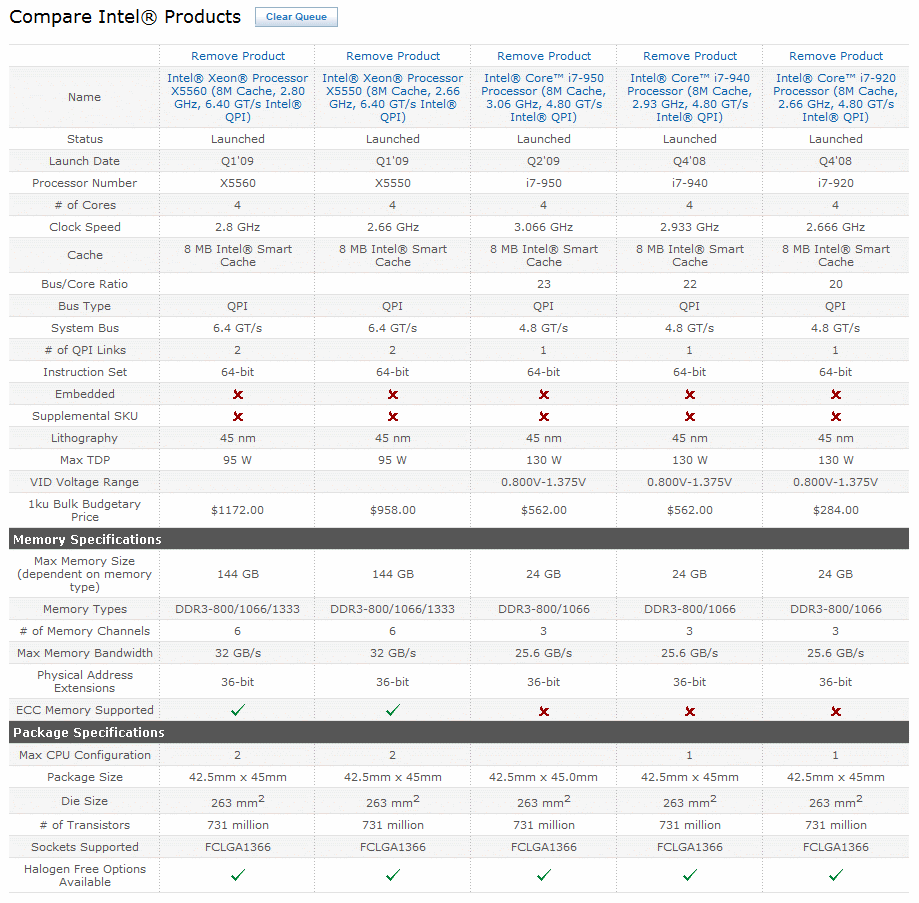
I couldn't find the Xeon W35xx series CPUs listed for comparison on Intel's product page. I'm not convinced that the W35xx series Xeon's support ECC memory given the fact that the Core i7's don't. The Core i7's and the Xeon W35xx series CPUs are all "Bloomfield" CPUs. However, as shown below the 55xx series Xeon's do support ECC and the Core i7's do not.

Xeonvsi7comparison.gif


I do not know if the Xeon 55xx require ECC memory but I wouldn't be at all surprised if they did. However I do know for a fact that the W35xx series Xeon's do not require ECC memory. I also do not know if they support ECC or not. As you can see from the chart above the 55xx series Xeon's have a lower TDP than their desktop counterparts do and they support considerably more memory than the Core i7 CPUs do.
 
if i were on a mission to find the golden oc'er, i'm one of those people who would prefer the xeon. it may be due to the opteron days, but i do know my x3110 xeon overclock much better than my e8400 and they are supposed to be the same cpu.

the difference was probably coincidental. like i said, i wouldn't pay the difference unless i was more concerned with the golden oc. thirty bucks seems like a lot to pay for that roll of the dice to me.
 
if i were on a mission to find the golden oc'er, i'm one of those people who would prefer the xeon. it may be due to the opteron days, but i do know my x3110 xeon overclock much better than my e8400 and they are supposed to be the same cpu.

the difference was probably coincidental. like i said, i wouldn't pay the difference unless i was more concerned with the golden oc. thirty bucks seems like a lot to pay for that roll of the dice to me.

I've seen some Xeons that are great overclockers. However, I have not seen Xeon's do anything that I haven't seen on exceptional examples from the Pentium 4, Core 2 Duo/Quad or Core i7 processor lines. The problem is that any differences in production between a Xeon and the Core i7's aren't shared publicly. Intel keeps that information close to their chests for their own reasons. The truth is that there isn't really enough data on Xeon overclocking compared to their desktop counterparts to draw a real conclusion about their overclockability. In the example above, you can clearly see that the Xeon 55xx series CPUs are different. As a result on a board that supports overclocking those CPUs, they might indeed be special compared to standard Core i7 CPUs. However, that may not be the case with the W35xx series. They may in fact be identical to their Core i7 counterparts.
 
IHowever, as shown below the 55xx series Xeon's do support ECC and the Core i7's do not.

I do not know if the Xeon 55xx require ECC memory but I wouldn't be at all surprised if they did.

The Xeon 55xx series does not require ECC / Registered memory but does support it.
If you look at the new ASUS Z8NA-D6C Dual LGA 1366 - it supports both ECC & non ECC.

I know that the Xeon 55xx series can "Turbo Mode" higher then the Retail Core i7.

The X5550, X5560, & X5570 can go up 266mhz when all 4 cores are in use. (400mhz if only one/two cores are in use)
I think the Retail Core i7 can only go up 133mhz when all 4 cores are in use.

All that depends on your cooling setup and TDP.

Of Course, if you are overclocking the CPU, this does not mean much, but for a stock config it is a nice speed increase.

I have started to use Xeon CPUs in all my systems since I run F@H on all of them.

Performance wise not sure if there is a difference, but I do know they run cooler due to lower TDP.
With so many systems in my house, power usage and heat are a major factor to me and worth a small price premium.
 
Last edited:
Sorry for the last post...

Does anyone know if it's possible to use a W35x + ECC RAM in normal "Desktop" X58 mobo's?
Someone at Ars mentioned that W's can be dropped into such mobos.....

However he wasn't sure if EEC RAM can also be used or whether uber-specialised (read: expensive) workstation mobo's are needed.

Cheers
 
Sorry for the last post...

Does anyone know if it's possible to use a W35x + ECC RAM in normal "Desktop" X58 mobo's?
Someone at Ars mentioned that W's can be dropped into such mobos.....

However he wasn't sure if EEC RAM can also be used or whether uber-specialised (read: expensive) workstation mobo's are needed.

Cheers

Some X58 boards do not list ECC support in their specifications while others do.

EVGA X58 3X SLI Classified -No ECC Support listed

ASUS P6T7 WS Supercomputer -ECC Support Listed

ASUS Rampage II Extreme -No ECC Support Listed

Given that all of these boards use the X58 chipset I think its fair to say that the X58 chipset supports ECC memory but it is up to the motherboard manufacturer to support it or not at their discretion. I hope this clears things up.
 
Some X58 boards do not list ECC support in their specifications while others do.

EVGA X58 3X SLI Classified -No ECC Support listed

ASUS P6T7 WS Supercomputer -ECC Support Listed

ASUS Rampage II Extreme -No ECC Support Listed

Given that all of these boards use the X58 chipset I think its fair to say that the X58 chipset supports ECC memory but it is up to the motherboard manufacturer to support it or not at their discretion. I hope this clears things up.

Pretty sure if the board says it supports the Xeon 35xx's, it supports ECC memory. I believe ECC memory support is determined by the memory controller, not the board. So if the board has the microcode to support the xeon, then the xeons memory controller will support ECC memory. But I may just be talking out of my ass...
 
Oh ok, then my assertions may be a little off (last post)
http://forums.anandtech.com/messageview.aspx?catid=28&threadid=2299660&STARTPAGE=2

So just look for a board with support for 35xx's in the BIOS & because the CPU's controller supports ECC, then by-proxy the mobo with accept it?!

Pretty much. The memory controller is inside the CPU so yes, the support of ECC RAM is dependent on the CPU rather than the chipset. Though the motherboard needs to be able to meet any additional electrical requirements and BIOS requirements that ECC RAM may have in order to actually function on the board.
 
Hmm looking at ARK there's not a single difference between 920 & W3520 aside from ECC.
http://ark.intel.com/Compare.aspx?ids=37147,39718,
I thought the TDP was better in the W3520, if that's all I'm paying the premium for then no thanks.

E5520 looks pretty sweet considering the price though!
http://ark.intel.com/Compare.aspx?ids=37149,37147,40201,40200,37106,37113,39723,39718,

E5520
http://processorfinder.intel.com/details.aspx?sSpec=SLBFD
http://ark.intel.com/Product.aspx?id=40200

Clock-speed is little on the low side, I wonder if anyone's had much success OC'ing it?
I guess it's benefited from the new stepping just as the 920 reportedly has...

Whatya reckon?
 
Hmm looking at ARK there's not a single difference between 920 & W3520 aside from ECC.
http://ark.intel.com/Compare.aspx?ids=37147,39718,
I thought the TDP was better in the W3520, if that's all I'm paying the premium for then no thanks.

E5520 looks pretty sweet considering the price though!
http://ark.intel.com/Compare.aspx?ids=37149,37147,40201,40200,37106,37113,39723,39718,

E5520
http://processorfinder.intel.com/details.aspx?sSpec=SLBFD
http://ark.intel.com/Product.aspx?id=40200

Clock-speed is little on the low side, I wonder if anyone's had much success OC'ing it?
I guess it's benefited from the new stepping just as the 920 reportedly has...

Whatya reckon?

Actually the VID voltage range for the Core i7 920 is greater than it is for the Xeon W3520. As you already pointed out, ECC support is the other difference listed.

I don't think you'll gain anything by going with an E5520 over a Core i7 920 or Xeon W3520. The stock clock speed of the E5520 is lower, the multiplier will be different (lower), stock TDP is lower, the QPI speed is slightly greater and the latter supports SMP. Where the rubber meets the road you are paying more money for a processor that runs at a lower clock speed. The TDP is probably only significantly lower because the E5520 runs at a slower stock clock speed. The TDP changes when overclocking. At the end of the day the actual heat generated and the power consumed will likely be similar between all three of the CPUs you are looking at here.

As for overclocking, I wouldn't expect too many experiences with the E5520. Unless you are going with a dual processor system and ECC RAM there really is little point to buying one over the Core i7 or Xeon W35xx series CPUs.
 
AFAIK only a handful of boards on the market support ECC functionality w/ 35xx's. The rest can take Xeons and ECC memory, they just won't actually do the checking (because it's disabled in the BIOS and/or the ECC pin is not connected).

Only X58 boards I know of that support ECC are:

Asus P6T WS Pro, P6T6, P6T7
ASRock X58 Supercomputer/Deluxe/Extreme
DFI X58-T3EH6/8
Workstation boards from Supermicro and Intel
 
Actually the VID voltage range for the Core i7 920 is greater than it is for the Xeon W3520. .

I wonder what the voltage range is like on the E5520 & L5520?
How significant is ECC anyway? My understanding is that it enables "some" more data integrity.

I'm building a bare-metal (native) hyper-visor (VMM)...
It will host a NAS/Media Storage server for starers, but I'll eventually implement many other specialised VM's. The next one in line will prolly be a MythTV backend/PVR.

With this in mind I'm guessing ECC would be more significant than "l337 h4x0r OC-bility"? :D

The TDP is probably only significantly lower because the E5520 runs at a slower stock clock speed. The TDP changes when overclocking. At the end of the day the actual heat generated and the power consumed will likely be similar between all three of the CPUs you are looking at here.

This is what I want to be 100% certain of...
They're prolly exactly the same but I want to find other people experiences with it first.

Not so much for maximum OC'bility...
But if I can raise it's frequency to the same as 920/W3520 and yet have the same or lower TDP; that would be golden :D
 
Last edited:
AFAIK only a handful of boards on the market support ECC functionality w/ 35xx's. The rest can take Xeons and ECC memory, they just won't actually do the checking (because it's disabled in the BIOS and/or the ECC pin is not connected).

Only X58 boards I know of that support ECC are:

Asus P6T WS Pro, P6T6, P6T7
ASRock X58 Supercomputer/Deluxe/Extreme
DFI X58-T3EH6/8
Workstation boards from Supermicro and Intel

Really, not one Gigabyte board?
 
I wonder what the voltage range is like on the E5520 & L5520?
How significant is ECC anyway? My understanding is that it enables "some" more data integrity.

I'm building a bare-metal (native) hyper-visor (VMM)...
It will host a NAS/Media Storage server for starers, but I'll eventually implement many other specialised VM's. The next one in line will prolly be a MythTV backend/PVR.

With this in mind I'm guessing ECC would be more significant than "l337 h4x0r OC-bility"? :D


This is what I want to be 100% certain of...
They're prolly exactly the same but I want to find other people experiences with it first.

Not so much for maximum OC'bility...
But if I can raise it's frequency to the same as 920/E5320 and yet have the same or lower TDP; that would be golden :D

If it's going to be a production server for business, forget overclocking. You don't need the headache and variables that come with that. Yes I realize you can do it and keep things 100% stable but if you ever encounter a problem you'll be wondering "was it my OC or something else?" You can't afford to take that chance or waste time troubleshooting your overclock should you run into application errors or other problems. In that case I'd use ECC memory in the construction of said server. Among those my choice for the board would either by an Intel workstation board, Supermicro board or perhaps something from ASUS? The ASUS P6T7 WS Supercomputer, P6T6 WS Revolution or even the P6T WS Professional would all be good choices.

If this is for your personal use ditch the ECC RAM and go with something that is faster and has lower latency. As for the E5520 overclocking, well the CPU may or may not overclock very well at all. As I said experiences doing that will be very limited because it doesn't make much sense to buy one of those CPUs for an enthusiast / gaming rig. Even if you can get it to the same frequencies as you could a Core i7 920 or Xeon W3520 you'd still have a TDP that's about the same. Again you'll gain nothing buy going with an E5520. All you'll do at the end of the day is have a little less cash in your wallet. You'll gain nothing by choosing the E5520 over a Core i7 920 or a Xeon W3520. I really can't stress this enough.

Core i7 series=Enthusiast, gaming and single socket workstations
W35xx series= Single socket workstations
E55xx series = Dual socket workstations


These processors really should be used in the markets for which they were intended. Though the Core i7 and the W35xx series really overlap each other in purpose and are largely the same excluding ECC support. Sure you can use an E5520 in the ASUS P6T7 WS Supercomputer, but what's the point? It supports 144GB of RAM and the ASUS P6T7 WS Supercomputer doesn't. Again for your purposes you'd be paying more for something that performs the same. I see no logic in that at all.

Corei7XeonComparison.gif


I found the Xeon E5520 finally and added it to the comparison. In any case the only "improvement" here is the QPI speed which again can easily be matched when overclocking the Core i7 920 and W3520 CPUs. In fact I think you can just set most boards to use the 6.4GT/S QPI speeds anyway without overclocking. In any case you can see that the E55xx series was intended for dual socket workstations and servers. It also supports 144GB of memory vs. 24GB. Look at the price increase vs. what you are going to get. There is almost ZERO difference in these CPUs for what you intend to do with them. You might get a lower TDP with the E5520 but frankly it won't do much if anything for you. It won't really change your overclock or lower your electric bill.

Really, not one Gigabyte board?

It wouldn't surprise me. Gigabyte doesn't cater to that market. ASUS does, but only with certain motherboard models.
 
Last edited:
Actually, L5520 looks as though it prolly would OC to 2.66Ghz & still have a lower TDP
http://ark.intel.com/Compare.aspx?ids=37147,40201,40200,39718

But to pay a pay $246 extra just for better thermal properties, higher default System BUS, & dual CPU config seems crazy!

$89 extra for an E5520 is not as much of a leap-of-faith...
Especially when it looks like W35x's don't have VT-d*, what's up with that? Man that's annoying!

*this is very significant considering my plans
 
Actually, L5520 looks as though it prolly would OC to 2.66Ghz & still have a lower TDP
http://ark.intel.com/Compare.aspx?ids=37147,40201,40200,39718

But to pay a pay $246 extra just for better thermal properties, higher default System BUS, & dual CPU config seems crazy!

$89 extra for an E5520 is not as much of a leap-of-faith...
Especially when it looks like W35x's don't have VT-d*, what's up with that? Man that's annoying!

*this is very significant considering my plans

I meant to clarify if you meant overclocking the E5520 to the default clock speeds of the Core i7 920 and Xeon W3520 or if you meant hitting the same high speeds those CPUs are know to reach. (4.0GHz+) The truth is you won't get much better thermal properties and the higher QPI speed isn't really a big deal. The dual CPU capability is only worth having if you intend to use the CPU in a dual socket workstation or server motherboard. If you don't that feature does you no good.
 
I still want to know where your finding these boards that allow you to overclock an E5520, since you seem hellbent on doing it.

I believe VT-d support is dependent on chipset, combined with a VT-x enabled processor. W35xx xeons are VT-x enabled.

http://download.intel.com/business/resources/briefs/xeon5500/xeon_5500_virtualization.pdf

The ASUS P6T7 WS Supercomputer lists the E5520 on their CPU compatibility list. It should allow for overclocking of that CPU. Though I am unsure what kind of results you'd actually get doing so. According to Intel, the Core i7 920 also supports VT-D. Again I've got no idea why anyone would buy a Xeon E5520 over a Xeon W3520 or a Core i7 920 unless they needed more than 24GB of RAM and SMP capability.
 
Last edited:
Theres some micro-code differences, but theres no physical differences between the chips.
 
Actually I think you may be right...
I forgot the X58 B3 onward has the IOMMU (VT-d).

But it does still concern me that W3520 doesn't have a tick against it for VT-d.
http://ark.intel.com/Compare.aspx?ids=37147,40201,40200,39718

Makes me think they've deliberately disabled this model from accessing it.
Or it could be a typo! ;-P

MUST got to bed 5am, night...

Theres some micro-code differences, but theres no physical differences between the chips.

The basic die of all Nehalem CPUs is more or less the same. Though Intel may have changed some of the features shown as being different in the chart above through microcode or through other means. The Core i7 920 doesn't support ECC RAM, the Xeon's do. The Xeon W3520 isn't listed as supporting VT-d but the Core i7 920 and Xeon E5520 do. The E5520 supports SMP, has additional QPI links and supports 144GB of RAM instead of 24GB. These differences may be physical (laser cut traces etc.) or the differences may just be in the microcode.
 
Meaning? W3520 can't access IOMMU? Soooo tired....

Well Intel didn't have a check mark or an X on that feature for the W3520 so I can't say for sure. Given that the W3520 has the same specifications as the Core i7 920, why not just buy the Core i7 920 instead in order to get VT-d support for sure? Unless you need ECC support (which is debatable based on what you've said thus far) the Core i7 920 identical to the W3520 for your purposes and both are far cheaper than the E5520 and again offer the same thing for your purposes.
 
I'm going make sure it doesn't have VT-d...
If it doesn't I will get E5520 as it has ECC/VT-d & is only approx. $89 more.

Thank-you very much for your help.
Good Night, or morning I should say!
 
The ASUS P6T7 WS Supercomputer lists the E5520 on their CPU compatibility list. It should allow for overclocking of that CPU. Though I am unsure what kind of results you'd actually get doing so. According to Intel, the Core i7 920 also supports VT-D. Again I've got no idea why anyone would buy a Xeon E5520 over a Xeon W3520 or a Core i7 920 unless they needed more than 24GB of RAM and SMP capability.

Looks like it only lists the non-HT models with the 4.6 GT/s bus.

LGA1366 socket for Intel® Xeon® processor E5502/E5504/E5506

Edit: just went to their CPU support page and it lists the P6T6, P6T7 and P6T Pro for the E5520. Might purchase one and try it with my Revo.
 
The basic die of all Nehalem CPUs is more or less the same. Though Intel may have changed some of the features shown as being different in the chart above through microcode or through other means. The Core i7 920 doesn't support ECC RAM, the Xeon's do. The Xeon W3520 isn't listed as supporting VT-d but the Core i7 920 and Xeon E5520 do. The E5520 supports SMP, has additional QPI links and supports 144GB of RAM instead of 24GB. These differences may be physical (laser cut traces etc.) or the differences may just be in the microcode.
Xeon x3xxx, Xeon x5xxx, and i7-9xx all come off the line side by side. Theres NO physical difference. Every difference is microcode.
 
Back
Top