• Some users have recently had their accounts hijacked. It seems that the now defunct EVGA forums might have compromised your password there and seems many are using the same PW here. We would suggest you UPDATE YOUR PASSWORD and TURN ON 2FA for your account here to further secure it. None of the compromised accounts had 2FA turned on.
    Once you have enabled 2FA, your account will be updated soon to show a badge, letting other members know that you use 2FA to protect your account. This should be beneficial for everyone that uses FSFT.

Does Linux Lack a Killer App?

Until linux can run MS Office and has a single unified place were admin's can throw approved software that people can just double click and install thats super easy to understand and has one unified interface. It just ain't happening. Better doesn't matter when your dealing with stupid.
Until Microsoft wants to put Office on Linux, I won't care. Also Libre works just fine for me so meh. Installing software is just as easy as long as you either use the sofware store or download .deb files. How you think Steam installs on Ubuntu or Mint? You install it through a .deb file or through the software center.
Then there's the fact of ownership and cost. Then there's the way to sell it. People insist on saying the software is free. No company wants to deal with "unsupported" software because they have to mitigate risk. Even when you tell them you can buy support packages they still wig out. I've been successful from the standpoint of saying the cost of software is x dollars a year (the cost of buying support).
Android would like to have a talk with you.

As far as the windows installer. Your missing the point on easy. You say well these commands or theres this graphic thing here. Its not unified. Windows installer is super easy, it may not work well, but its super easy and the same process on all current versions of windows. When they go home its the same.
Mac OS X installs applications similar to Linux. That's been working fine for them.
What non windows computers are having success penetrating the corporate desktop market at all? Apple. Why? because all of the problems above are addressed and you're still pissing up a rope because of GPO control and the like from the actual IT side of things.

Not even Microsoft can penetrate the market with Windows 8. It's gotten to the point where the market hardly wants to switch away from XP, and soon it'll be Windows 7 that people will refuse to switch from. Is it a surprise why Linux is having no better luck?
 
Synaptic does manage that in a similar way. When it automatically installs things it flags them as automatically installed and if you remove all their manually installed dependants it sticks them in an "autoremovable" status category. But you have to opt-in to it just like you have to do with apt-get. If it knows the stuff is no longer needed why doesn't it automatically remove it?

I would much rather have it ask me to remove a dependency then for it to automatically do it and really assume that's what I want rather than asking.
 
No just typical Linux ignorance. The Windows uninstaller is god awful and leaves so much shit behind... It's so far behind things like synaptic that it's not even a comparison.

My thoughts exactly.
Still leaves a bunch of leftovers in the system REG. This is why the reg file balloons over time and slows the system down.
You have to run seperate utilities to parse out the junk.
 
Not even Microsoft can penetrate the market with Windows 8. It's gotten to the point where the market hardly wants to switch away from XP, and soon it'll be Windows 7 that people will refuse to switch from. Is it a surprise why Linux is having no better luck?

Is there any real question why? Your average consumer wants something they're comfortable with. Windows 8 is way too different from XP. And at many companies, if a product is working, why upgrade?

As mentioned earlier by another poster, it comes down to the fact that it needs to just work. This is a main issue with Linux, it doesn't just work. Throughout the thread, "installs are easier on X than Y." As crazy as this sounds, I'm sorry, but installing is not for your average user. Your typical user will go online to Dell and have a prepared computer sent to them, or go to Best Buy and buy a prepared computer. They're after something as simple as operating your TV, absolutely no thought needed nor required. And it doesn't matter if Linux can be easier to use than Windows after learning the basics. It's the learning part which turns your average user off from it.
 
My thoughts exactly.
Still leaves a bunch of leftovers in the system REG. This is why the reg file balloons over time and slows the system down.
You have to run seperate utilities to parse out the junk.

Linux isn't perfect either. I've had a lot of trouble removing software completely as well, but no where near as bad as Windows. To the point that installing 3rd party software is usually the only way to fix things. Nothing uninstalls easily or completely. Windows doesn't have a way to force an application to be removed.

As mentioned earlier by another poster, it comes down to the fact that it needs to just work. This is a main issue with Linux, it doesn't just work. Throughout the thread, "installs are easier on X than Y." As crazy as this sounds, I'm sorry, but installing is not for your average user.
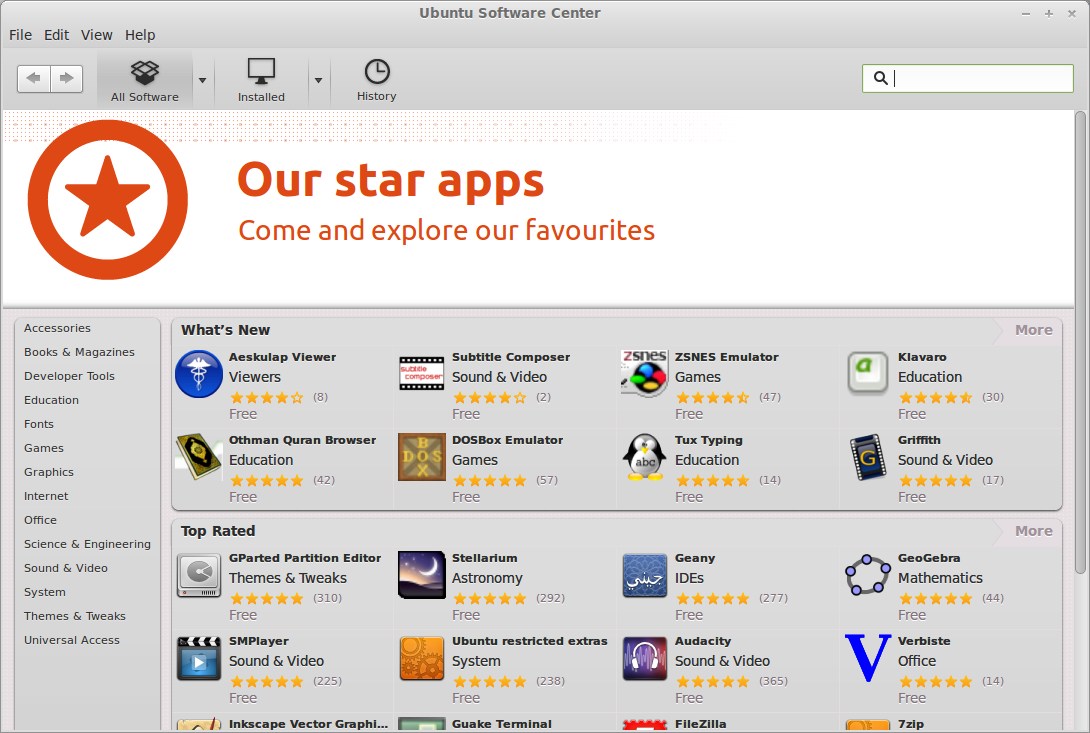
Why are people arguing this still? Ubuntu and Mint have a software center for years. When was the last time anyone here used Linux, since Ubuntu 10.10? And there's .deb files, which have been around forever.

ubuntu-software-center.jpg

Your typical user will go online to Dell and have a prepared computer sent to them, or go to Best Buy and buy a prepared computer. They're after something as simple as operating your TV, absolutely no thought needed nor required. And it doesn't matter if Linux can be easier to use than Windows after learning the basics. It's the learning part which turns your average user off from it.

Windows 8 made is difficult to find the shutdown button when it was first released. Not sure if that's a problem, but you won't have that issue with Mint or Ubuntu. Nobody even knows if a program is truly off or not in Windows 8. But Linux's only problem is Windows software compatibility. Things like Adobe Photoshop or iTunes just don't exist on Linux. There's alternatives but the alternatives suck. Nobody cares about MS Office since Office 2003. Anything after that was just making the GUI pretty. Libre or Open Office works just fine.

More importantly, Windows games don't work nearly as well or as easily.
 
Installed Linux Mint 17 on my work computer recently. Installed a Brother HL-2140 laser printer, which was apparently successful (printer recognized, driver found and installed, etc.). Tried printing something. Oh God make it stop spewing blank pages at me. Tried printing something on the networked Dell printer, which was also recognized. Oh God make it stop spewing pages with garbled text at me.

Spent about an hour trying out all the various fixes posted by other people whom had used older versions of Linux Mint to no avail. Eventually found a CUPS driver... whatever that is... and installed it for the Brother printer. That worked.

Fuck that.
 
The biggest problem with Linux and its' variations and software is that it's free...

Line up a bunch of almost free $5 charging prostitute and one $500 prostitue, and the majority of people who can afford it will pick the $500 prostitute every time while laughing at the people who are doing the $5 prostitutes. Why? Because deep in our minds, there's something significantly "wrong" with both the people who frequent too-cheap hookers and the actual hooker who charges too little. Doesn't matter if it's true or not, but that's the average mindset. Sure, the too-cheap hooker has all the same physical assets as the more expensive hooker, but people generally believe, and are more likely to be correct, that they will get a better overall experience with the $500 prostitute.

Normal people expect that $5 hookers are crack-addicted, STD-ridden, poor crazy bitches with no self-worth, while $500 hookers, while perhaps not perfect, have some self-value and can at least afford treatment for their other ailments and hide it while performing their trade.

Sure you can likely find a special $5 whore who isn't a crack-ridden, STD laden, poor crazy bitch with no self-worth if you partake in enough searching and research, but it's not worth the crack addictions, STD's, and craziness, people believe they will likely encounter along the way when compared to just spending the money on a $500 hooker in the first place.

Linux's biggest problem is that it is likened to a $5 whore surrounded by men/women who will actually have sex with $5 whores. It's just not worth the hassle for most people.

I wish this could be my sig. :D
(And I use Linux too)
 
My thoughts exactly.
Still leaves a bunch of leftovers in the system REG. This is why the reg file balloons over time and slows the system down.
You have to run seperate utilities to parse out the junk.

Ya I remember 1998 when the reg slowed down a computer too. Seriously what are you guys running?
 
Linux can't gain more ground until the different distro's pull their heads from their asses and work together.. and stop this "new ditro released this week that is X time better than Y and A times faster than B"
 
The biggest problem with Linux and its' variations and software is that it's free...

Most OS's are free today. Even Windows 8 is free on tablets. Apple doesn't charge for iOS. Free is the way of today. The only OS that charges is Windows on Desktops.
 
I've been using Linux Mint since Mint 10. Let me tell you, it was a big learning experience for me because it was different from Windows XP. However, since coming from a time when DOS was common usage on computers, using Terminal seemed like second nature after learning the quirks about it.

I'm now on Mint 16 on my laptop and desktop (via dual boot). Linux doesn't need a "killer app". Linux has the following that does the job as well as Windows alternatives:

  • Blender = 3D rendering
  • LibreOffice = a godsend to those that don't like Office's Ribbon interface
  • Audacity = audio editing
  • Inkscape = vector-based drawing
  • GIMP = Photoshop alternative
  • Thunderbird = best Outlook alternative
  • Mplayer/SMplayer = video player
What does it need then? It needs unification or focus on its distribution, and definitely better driver support. There are various distributions that are tailor-made to do specific things for the user from server to regular desktop usage to media creation to reduced resource usage (XFCE, LXDE) to whatever you can think of. However, when it comes down to it, you're looking at having too much on your platter without knowing what's good for your intended purpose.

For your average user that just does web browsing, e-mail, word processing, Linux is a good alternative. For the power user, it needs improvements. Off the top of my head, I say the following is needed:

  • Better hardware and driver support from major manufacturers including newer and upcoming technologies and standards like 802.11ac, etc.
  • Unification on software distribution and installation. If it's an Ubuntu derivative, then one DEB-based installation works in all Ubuntu-based distributions. If I install a new hardware or software, it's the same approach as doing it in Ubuntu, Fedora, or FreeBSD.
  • "Plug-and-play" approach with software and drivers without the need of compiling from Terminal. Installing a video card, for example, should be as easy as Windows-- download the installer, run it, restart computer, and start using it immediately. No need to download dependent files from Synaptic (or your choice of software installer) or from Terminal.
  • Required files needed for software and drivers should be auto-installed, downloaded, and updated. For example, installing AMD's Catalyst drivers means I'd have to download [an updated] GCC and other dependencies to ensure that the drivers are installed properly.
Other than that, I find promise in Linux. I would use it more if I didn't play games so often in Windows [8.1u1]. Linux is rock-stable, secure, and when you get it working it's practically a solid operating system. Updating a lot of system software means the package manager stops the service(s), updates it, restarts the service, and I don't have to restart the computer. Only time is when it does restart the computer is when system files need a restart after an update which is a lot less often than Windows.
 
Most OS's are free today. Even Windows 8 is free on tablets. Apple doesn't charge for iOS. Free is the way of today. The only OS that charges is Windows on Desktops.

And Apple. First ones free over in apple land after that you gotta pay the dealer.
 
I'm now on Mint 16 on my laptop and desktop (via dual boot). Linux doesn't need a "killer app". Linux has the following that does the job as well as Windows alternatives:

  • Blender = 3D rendering
  • LibreOffice = a godsend to those that don't like Office's Ribbon interface
  • Audacity = audio editing
  • Inkscape = vector-based drawing
  • GIMP = Photoshop alternative
  • Thunderbird = best Outlook alternative
  • Mplayer/SMplayer = video player

Everyone one of these apps also runs on Windows and all but one OS X I believe. So all of these options are available to Windows users plus the ones that are Windows only.
 
Everyone one of these apps also runs on Windows and all but one OS X I believe. So all of these options are available to Windows users plus the ones that are Windows only.
Yes, that I know. They're still good alternatives, however.

I still use Thunderbird, LibreOffice, InkScape, GIMP, and Audacity in Windows.
 
Yes, that I know. They're still good alternatives, however.

I still use Thunderbird, LibreOffice, InkScape, GIMP, and Audacity in Windows.

Ya so the point is there is no reason to run Linux all you get is less choices.
 
Ya so the point is there is no reason to run Linux all you get is less choices.

Exactly. I don't see how cross-platform software that's feature equivalent across platforms makes a case for any one platform.
 
Nope, the command line is the killer app. It's incredible.

I use OpenWindows in my job enviornment. No start bar, no desktop icons. But you can open several konsoles/xterms at once and man you are unstoppable.
 
And Apple. First ones free over in apple land after that you gotta pay the dealer.

Its minimal though. $20 for an OS, big deal And they don't even use any type of DRM or verification if you want to go that route. And this last one (Mavericks) was free for everyone.

Apple doesn't need to charge for the software. They generate revenue elsewhere.
 
Everyone one of these apps also runs on Windows and all but one OS X I believe. So all of these options are available to Windows users plus the ones that are Windows only.
The Windows only ones are usually worse then the open source alternatives, with the exceptions of GIMP over Photoshop. I just can't get used to GIMP. I still run Windows on my desktop PC, and it's just full of open source software. It's easier to install and no product keys.
 
The Windows only ones are usually worse then the open source alternatives, with the exceptions of GIMP over Photoshop.

It's not that cut and dry. I know that a lot of people around here don't like Microsoft Office but it is the de facto business standard.
 
Considering almost nothing uses msi installers or use them as part of a larger installer that point is invalid.
Just because people haven't migrated to MSI installer doesn't invalidate the fact that MSI installers resolve the issue of leaving things behind when an application is uninstalled.

So no, valid point. It just means that the complaint now lies with the devs still using outdated install wizards and uninstall routines instead of upgrading to an MSI package.
 
If you EVER have to use a command line, you've lost 99% of the market. I know that sounds silly to everyone here, but it's true. The minute the words configure, kernal, driver, well you know the rest, appear, all those people are completely lost. Those 99% don't even know how to install windows, much less linux. They don't know what a drive is, what a partition is (god forbid whether it's primary, active or not, etc.), root is something that a plant has that's in the ground. An optical drive is something they go to the eye doctor for. For many years, I tell people to come to hardforum when they need help with their computers, they get back to me that they can't even figure out which part to go to. It's that bad.
 
If you EVER have to use a command line, you've lost 99% of the market. I know that sounds silly to everyone here, but it's true. The minute the words configure, kernal, driver, well you know the rest, appear, all those people are completely lost. Those 99% don't even know how to install windows, much less linux. They don't know what a drive is, what a partition is (god forbid whether it's primary, active or not, etc.), root is something that a plant has that's in the ground. An optical drive is something they go to the eye doctor for. For many years, I tell people to come to hardforum when they need help with their computers, they get back to me that they can't even figure out which part to go to. It's that bad.

For most people that use PCs...
Configure is the body of someone in an orange jumpsuit.
A driver is the person who brings them home from the bar.
A kernal is what gets stuck between their teeth when eating popcorn.
Windows are what open to let air into the house.
Linux is a Peanuts character.
Dos is two in Mexican. (yes, I know Spanish is the language in Mexico, they don't):D
A mouse ate the cheese in the trap.
Burning CDs involves a microwave set to 15 seconds.
GUI describes a peach pie.
Docking stations hold their yachts.
Power strips cost $100 in the backroom and if she likes you you might get a handie out of the deal.
Cupholders pop out of the front of their computers.
Printers and scanners are usually unpaid interns.
RDIF is the sound the Budwiser frogs' retarded cousin makes.
A browser is a potential customer.
Wireless means it magically works out of the box without being plugged in to anything including coax, ethernet or power.
Qi is an egg and cheese dish in a pie shell that sometimes has ham or salmon in it.
What did I miss?
 
Just because people haven't migrated to MSI installer doesn't invalidate the fact that MSI installers resolve the issue of leaving things behind when an application is uninstalled.

So no, valid point. It just means that the complaint now lies with the devs still using outdated install wizards and uninstall routines instead of upgrading to an MSI package.

Where the blame lies is irrelevant. The reality is nobody uses it so it's not a valid argument given the context of this discussion...
 
It's not that cut and dry. I know that a lot of people around here don't like Microsoft Office but it is the de facto business standard.

I hear that a lot and don't understand why. Maybe in a business where you can't afford to deal with any inconsistencies, but those businesses still use Office 2003/2007.
 
I hear that a lot and don't understand why. Maybe in a business where you can't afford to deal with any inconsistencies, but those businesses still use Office 2003/2007.

I work at a bank that deals with countless numbers of Office documents, so you are correct that we can't afford to deal with many inconsistences. We moved to Office 2007 five years ago corporate wide and that's the main version we have currently deployed though users on a one off basis can move to 2010 if they choose or need certain capabilities like 64 bit Office, and that's useful for those who crunch large spreadsheets and we have a lot of those folks in a bank.
 
It's not that cut and dry. I know that a lot of people around here don't like Microsoft Office but it is the de facto business standard.

For some maybe. The company I work for is moving to Google docs and a select few may keep Office.
 
I hear that a lot and don't understand why. Maybe in a business where you can't afford to deal with any inconsistencies, but those businesses still use Office 2003/2007.

It matters to anyone who values time.
 
Where the blame lies is irrelevant. The reality is nobody uses it so it's not a valid argument given the context of this discussion...
If you're going to make the argument that things that aren't commonly used are irrelevant, then we should stop discussing desktop Linux in this thread, as it's used even less-frequently than the MSI.

Anyway, MSI installers solve the "bits left behind" complaint. Microsoft has already provided a fix, sorry your favorite dev hasn't moved towards implementing it yet.
 
If you're going to make the argument that things that aren't commonly used are irrelevant, then we should stop discussing desktop Linux in this thread, as it's used even less-frequently than the MSI.

Anyway, MSI installers solve the "bits left behind" complaint. Microsoft has already provided a fix, sorry your favorite dev hasn't moved towards implementing it yet.

Whats so hard to understand about what i said? People made the claim that MSI makes installs clean on windows. NOBODY FUCKING USES MSI INSTALLERS. Invalid argument is invalid.

If MSI was used more commonly it would make sense in defending the shitty situation of installers in windows but they dont so the point is moot...
 
It's not that cut and dry. I know that a lot of people around here don't like Microsoft Office but it is the de facto business standard.
That's one thing I've noticed between Office, especially the newest one I currently use in Win 8.1u1, and LibreOffice is the lack of collaboration, sharing, review and editing tools. These are things I see, in my opinion, necessary in a business environment.

However, for normal day-to-day usage, LibreOffice suffices for non-business usage.

I still stand with what I said earlier. It's not so much a killer app that's needed, but easier ways to install drivers and software that's on the level of plug-n-play in Windows without the need of compiling in Terminal or downloading dependencies. Synaptic and the driver manager in Mint works, but it's not as close to the ease of PnP in Windows. It's getting there though. Since Linux uses no registry, just like OSX, once something is uninstalled, it's completely uninstalled. That is something that I don't see happen in the majority of the Windows drivers and software I uninstall.
 
I work at a bank that deals with countless numbers of Office documents, so you are correct that we can't afford to deal with many inconsistences. We moved to Office 2007 five years ago corporate wide and that's the main version we have currently deployed though users on a one off basis can move to 2010 if they choose or need certain capabilities like 64 bit Office, and that's useful for those who crunch large spreadsheets and we have a lot of those folks in a bank.

This is a thread about Linux, not about your company and a non-relevant Microsoft product.
 
That's one thing I've noticed between Office, especially the newest one I currently use in Win 8.1u1, and LibreOffice is the lack of collaboration, sharing, review and editing tools. These are things I see, in my opinion, necessary in a business environment.

However, for normal day-to-day usage, LibreOffice suffices for non-business usage.

I still stand with what I said earlier. It's not so much a killer app that's needed, but easier ways to install drivers and software that's on the level of plug-n-play in Windows without the need of compiling in Terminal or downloading dependencies. Synaptic and the driver manager in Mint works, but it's not as close to the ease of PnP in Windows. It's getting there though. Since Linux uses no registry, just like OSX, once something is uninstalled, it's completely uninstalled. That is something that I don't see happen in the majority of the Windows drivers and software I uninstall.

Personal users find value with what they work with elsewhere. For instance many personal users buy MS office simply because they know it and don't want to waste time learning how to use libre office et al. You may think that's crazy but its not really, if they don't use something often then its not worth investing time in learning it and memorizing 2 different ways to complete the same task. For libre office its only valuable for a certain segment of users in the mid use low income catagory. basically they use it enough to bother and be in practice using it, but they don't use it so much that paying extra to save time hundreds of times isn't worth it.
 
Back
Top