• Some users have recently had their accounts hijacked. It seems that the now defunct EVGA forums might have compromised your password there and seems many are using the same PW here. We would suggest you UPDATE YOUR PASSWORD and TURN ON 2FA for your account here to further secure it. None of the compromised accounts had 2FA turned on.
    Once you have enabled 2FA, your account will be updated soon to show a badge, letting other members know that you use 2FA to protect your account. This should be beneficial for everyone that uses FSFT.

Does distance between m2 slot and CPU make a difference?

Coldblackice

[H]ard|Gawd
Joined
Aug 14, 2010
Messages
1,156
Generally, does distance between m2 slot and CPU bear any impact whatsoever in terms of latency/performance/response time?

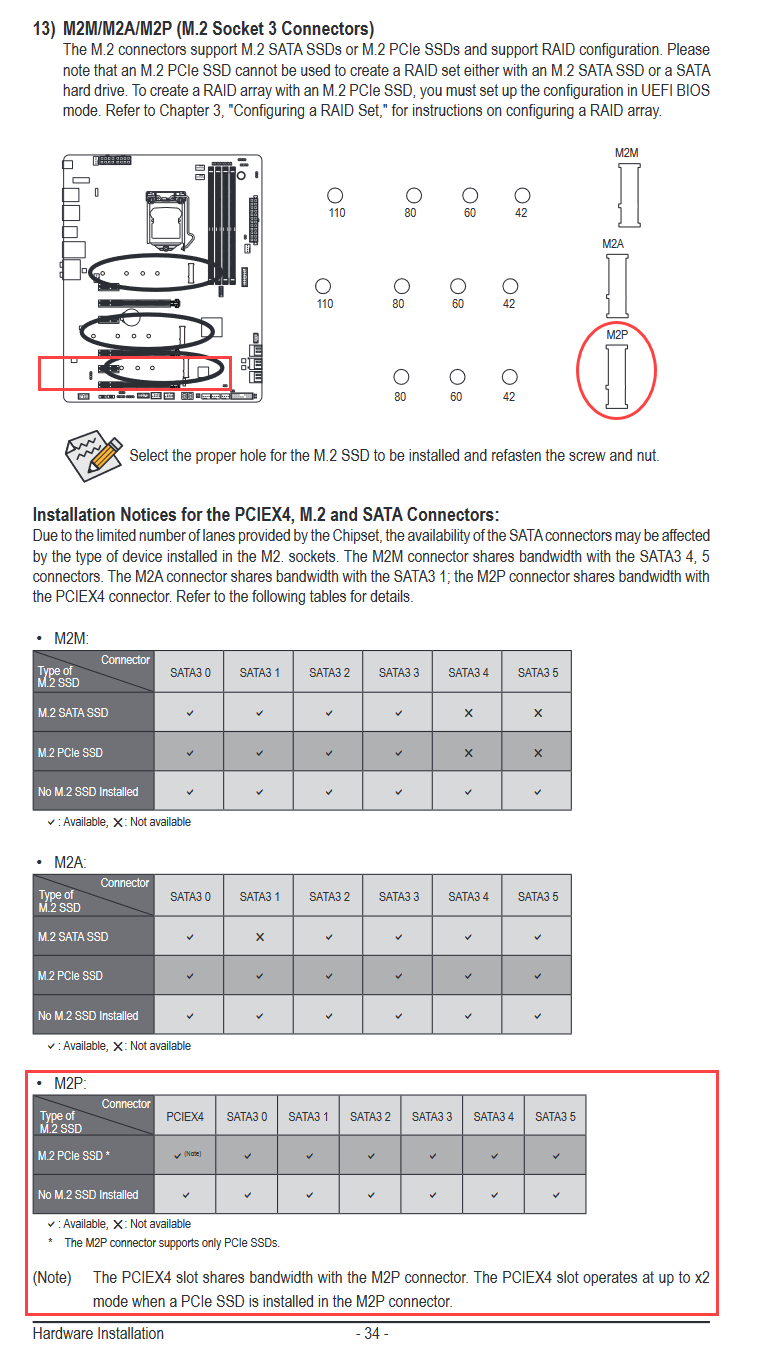
Specifically, on a Gigabyte Z390 Aorus Master (with a WD Black SN750 1TB NVMe drive), there are 3x m2 slots. I've RTFM already (attached) and have had the SN750 plugged into the bottom slot, furthest from CPU, due to it appearing to not route any of its lanes through the chipset, as I inferred that'd have the fastest responsiveness of the three.

However, I'm second-guessing, wondering why they'd place this slot (M2P) on the opposite side of the board from the CPU, and likewise the chipset-laned slot (M2M) furthest away from the chipset.

I assume any performance differences between these slots (assuming equally unloaded) is likely negligible, or at least not humanly noticeable. I'm still curious on this though from a theoretical perspective.
 

Attachments

  • m2.png
    m2.png
    144.9 KB · Views: 0
Some folk would swear by the fact that the closer a slot is to the cpu, the better the performance...

Others will talk this subject to death and say it don't matter none'ya....

But in the 200+ rigs I've built/used since nvme drives have been available, I've never seen any REAL differences, even though you might be able to measure a slight change using some highly specialized test bench software or precise metering equipment etc ...

However, for GPU's, the slot closest to CPU is normally the best one to plug your GPU into, since it almost always is wired for 16x and will provide the max bandwidth possible, which in this case usually does yield the best performance.... but that's a somewhat different scenario for a different discussion :D
 
Yes, it most certainly makes a difference. This is why Apple (And AMD, and soon intel) put RAM on-package with the CPU, why memory slots are as close as they are to the CPU. In electrical signalling , the closer (shorter) the wirepath the less the overall resistance, therefore the power required to push the electrons to their destination is lowered, which also effects SNR. Will you see a real-world difference between 2 different nvme devices outside of a synthetic benchmark, probably not, but it is there and it gets progressively worse the square of the distance.
 
Unless you play benchmarks all day, no...you wont. There are many complex layers to a mobo as you are likely aware so sure there is a reason for it.
 
On your board all NVME slots are provided by the chipset.

1694997118401.png


So I think distance to the CPU wouldn't really matter. On newer platforms where you typically have one M.2 NVME fed by the CPU and others provided by the chipset, the CPU fed M.2 is typically the overall best performing one. It usually is closest to the CPU and I think the motherboard designers do that deliberately.

The other way you could approach this is look at the block diagram of your board. I couldn't find one in the manual, but hypothetically the best performing one should go through less switches and be directly wired to the chipset. I don't think trace length will typically come into play.
 
In theory. But I don't loose sleep over my network patch cords having extra length on them...
 
In reality however, we are talking fractions of fractions of a second latency here, and for all use aside from high frequency trading, none of this matters.

that was, in fact a much longer way to say "no. not really".
you win 1 internets.
 
Back
Top