Choosing an ethernet cable-what are the differences?

Mr Happy

Weaksauce
Joined
Jul 19, 2013
Messages
116
Hello all

I have a BT Home Hub in my house with fibre optic broadband.

I have consoles and a smart TV(I only use it for TV at present, never actually used the smart functions); all of which I would like to connect to the internet via wired connection.

Can anyone tell me what the differences are between different Ethernet cables? do they vary in speed?

I would like to buy a flat cable to fit below carpet better/below doors easier, but would this impact my broadband speed?

Also, what do the different 'categories' of Ethernet cable mean; and what is an RJ45 cable?

Many thanks
 
RJ45 is not a cable. RJ45 is a connector/jack and pinout standard-hence the name: "Registered Jack 45"

https://en.wikipedia.org/wiki/Modular_connector#8P8C


Regards the different "categories" of ethernet cable:

http://www.lifehacker.com.au/2013/04/ask-lh-whats-the-difference-between-cat5-cat5e-and-cat6-cables/


Flat versus standard cable makes no IRL difference in speed.

Not all correct

RJ45 is a cable, the connector is a 8P8C (8 pins, 8 contacts).

A RJ48 cables is the same cable and same connector, but the way the wires in the cable are laid makes it a RJ45 or a RJ48 Cable.

Even Cisco sometimes screw this up.

Don't all ways trust wikipedia.

i seen this error to often, been working in the electronics industry for the last 16 years now, with the 12 of them in the military industry, doing C3i systems with a lot of networking for naval ships and army purpose.
 
Last edited:
Cat5 = 100 Mbit over 100m
Cat5e = 1000 Mbit over 100m
Cat6 = 1000 Mbit over 100m or 10000 Mbit over 30m
Cat6a = 10000 Mbit over 100m

The rj 45 is the end terminal connector.

For a new install the lowest I'd go is cat5e, but I'd prefer cat6 for future potential.
 
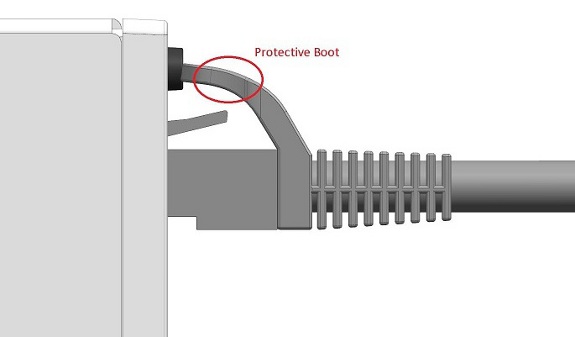
If you are using a 3650 or 3850 Series Cisco switch just make sure you don't use a cable that has a protective boot. :D

fn63697_03.jpg


That black button is the factory reset. :eek:

http://thenextweb.com/insider/2015/...-fail-is-a-network-engineers-worst-nightmare/
 
Just get a CAT5e or CAT6 cable that's the right length and call it a day.

Do not get a crossover cable.
 
As an Amazon Associate, HardForum may earn from qualifying purchases.
A shield is a layer of conductive stuff like aluminum with another uninsulated wire going along with it. It's placed between the pairs and the PCV insulation.
You can get CAT5E with or without. I don't know how relevant this is for Ethernet.

But I did experiment with a CCTV setup using shielded Cat 5E.

I have 4 analogue (non-IP) cameras, all around 20-40 metres from the receiver/recorder. One outside.

The cameras are connected via Cat runs.
Two pairs of the cable are used for 12V, Another two are grounds for the 12V power, one pair is video (using baluns on both ends), and one pair is left as spare.

I was looking at the monitors, and as I touched the 'shield' to the grounded casing at the receiver - the picture became less noisy on all cams. Crystal clear. Disconnected the shield - some 'snow' re-appeared. So the shield does work. YMMV.
 
Back
Top