• Some users have recently had their accounts hijacked. It seems that the now defunct EVGA forums might have compromised your password there and seems many are using the same PW here. We would suggest you UPDATE YOUR PASSWORD and TURN ON 2FA for your account here to further secure it. None of the compromised accounts had 2FA turned on.
    Once you have enabled 2FA, your account will be updated soon to show a badge, letting other members know that you use 2FA to protect your account. This should be beneficial for everyone that uses FSFT.

calling all astrophotographers...

Phimp

Gawd
Joined
Dec 9, 2006
Messages
596
pleeeaase tell me that you have your gear set up to take some hi-res photos of the moon tonight... for when the rocket is launched into a crater on the moon at 5580 miles per hour, kicking up 6.2 km of dust to be studied...
link to NASA's blog detailing the mission
it's going down at 3:15am Pacific Time.
it will also be broadcasted live on NASA TV

From what I've read, anyone west of the Mississippi at the time of impact will be able to see it with any cheap backyard telescope..
 
There are several ways to set up rigs for high quality ones.

Easiest would probably bet to get a T ring which attache's to the camera where the lens would go (SLR) and then you put the telescopes lens in the ring which then connects to the scopes eyepiece.

There are other adapters for standard point and shoot camera's.

Some people have special scopes and mounts that attached to their main scope and the camera mounts to that but it can get fairly pricey.

T rings and adapters are fairly cheap...
 
i wish i could, but frankly i don't have a proper lens or enough converters to get there.
 
Yeah, I've looked into getting a telescope & a T-ring/fitting for my 40D so I can get introduced into astrophotography... but I just haven't had the money laying around yet.

as for tonight, it's too cloudy to even see the moon anyways, so I suppose I'll have to make due with the live broadcast from the satellite.
 
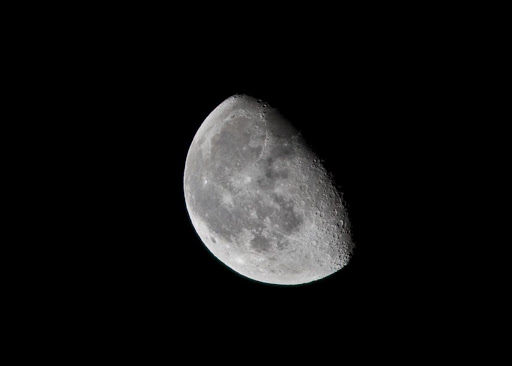
Well thanks a lot guys... I was hoping to go to bed fairly early but I ended up staying late to try to get a shot of this with my little 55-250mm telephoto.

Here's a 1:1 crop of what I got:
IMG_1584_1.jpg


I don't see anything... do you?
 
http://www.nasa.gov/multimedia/nasatv/index.html

the live feed from the satellite. i think impact is in a couple minutes.
the plume of dust after the impact is supposed to be what's visible.

apparently, the advertised 3:15am pst, was for the start of the live broadcast which was mostly interviews of nasa directors and such, but the impact is about a minute from now
 
Last edited:
Well thanks a lot guys... I was hoping to go to bed fairly early but I ended up staying late to try to get a shot of this with my little 55-250mm telephoto.

Here's a 1:1 crop of what I got:
IMG_1584_1.jpg


I don't see anything... do you?

very cool man, I'd love to be able to do that. I saw something recently on the internet about amateur astrophotographers where they were taking pictures of nebula's and such though with some sort of spectral filters and using 2-3 hour exposures. I was unaware that it was even possible (because of the atmosphere). Pretty wild to say the least


check this out, it's pretty cool too. Take pictures from the edge of space for little $$$ :D
http://www.popsci.com/military-aviation-amp-space/article/2009-09/how-take-photos-edge-space-150
 
Hmm... kindof sad I missed this. Don't think my 70-300vr would have really done the scene justice, but it would have been fun to try.

Nice shot SilverMK3! Very sharp and well-exposed.
 
haha. well I think I missed it too. That shot was taken an hour too early :(

I was playing some COD4 afterwards to stay awake for the 4:30am impact and totally forgot about it until just after 5am. I took a quick handheld snapshot and didn't see anything new so I went to bed.

Thanks for the kind comments. madFive your 70-300 would've been a bit bigger and more detailed than mine, as I was only using a 55-250mm lens. It was almost bright enough to shoot handheld (with VR/IS).

I've been experimenting with moon shots for the past couple of weeks on a friend's suggestion (see my blog for more) and this is by far the best one I've got.

The workflow is prett simple:
- set the camera to manual
- lock the ISO fairly low: 100-400
- open up your aperture as wide as it will go (f/5.6 on the long end for mine)
- start with a shutter speed of around 1/300th and work your way up to brighten the scene.
- use live view and zoom into the screen as much as possible to set your focus, there's enough contrast to use AF.
- use a tripod and 10 second timer or remote to reduce vibration
The moon moves fairly quickly so that's why I used such a fast shutter speed, otherwise it would blur or totally wash out the detail.
 
Cool shot dr.stevil. Did anyone else manage to get any shots during the actual impact time?
 
Back
Top