• Some users have recently had their accounts hijacked. It seems that the now defunct EVGA forums might have compromised your password there and seems many are using the same PW here. We would suggest you UPDATE YOUR PASSWORD and TURN ON 2FA for your account here to further secure it. None of the compromised accounts had 2FA turned on.
    Once you have enabled 2FA, your account will be updated soon to show a badge, letting other members know that you use 2FA to protect your account. This should be beneficial for everyone that uses FSFT.

Apple intros MacBook Neo: $599 with an iPhone chip

The A18 Pro is built on TSMC's 3nm (N3E) while the A19 Pro is on 3nm N3P. You could easily move onto the A19 Pro and at least have a current chip in the Neo's. The A18 Pro is 98.7 mm2 while the A19 Pro is 105 mm2. Not exactly breaking the bank here. As for the M2's to be in production, it would be even cheaper since they're built on TSMC's 5nm. Really does seem like Apple had a lot of A18 Pro's laying around.
m2 is a much bigger die on a bigger package, A18 pro is not just a smaller chip with better wield, it sit on a smaller package (thus the 8GB memory limit).

With an a18pro your memory in INFO-PoP package wise for a very small soc (decade of aggressive iPhone physical size constraint), just dies alone you have 50% more a18 than m2 if not more with a bit better yield, making the tsmc 3 tax over 5 not much of an issue. But also the smaller package cut cost, m2 is a big in comparison complex substrate for the in package memory modules (and yield loss when something happen to the memory being attach goes wrong)

A18pro used in the Neo laptop are in part binned down from the iPhone (so yes could be stock in hand) has the iphone pro used the 6 gpu cores while the laptop is down to 5. But it would still be a cheaper computer to make (power delivery, cooling and so on will also be a tiny bit cheaper) regardless.

as for easily move into the a19 pro, if you look at m5 vs a19pro benchmark it could mess up with their product line (do not listen to some apple do not mind cannabilising products talking point), but also not sure the yield is already has good and the a19pro line are I think made with a more costly 12gb of faster ram and with that type of packaging the ram-cpu are fused at TSMC not later on ?), 12gb of 8533/9600 LPDDR5X vs 8GB of 6400 is a really big deal right now at that price point.

When something is cheaper than the other option, there is not much need to speculate more than that.
 
Last edited:
While sales data and estimates won't be available for a while, it looks like the Neo is at least an initial success. Go to the Apple Store and all Neo configs take at least two to three weeks to ship.

Again, the real tell will be long-term performance. What you're seeing now is a combination of early adopters with the first wave of everyday buyers. I want to see shipments for the spring (April to June); that's when you'll see both the first full quarter as well as more of the general public, the people who buy a Neo because it was nicer than the Acer and HP laptops they tried at Best Buy.
 
At $599 total system price, there really isn't much room in terms of chip costs. While neither of us is privy to what Apple pays TSMC, it's reasonable to say that a late 2024 chip based on a slightly older process, especially a binned chip, will cost less than an up-to-the-minute part. And notably, Apple doesn't have to worry about chip supply for one product cutting into sales of another (if the Neo proves popular, that could theoretically impact iPhone 17 Pro production).
$600 is not as low of a price point as you may think, while keeping in mind that the Neo also comes in a $700 flavor which just increases the size of the SSD to 512GB. Remember the Neo has a 2 year old generation SoC meant for a phone. The Intel Ultra 5 226V is already a better chip in my opinion and much like the A18 Pro, it was also released 2 years ago.
As for 5nm production, there are a couple of issues. To start, it's now on the trailing edge of TSMC's main output. Still significant, but a potential concern if Apple needs higher volumes.
Doesn't sound like Apple wants to put any serious effort into the Neo's SoC.
There's also the matter of battery size. The Neo is $599 in part because it only needs a 36.5 watt-hour battery. The M2 Air had a 52.6 watt-hour pack, so that could add to the cost.
The M2 Air also lasts 2 hours longer. Which is odd because you can still find M2 Air's brand new for a little over $700.
I used an iMac with 8GB of RAM well past when that was considered enough, including for Photoshop; it was stable. And I've seen numerous real-world tests by now that show 8GB is still viable and isn't crashing apps.
You could of course use a laptop with 8GB of ram in 2026. Should you? Probably not. If there's a main reason not to get the Neo, it would be the 8GB limitation. To give you an idea, my Google Pixel 6 Pro phone has 12GB of ram. My five year old phone has more ram than the 2026 Neo. Another interesting fact but I can't find a laptop with 8GB of ram that comes with an Intel Ultra 5 226V.
Not what I'd rely on for serious creative work, but the Neo isn't aimed at that audience.
We're making a lot of excuses for the Neo.
Besides, if we're going to trade anecdotes... I've also seen my fair share of Windows and (to a lesser degree) Linux proponents who hold on to untrue stereotypes of Apple products,
You mean like the perceived build quality of Apple products?
like people who assume you're forced to buy Mac apps from the App Store.
Almost there. The first thing any seasoned MacOS user does is disable Gatekeeper.
That's the thing: the characteristics of a $600 Windows laptop are so entrenched by now that you can predict the capabilities without reading the spec sheet (mediocre 1080p display, lousy speakers, usually plastic or a cheap alloy, sometimes dodgy keyboard/trackpads). I'll be happy if the Neo forces Windows vendors to step up as that helps everyone.
This doesn't always work out the best for Windows machines. Remember when Apple removed the headphone jack and now every Android phone does it? Same goes for SD Card slots. What this could mean for Windows machines is that Intel will bring back their Atom chips, which were awful. I think AMD already has a cheap crap SoC as well.
The Mac mini has been around since 2005. If Apple only carried budget computers for just long enough to drive initial upsells, people wouldn't be snapping up the M4 model en masse right now.
There was a 4 year gap between 2014 and 2018, where everyone was complaining that Apple stopped updating them. It was largely considered neglected. It wasn't until Apple went ARM that we now see regular updates to the Mac Mini. Even still, there was a 2 year gap between the M1 Mini and M2 Mini. There is currently no M5 Mac Mini until June of this year. Like the Neo, the Mac Mini was meant to bridge the gap and get people into the Apple ecosystem. Once it's done it's job, it'll be abandoned and forgotten. The reason the Mini continues to exist is because Apple needs to bring more people onto MacOS.
The Neo is a better buy than most Snapdragon laptops... and I can speak from experience. There are some amazing options like the Surface line, but there are also a lot of low-end Snapdragon X machines that are slow and somehow have modest battery life. And paradoxically, app compatibility is sometimes better on the Mac side.
The Snapdragon laptops are absolutely trash, but from a spec sheet they do look better. Again, they come with 16GB of ram and have more I/O. Just like the Intel 226V, I don't see anything less than 8GB available. The GPU performance on the Snapdragon's are absolutely trash, but so is the Neo. They do all come with 1080P equivalent screens, but if we can excuse the 8GB and I/O of the Neo, then we can excuse the screens on these Windows laptops. Even the Surface devices with Snapdragon chips have a display that's barely better than 1080P, and they cost a fortune too.

Should anyone buy a Snapdragon Laptop? Course not, but should anyone buy a Macbook Neo laptop? Of course not. They're all trash.
A18pro used in the Neo laptop are in part binned down from the iPhone (so yes could be stock in hand) has the iphone pro used the 6 gpu cores while the laptop is down to 5. But it would still be a cheaper computer to make (power delivery, cooling and so on will also be a tiny bit cheaper) regardless.
Pretty obvious the Neo's use of the A18 Pro is because Apple can produce them cheap and had a lot already in stock.
as for easily move into the a19 pro, if you look at m5 vs a19pro benchmark it could mess up with their product line
What benchmarks?
When something is cheaper than the other option, there is not much need to speculate more than that.
It's because it's cheaper.

View: https://youtu.be/Fy46fO_-AY0?si=9gGVjIpWhhwSe7Ui
 
It's because it's cheaper.
yet you always try to things about some complicated others reasons, the way you talked it did seem strange to not use an more expensive M2 instead.

What benchmarks?
https://browser.geekbench.com/ios-benchmarks, single core in a phone chassis faster than an M4 in a ipad chassis.

$600 is not as low of a price point as you may think,
But $500 this september for new school year sales could be, if you look at latest models pricing they seem different than the fume of the older pre ram/nand price jump one we can still find.
 
$600 is not as low of a price point as you may think, while keeping in mind that the Neo also comes in a $700 flavor which just increases the size of the SSD to 512GB. Remember the Neo has a 2 year old generation SoC meant for a phone. The Intel Ultra 5 226V is already a better chip in my opinion and much like the A18 Pro, it was also released 2 years ago.
The 512GB model also adds Touch ID (really present to better justify the price, but it's there).

The Core Ultra 5 226V isn't all that hot, based on my investigations (and I liked using the 256V!). It's weaker in single-core, comparable in multi-core, and that era of integrated Intel GPUs is nothing to write home about. It also consumes a lot more power than an A18 Pro, The main advantage is simply that you can go beyond 8GB of RAM, which is obviously valuable but doesn't hand it a decisive victory in some tasks.


You could of course use a laptop with 8GB of ram in 2026. Should you? Probably not. If there's a main reason not to get the Neo, it would be the 8GB limitation. To give you an idea, my Google Pixel 6 Pro phone has 12GB of ram. My five year old phone has more ram than the 2026 Neo. Another interesting fact but I can't find a laptop with 8GB of ram that comes with an Intel Ultra 5 226V.
We also hsven't seen meaningful upgrades in phone RAM for a few years (16GB is usually as high as it gets). And you know full well that memory management in Android isn't the same as in macOS, so it's not a one-for-one comparison.

To be clear: I really think the next-gen Neo will be where it's at as it's likely going to jump to 12GB of RAM (what's included in the A19 Pro). Still not a ton, but it'll provide much more breathing room on top of improved raw computing power.


This doesn't always work out the best for Windows machines. Remember when Apple removed the headphone jack and now every Android phone does it? Same goes for SD Card slots. What this could mean for Windows machines is that Intel will bring back their Atom chips, which were awful. I think AMD already has a cheap crap SoC as well.
If Windows rivals improve their designs, then it'll help.

I don't see Intel reviving the Atom any time soon. It's currently in crisis mode and focusing on core products. More importantly, anything in that category would involve a fundamentally different approach than Intel took during the Atom's lifespan (remember, most Atoms were single- or dual-core parts).


There was a 4 year gap between 2014 and 2018, where everyone was complaining that Apple stopped updating them. It was largely considered neglected. It wasn't until Apple went ARM that we now see regular updates to the Mac Mini. Even still, there was a 2 year gap between the M1 Mini and M2 Mini. There is currently no M5 Mac Mini until June of this year. Like the Neo, the Mac Mini was meant to bridge the gap and get people into the Apple ecosystem. Once it's done it's job, it'll be abandoned and forgotten. The reason the Mini continues to exist is because Apple needs to bring more people onto MacOS.
That's true, although that's partly because Intel was deep into its "14nm++++++" era where Apple wouldn't have accomplished much by slotting in new CPUs.

Apple hasn't "forgotten" the mini in the years since. The system's price has made it more sensitive to chip costs. Remember how the M2 MacBook Air initially cost more than the M1 version? The Mac mini wouldn't have done well if Apple had needed to hike the price by $50 to $100.

With that said, I want to see how Apple handles the Neo. My theory: as Apple is likely to keep using phone chips, it should be easier to update the Neo on an annual basis given that the costs and power draw won't change much. This is also likely to be much more of a gateway system than even the Mac mini, so keeping it current is in Apple's best interests.


The Snapdragon laptops are absolutely trash, but from a spec sheet they do look better. Again, they come with 16GB of ram and have more I/O. Just like the Intel 226V, I don't see anything less than 8GB available. The GPU performance on the Snapdragon's are absolutely trash, but so is the Neo. They do all come with 1080P equivalent screens, but if we can excuse the 8GB and I/O of the Neo, then we can excuse the screens on these Windows laptops. Even the Surface devices with Snapdragon chips have a display that's barely better than 1080P, and they cost a fortune too.

Should anyone buy a Snapdragon Laptop? Course not, but should anyone buy a Macbook Neo laptop? Of course not. They're all trash.
I've used them... let's put it this way: an A18 Pro crushes the base Snapdragon X in single-core and GPU performance, and isn't far behind in multi-core. RAM size will only affect some tasks in this price bracket, but general computing performance affects everything.

Depending on what you buy, they're not trash. I think the Neo escapes that label as it's well-built and better-performing in some key areas, even with that memory ceiling.
 
The Core Ultra 5 226V isn't all that hot, based on my investigations (and I liked using the 256V!). It's weaker in single-core, comparable in multi-core, and that era of integrated Intel GPUs is nothing to write home about. It also consumes a lot more power than an A18 Pro, The main advantage is simply that you can go beyond 8GB of RAM, which is obviously valuable but doesn't hand it a decisive victory in some tasks.
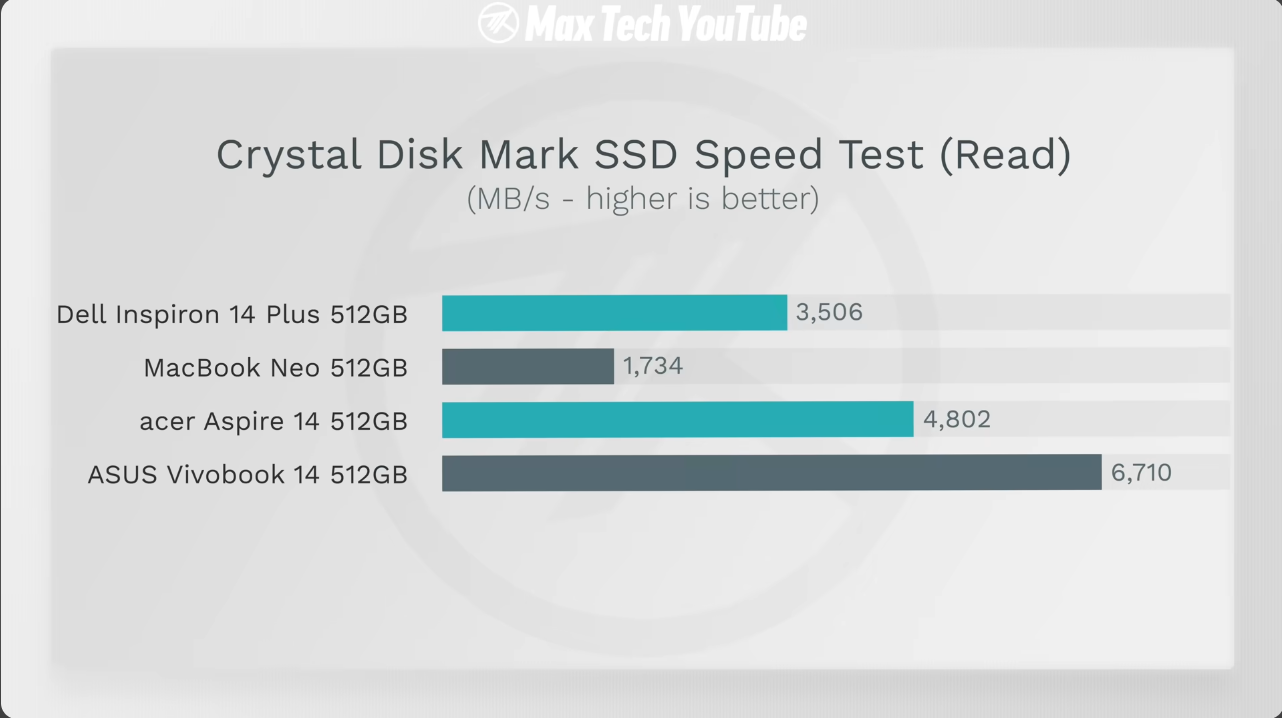
Much more advantages for the 226V. Zip Tie Tech is probably the only person who actually reviewed the Neo, and not a good job. Still waiting on that Just Josh review. According to Zip Tie Tech, the Neo isn't exactly responsive. Though at the same time he claims it's really snappy and fast. He says you can feel the single core speed, but he also points out it's only quick "briefly". There is no cooler for the A18 Pro, which isn't a surprise since this is Apple. The Neo will quickly over heat and throttle it's performance. Because of the 8GB of ram, the system is constantly thrashing the SSD. The problem is the SSD is really slow. Like 1.5 GB/s to 1.7 GB/s in read/write. Which is comically slow compared to the Intel 226V is capable of. Which again, Zip Tie Tech did notice that applications weren't loading as fast on the Neo due to the SSD. He also mentioned that while the Neo can video edit, he did say that exporting was slow. Saying so much as to leave the laptop over night to export, because again the laptop does thermal throttle.

This is why again Geekbench and Cinebench scores do not tell the whole story. The Intel Ultra 5 226V is simply a better overall chip. It also goes to show that the tech community is very contradicting as if they're trying to appease a sponsor. Zip Tech Tech says the Neo is responsive but gives many examples where it isn't.
I've used them... let's put it this way: an A18 Pro crushes the base Snapdragon X in single-core and GPU performance, and isn't far behind in multi-core. RAM size will only affect some tasks in this price bracket, but general computing performance affects everything.

Depending on what you buy, they're not trash. I think the Neo escapes that label as it's well-built and better-performing in some key areas, even with that memory ceiling.
Willing to bet that the Snapdragon X chips will sustain their performance better and longer since they have active cooling fans. The A18 Pro doesn't even have a heat sink on the Neo. There's also SSD performance as well as USB performance. There's a lot more that goes into a computers overall snappy feel than just a fast single threaded CPU.
 
Much more advantages for the 226V. Zip Tie Tech is probably the only person who actually reviewed the Neo, and not a good job. Still waiting on that Just Josh review. According to Zip Tie Tech, the Neo isn't exactly responsive. Though at the same time he claims it's really snappy and fast. He says you can feel the single core speed, but he also points out it's only quick "briefly". There is no cooler for the A18 Pro, which isn't a surprise since this is Apple. The Neo will quickly over heat and throttle it's performance. Because of the 8GB of ram, the system is constantly thrashing the SSD. The problem is the SSD is really slow. Like 1.5 GB/s to 1.7 GB/s in read/write. Which is comically slow compared to the Intel 226V is capable of. Which again, Zip Tie Tech did notice that applications weren't loading as fast on the Neo due to the SSD. He also mentioned that while the Neo can video edit, he did say that exporting was slow. Saying so much as to leave the laptop over night to export, because again the laptop does thermal throttle.

This is why again Geekbench and Cinebench scores do not tell the whole story. The Intel Ultra 5 226V is simply a better overall chip. It also goes to show that the tech community is very contradicting as if they're trying to appease a sponsor. Zip Tech Tech says the Neo is responsive but gives many examples where it isn't.

Willing to bet that the Snapdragon X chips will sustain their performance better and longer since they have active cooling fans. The A18 Pro doesn't even have a heat sink on the Neo. There's also SSD performance as well as USB performance. There's a lot more that goes into a computers overall snappy feel than just a fast single threaded CPU.
Here's that Jush Josh review you were waiting for:


View: https://www.youtube.com/watch?v=Ga9NAZLCQpc

He's harder on the Neo than some (I don't think others are necessarily wrong), but the conclusion is similar to what ZTT and some others have reached: the design is great and it's a laptop worth considering, but the recommendation depends on what's on sale and what you prioritize.

I'll agree that you should get a refurb MacBook Air or a good Windows laptop if they're discounted enough to be in the ballpark. The Zenbook A14 with the original Snapdragon X is down to $700, for instance... if you don't mind a chip that wasn't quick a year ago, it's dandy. I do wince at that Aspire 14 AI though. Technically good... design-wise, flimsy as all hell.

Josh is right in that the next Neo could be the one to watch with more RAM and higher overall performance. You probably won't see budget Windows machines go beyond 16GB of RAM for a while, so an A19 Pro with 12GB of faster memory could effectively eliminate a lot of complaints.

And I'll say this: I still expect the Neo to sell well no matter what its harshest critics say. Not that they'll always be wrong, just that the areas Apple clearly nails (design, display, input, ecosystem) could draw in a lot of people put off by Windows machines and Chromebooks that clearly feel cheap.
 
It would make sense if they upgraded it every year with the next iPhone chip in the line. So next year should be 12GB, which they would want if they want to push their AI services.
 
The Zenbook A14 with the original Snapdragon X is down to $700, for instance... if you don't mind a chip that wasn't quick a year ago, it's dandy
It is perfectly fine for everyday stuff. The only place I notice where it's sluggish is compiling source...and that's mainly in comparison to my desktop, an i7-14700K. It's not noticeably slower than my work laptop, which is something like an i5-1340P.

Also, for that price you get a wildly-better screen than a Dell. I ran the testufo ghosting page on half a dozen Snapdragon laptops before grabbing this one and, while it's not oled, it's pretty darn good from that perspective.
 
Willing to bet that the Snapdragon X chips will sustain their performance better and longer since they have active cooling fans. The A18 Pro doesn't even have a heat sink on the Neo. There's also SSD performance as well as USB performance. There's a lot more that goes into a computers overall snappy feel than just a fast single threaded CPU.

All the reviews I have seen, don't have any issues with heat on these. I know its painful for us PC users... but for what a Neo is. Ya its fine. I have seen people pushing it and the system not pushing over 50c. Its not going to throttle under any reasonable workloads you are going to throw at a $500 laptop. All those reviews also report the neo is in fact pretty snappy for realistic neo workloads. (and even for some that are for sure not for a $500 laptop)

Same thing with the 8gb of ram. I know it bothers windows users (I know your not a windows guy Duke) a ton that Apple is selling a 8gb laptop, and people are not breaking out the pitchforks. On a mac doing $500 laptop things. 8gb is fine. I know that sounds sounds wrong... but it is. Apple has the absolute best RAM compression/swap/paging system in the industry. Its not even close. Its a better setup that we have on Linux as well. They use 2 different ram compression algorithms, they cam dynamically adjust compression levels on the fly, and for at least Mac silicon compiled software Apple has swap hooks. Software can request chunks be sent to swap (instead of waiting for the system to do it). This means software can decide when its a good time to move something to swap, or if there is reason to NOT move it to swap (their hooks allow for push and hold calls). So yes their browser experience is still snappy even with only 8gb of ram and a ton of tabs open. I have seen people testing audio production stuff like Abelton which I would NEVER suggest buying a $500 macbook to run... and you know what ran pretty damn well. (probably better then any windows laptop short of $1500)

There are many reasons to shit on Apple. The ability they have to closely tie their software and hardware together though is second to none. Though it doesn't need to be unique. Microsoft has been sleeping at the wheel on their consumer products for a long time. They never bothered to fix their file system issues (which makes disk swaps on windows worse then it needs to be). They have never looked into a Zram or Apple ram compression method of their own. (Apple has been using ram compression for 18 years). Its like they make choices to protect OEM sales more then deliver a better products. Apple also uses always on disk compression. We can do that in Linux as well of course. Apple just makes a choice to just do new things as they come.

Honestly as a Linux user. I am envious of Apple tech. Their file system I would use if it was open source and I could use it on Linux, it is BTRFS only a lot better. Apple uses multiple compression methods... and of course its Apple so nothing is user facing. Their kernel/IO scheduler chooses which compression method/level to use on every file. Boot files config files get fast methods. Text documents will get max compression settings. I mean perhaps controls aren't needed anyway. It entire point is it will save you as much space as it can without you noticing a major performance hit. Their Ram compression works much the same way, dynamically scaling compression levels, and using 2 different algorithms for page files and raw data. Zram I hope will evolve into what Apple Ram compression already is.
We are very close in Linux land, we have created things that work much the same way... but frankly Apple is ahead in most things storage related. (I think Linux has some better IO schedulers... but that isn't a big deal for consumer hardware)
 
Last edited:
They have never looked into a Zram or Apple ram compression method of their own. (Apple has been using ram compression for 18 years)
windows has been using ram compression for a long time (~a full decade now, that one difference between windows 10 and before), task manager will show you the amount currently compressed.

Xpress and you have different compression level on the fly adjusted with how much cpu is free to do it and it will use it even if you have 64 gb system because in some scenario, still faster to boost effective bandwith in exchange of some compute.

https://dfir.ru/2018/09/08/memory-compression-and-forensics/
According to Microsoft, the Xpress algorithm has three variants:

  • LZNT1,
  • plain LZ77,
  • LZ77+Huffman.
  • COMPRESSION_FORMAT_XPRESS (plain LZ77),
  • COMPRESSION_FORMAT_XPRESS_HUFF (LZ77+Huffman).
 
Last edited:
windows has been using ram compression for a long time (~a full decade now, that one difference between windows 10 and before), task manager will show you the amount currently compressed.

Xpress and you have different compression level on the fly adjusted with how much cpu is free to do it and it will use it even if you have 64 gb system because in some scenario, still faster to boost effective bandwith in exchange of some compute.

https://dfir.ru/2018/09/08/memory-compression-and-forensics/
According to Microsoft, the Xpress algorithm has three variants:

  • LZNT1,
  • plain LZ77,
  • LZ77+Huffman.
  • COMPRESSION_FORMAT_XPRESS (plain LZ77),
  • COMPRESSION_FORMAT_XPRESS_HUFF (LZ77+Huffman).

Thanks I didn't realize MS had added a version of ram compression with W10.
Reading up on what I missed now. Yes it uses a very light compression method 1.4x on average. Still better then nothing. I can't speak from experience, but reading about it it sounds like it really doesn't generally kick in till your close to pushing disk cache. I am not sure if there are any software api hooks or anything... though in windows land you are still at the mercy of software developers. To be fair to MS they have added API hooks for plenty of good tech in the past but implementation is generally out of their hands.

But yes I stand corrected. They are using their own version of ram compression. :)
 
Here's that Jush Josh review you were waiting for:


View: https://www.youtube.com/watch?v=Ga9NAZLCQpc

Finally, a real reviewer.
He's harder on the Neo than some (I don't think others are necessarily wrong), but the conclusion is similar to what ZTT and some others have reached: the design is great and it's a laptop worth considering, but the recommendation depends on what's on sale and what you prioritize.
That's because he's not an Apple sponsored reviewer. Most if not all the reviews act like they're sponsored. He showed things that no other reviewer did like the laptop would pause and audio streams would cut out, likely due to the 8GB of ram. The other reviewer for Just Josh claimed it feels slower than his M2 Air. Loading up a 17 year old game took such a long time they thought something went wrong.

He did test the GPU briefly and it's worse than a Intel Ultra 5 226V, like I suggested. Moving to an Core Ultra 7 258V which I have suggested will have double the GPU performance of the Neo. Adobe Premiere Pro for Just Josh was as he put it, "Died in a heat" and memory was always full, and this was with a basic video for them.

As for battery, the Neo had the worst battery life except for the M2 Air, and yes this includes Windows laptops. He did run Cinebench 2026 and while it did beat out most Windows machines in single threaded, it was dead last multi-threaded. It's worse than the M1 and M2 chips in every way, at least according to his benchmarks. The SSD performance like I said was pathetic as it was often a fraction of the performance of modern Macbooks. Remember that even Macbooks SSD performance is slow when compared to modern Windows machines, so that makes the Neo really slow. WIFi 6e on the Neo is not performing at WiFI 6e speeds.
Josh is right in that the next Neo could be the one to watch with more RAM and higher overall performance. You probably won't see budget Windows machines go beyond 16GB of RAM for a while, so an A19 Pro with 12GB of faster memory could effectively eliminate a lot of complaints.
The Neo needs a number of things, like a proper laptop chip and not an iPhone chip. In almost every aspect the A18 Pro is so slow, with the exception of single threaded performance. Without a heat sink to help cool down the Neo's A18 Pro, it quickly becomes useless for anything other than web browsing and light tasks. You're not going to video edit on this laptop, period.
And I'll say this: I still expect the Neo to sell well no matter what its harshest critics say. Not that they'll always be wrong, just that the areas Apple clearly nails (design, display, input, ecosystem) could draw in a lot of people put off by Windows machines and Chromebooks that clearly feel cheap.
It's going to sell well because Apple fans will make the mistake and buy this. Keep an eye on the Amazon frequently returned message for it. But again, this is meant for schools and schools will buy them. It won't displace Chromebooks either as they're still cheaper and will still do the same job without the luxury of the Neo's screen and speakers. I expect Neo's to appear in California schools which are the group of people who think Apple products as best products.
 
All the reviews I have seen, don't have any issues with heat on these. I know its painful for us PC users... but for what a Neo is. Ya its fine. I have seen people pushing it and the system not pushing over 50c. Its not going to throttle under any reasonable workloads you are going to throw at a $500 laptop.
The only review I've read/watched was ZTT's, and someone who put a heat transfer pad on the CPU. Alex made it pretty clear that under heavy workloads it'll throttle hard. IIRC he was using stuff like Cinebench; I don't know what people would normally do that would cause throttling.

Apple has once again prioritized other things than performance, by not connecting the CPU's heatsink to the fan. I'm not complaining about that, but the tradeoff is that people who've added a heat transfer pad to dump heat into the case bottom report it throttles less...but the bottom of the case warms up to the point where some people might find it uncomfortable.
 
  • Like
Reactions: ChadD
like this
Honestly as a Linux user. I am envious of Apple tech.
I'd buy a Macbook in a hot second if I could replace MacOS with Linux. (Well, I might not because of the pricing, but that's a separate issue.)
 
I can't speak from experience, but reading about it it sounds like it really doesn't generally kick in till your close to pushing disk cache.
You can choose for the whole process a priority (the app can do it, or you yourself in the task manager).

There some granular...
https://learn.microsoft.com/en-us/windows/win32/api/memoryapi/nf-memoryapi-virtuallock

maybe saying you cannot page a plage of memory make it so you can tell windows to not compress as compression tend to be considered a middle step between the 2.


I think on windows, people let the OS in charge a lot and it do it for cold data instead of paging on disk yes. Gamedev will tend to have their own malloc, pools, etc.. and their own ram compression instead of letting the os doing it, as they are obsessed with optimisation.
 
  • Like
Reactions: ChadD
like this
The only review I've read/watched was ZTT's, and someone who put a heat transfer pad on the CPU. Alex made it pretty clear that under heavy workloads it'll throttle hard. IIRC he was using stuff like Cinebench; I don't know what people would normally do that would cause throttling.

Apple has once again prioritized other things than performance, by not connecting the CPU's heatsink to the fan. I'm not complaining about that, but the tradeoff is that people who've added a heat transfer pad to dump heat into the case bottom report it throttles less...but the bottom of the case warms up to the point where some people might find it uncomfortable.

That is fair. I have no idea why Apple wouldn't add a transfer pad... maybe they figure not burning grandmas/some kids lap is more important. I don't know, I have no idea what the real world difference is. :)

That is the thing ya. You can make almost all laptops that don't sound like jets throttle throwing cinabench at them. For real neo type light compute workloads, phone work loads with a big screen. it's probably just fine.
 
Thanks I didn't realize MS had added a version of ram compression with W10.
Reading up on what I missed now. Yes it uses a very light compression method 1.4x on average. Still better then nothing. I can't speak from experience, but reading about it it sounds like it really doesn't generally kick in till your close to pushing disk cache. I am not sure if there are any software api hooks or anything... though in windows land you are still at the mercy of software developers. To be fair to MS they have added API hooks for plenty of good tech in the past but implementation is generally out of their hands.

But yes I stand corrected. They are using their own version of ram compression. :)
Linux ha ZRAM and it even got a recent patch to boost performance.
 
  • Like
Reactions: ChadD
like this
That's because he's not an Apple sponsored reviewer. Most if not all the reviews act like they're sponsored. He showed things that no other reviewer did like the laptop would pause and audio streams would cut out, likely due to the 8GB of ram. The other reviewer for Just Josh claimed it feels slower than his M2 Air. Loading up a 17 year old took such a long time they thought something went wrong.

He did test the GPU briefly and it's worse than a Intel Ultra 5 226V, like I suggested. Moving to an Core Ultra 7 258V which I have suggested will have double the GPU performance of the Neo. Adobe Premiere Pro for Just Josh was as he put it, "Died in a heat" and memory was always full, and this was with a basic video for them.

As for battery, the Neo had the worst battery life except for the M2 Air, and yes this includes Windows laptops. He did run Cinebench 2026 and while it did beat out most Windows machines in single threaded, it was dead last multi-threaded. It's worse than the M1 and M2 chips in every way, at least according to his benchmarks. The SSD performance like I said was pathetic as it was often a fraction of the performance of modern Macbooks. Remember that even Macbooks SSD performance is slow when compared to modern Windows machines, so that makes the Neo really slow. WIFi 6e on the Neo is not performing at WiFI 6e speeds.
Even the hard-in-the-paint fans like iJustine aren't Apple-sponsored. Now, they'll clearly get event invitations and (temporary) review units, but they aren't paid to say nice things.

Josh is good for the reasons that you mentioned, although I also think he's being intentionally hard precisely because that helps him stand out. There's a flip side to this where it's fair to note that many Neo owners will care less about running multiple media streams at once and more about how the display looks or the trackpad feels.

I wouldn't recommend most any $600 laptop for serious video editing. I've seen other reviews where Premiere Pro on Windows devices isn't updating frames live, struggles with more than a modest project... you get the idea. As the saying goes: if your livelihood depends on a fast computer, the added expense will pay for itself quickly. A pro video editor can easily justify $1,600-plus on a MacBook Pro as they'll make that money back by completing more projects. It's fine for editing home and social posts, though.

Battery life seems to vary wildly depending on what you're doing, and it's important to note that Josh ramps up the brightness to 300 nits; probably beyond what you need indoors. But it is fair to say that the Neo is not for the sort who needs to spend eight or more hours juggling multiple apps. Hoping there are improvements for the next gen.


The Neo needs a number of things, like a proper laptop chip and not an iPhone chip. In almost every aspect the A18 Pro is so slow, with the exception of single threaded performance. Without a heat sink to help cool down the Neo's A18 Pro, it quickly becomes useless for anything other than web browsing and light tasks. You're not going to video edit on this laptop, period.
It's not going to get a "proper laptop chip" unless the economics and power/heat considerations make sense. And I don't think it has to. I look at it this way: phone processing power is improving at a faster rate than it is with computers, so it might not be long before it's difficult to complain about the Neo's value for money.


It's going to sell well because Apple fans will make the mistake and buy this. Keep an eye on the Amazon frequently returned message for it. But again, this is meant for schools and schools will buy them. It won't displace Chromebooks either as they're still cheaper and will still do the same job without the luxury of the Neo's screen and speakers. I expect Neo's to appear in California schools which are the group of people who think Apple products as best products.
When even PC vendor execs are alarmed (and I don't just mean ASUS, ZTT's host has talked to others who share the sentiment), I suspect the Neo will do well beyond just fans. After all, fans would likely buy Air and Pro models; they don't really need the Neo.

Apple's education strategy so far appears to be focused more on college students than bulk school purchases, which for now is the right call. It's not cheap enough that a grade school can buy a few hundred units and stay within budget. Although I'd note that the Neo is much more repairable than many recent Macs, so it's clearly designed for classrooms (where kids are less-than-gentle with their computers). This might be part of a long-term play to reassert Apple's former hold on the educational market.
 
You can choose for the whole process a priority (the app can do it, or you yourself in the task manager).

There some granular...
https://learn.microsoft.com/en-us/windows/win32/api/memoryapi/nf-memoryapi-virtuallock

maybe saying you cannot page a plage of memory make it so you can tell windows to not compress as compression tend to be considered a middle step between the 2.


I think on windows, people let the OS in charge a lot and it do it for cold data instead of paging on disk yes. Gamedev will tend to have their own malloc, pools, etc.. and their own ram compression instead of letting the os doing it, as they are obsessed with optimisation.
For sure games are mostly compressing textures and using GPU compression more then ram compression... as I understand how most games are optimized.

So MS does give developers a way to lock things from paging. Not quite a force push though I doubt many windows developers would do that on purpose anyway. :) You know makes me wonder a bit if the issue with MS ecosystem ram usage is mainly a third party developer one. Devs using API hooks like VirtualLock. Only half joking. Those developers developers developers seem to always be a pita for ms. Either not implementing things, OR over implementing things. I know as a Linux user, when the kernel devs added the annoying split lock slow down mode.... We got to figure out which Windows games and software were guilty of having split lock code, was/is a surprising number. I mean your code has to be unintentionally bad as no one programs split locks on purpose. God of war, the latest far cry and Street fighter 6 all trigger split lock mitigations. As does any games using battleeye (the Linux friendly version) so all the old ubisoft games. If you don't disable split lock mitigations they run like complete ass. (so they are using split locks, turning the mitigations off just stop the kernel from purposely making them run like shit). [also interesting to note... at least some of the non kernel level anti cheat stuff in windows is breaking cache barriers and probably resulting in game crashes] For awhile the Linux steam client used to invoke split lock warnings. (they fixed it before they implemented the slow down mode). I'm sure a lot of other windows software is guilty of the same. Lot of crappy code out their causing ram issues. I know Linux has its share of badly coded things in the wild... I don't know I guess the open source community of shame keeps things a bit cleaner. No one wants to get laughed at. No one wants to be the Lutris dev arguing about your vibe code wins with a community scouring for code to hate. haha
 
Last edited:
. Adobe Premiere Pro for Just Josh was as he put it, "Died in a heat" and memory was always full, and this was with a basic video for them.
This is probably not an adobe premier pro machine, 2k video on final cut do seem fine according to people that did try.

but finalcut/adobe premier pro cost a lot for this laptop, even premiere for students edition is $240 a year.

People will run iMovie on this or the free tier of davinci (highly using mac neural silicon and what not) which run way better on low memory mac than premiere, I doubt you go for the fancy professional level app instead of the free/open source alternative on $500 machine that much.
 
Last edited:
  • Like
Reactions: ChadD
like this
Even the hard-in-the-paint fans like iJustine aren't Apple-sponsored. Now, they'll clearly get event invitations and (temporary) review units, but they aren't paid to say nice things.
You mean just like how Linus Tech Tips was very pro Qualcomm and claimed their opinions weren't effected by his sponsorship with Qualcomm? They even claimed they would never go back to x86 laptops, and now you can't see them using anything but x86 laptops.
oh-sure-john-candy.gif

Josh is good for the reasons that you mentioned, although I also think he's being intentionally hard precisely because that helps him stand out. There's a flip side to this where it's fair to note that many Neo owners will care less about running multiple media streams at once and more about how the display looks or the trackpad feels.
Just Josh did the same thing with Snapdragons and even called out Linus Tech Tips over it. The video has since been removed. Months later, Snapdragon laptops have a frequent return label on Amazon. So no, I don't think Just Josh is doing it for the clout.
I wouldn't recommend most any $600 laptop for serious video editing. I've seen other reviews where Premiere Pro on Windows devices isn't updating frames live, struggles with more than a modest project... you get the idea. As the saying goes: if your livelihood depends on a fast computer, the added expense will pay for itself quickly. A pro video editor can easily justify $1,600-plus on a MacBook Pro as they'll make that money back by completing more projects. It's fine for editing home and social posts, though.
Except that the Neo is bad, like really bad. You're not going to wait overnight to export a video on a laptop with a Intel Ultra 5 226V. The ram isn't even the biggest issue in this case, but the lack of any sort of cooling. No heatsink, or even using the housing as a heatsink. It's not like Just Josh just says it like Zip Tie Tech, but briefly shows it. I would expect the 226V to spend 20-30 minutes to export a 1hour Full HD video. You can absolutely video edit on a Lunar Lake laptop, where the same can't be said for the A18 Pro Neo.
Battery life seems to vary wildly depending on what you're doing, and it's important to note that Josh ramps up the brightness to 300 nits; probably beyond what you need indoors. But it is fair to say that the Neo is not for the sort who needs to spend eight or more hours juggling multiple apps. Hoping there are improvements for the next gen.
He kept everything equal because realistically most people aren't going to do anything extra to save on battery. Yes, you could lower brightness but this won't change things much since you can also do the same on Windows laptops. The good news is that no Windows laptop runs slower unplugged either, so any argument against them is lost to time.
It's not going to get a "proper laptop chip" unless the economics and power/heat considerations make sense. And I don't think it has to. I look at it this way: phone processing power is improving at a faster rate than it is with computers, so it might not be long before it's difficult to complain about the Neo's value for money.
I say proper because as you can see the A18 Pro isn't good for I/O, SSD, and even WiFi performance. The Neo is worse when compared to competing Windows and even Macbook laptops. Even putting something as simple as a heat sink would improve the Neo immensely. The only reason I can think why Apple didn't put a heatsink is so the Neo doesn't cannibalize their better Macbooks. Keep in mind that Intel probably has no problem to continue to make Lunar Lake based chips and completely dominate the Neo's A18 Pro, because again The Intel 226V still a much better chip by a factor of 10X.
When even PC vendor execs are alarmed (and I don't just mean ASUS, ZTT's host has talked to others who share the sentiment), I suspect the Neo will do well beyond just fans. After all, fans would likely buy Air and Pro models; they don't really need the Neo.
The alarm is well warranted because people will buy Neo's. The benefit for Windows laptop manufacturers is when they try the Neo and end up returning them. Though, I would still like to see Windows laptop manufacturers up their game and improve things. The webcam being the worst as there's no excuse for such bad webcams in 2026.
Apple's education strategy so far appears to be focused more on college students than bulk school purchases, which for now is the right call. It's not cheap enough that a grade school can buy a few hundred units and stay within budget. Although I'd note that the Neo is much more repairable than many recent Macs, so it's clearly designed for classrooms (where kids are less-than-gentle with their computers). This might be part of a long-term play to reassert Apple's former hold on the educational market.
Probably the only saving grace for the Neo are schools because as we all know, school isn't a place for smart people.
 
That is the thing ya. You can make almost all laptops that don't sound like jets throttle throwing cinabench at them. For real neo type light compute workloads, phone work loads with a big screen. it's probably just fine.
Without having a Neo to try, I can't compare...but Eclipse-based development and compiling works pretty well for me on the Zenbook. The fans were blasting for a while the first time I ran it--I assume doing something like the equivalent of jitting x86 to Arm--but after that it's been nearly silent.

I will point out that, while I paid under $600, it lists for $1000...but I've seen it on sale since I got it. Having said that, the display is a lot better than multiple other Snapdragon laptops I played with in the same price bracket. Dell, HP, and Microsoft's were just smeary messes (I had come there to get the Dell, I think, as it was cheaper then even the Zenbook...but the Zenbook's better in many ways).
 
Without having a Neo to try, I can't compare...but Eclipse-based development and compiling works pretty well for me on the Zenbook. The fans were blasting for a while the first time I ran it--I assume doing something like the equivalent of jitting x86 to Arm--but after that it's been nearly silent.

I will point out that, while I paid under $600, it lists for $1000...but I've seen it on sale since I got it. Having said that, the display is a lot better than multiple other Snapdragon laptops I played with in the same price bracket. Dell, HP, and Microsoft's were just smeary messes (I had come there to get the Dell, I think, as it was cheaper then even the Zenbook...but the Zenbook's better in many ways).
My HP laptop with the Ryzen 5500U with CachyOS installed would scream the fans the moment I started using FireFox. The cooling by default is aggressive on this laptop. Once I installed auto-cpufreq and TLP-UI, then fans never ramp up. Keep in mind I like to lap the heasink and then polish it with Flitz along with new good thermal paste to optimize my laptops cooling. A little aluminum tape to seal around the heatsink and my laptop rarely goes up 60C. The laptop can last for several hours because I also have the brightness set very low. I imagine the default Windows power savings isn't very good either, though still a lot better than Linux's default.

I forgot about MaxTech, but that guy is absolutely a shill when sponsored. I don't agree running the Neo at 500 nits because I'm sure you'd go blind doing it. The 500 nits is mostly for outdoor use. Though do remember this is the only guy who actually tested Apple's 8GB=16GB for Windows and showed it was a huge lie. The interesting part of Max Tech's video is when they tried just switching applications to see who was the fastest, and the Neo was by far the slowest. Goes to show that the single threaded performance theory doesn't apply to 8GB of ram. The GPU test was interesting because Geekbench declared the Neo the fastest but in every other test it was the slowest. It's interesting because this is yet another reason to avoid Geekbench. His video also confirms that the Neo's battery life is terrible, which is strange when you consider how many people here declared the Neo to be the winner with battery life, and I even agreed with them. Turns out, we're all wrong.
 
Last edited:
As an Amazon Associate, HardForum may earn from qualifying purchases.
Except that the Neo is bad, like really bad. You're not going to wait overnight to export a video on a laptop with a Intel Ultra 5 226V. The ram isn't even the biggest issue in this case, but the lack of any sort of cooling. No heatsink, or even using the housing as a heatsink. It's not like Just Josh just says it like Zip Tie Tech, but briefly shows it. I would expect the 226V to spend 20-30 minutes to export a 1hour Full HD video. You can absolutely video edit on a Lunar Lake laptop, where the same can't be said for the A18 Pro Neo.
I've seen better Premiere Pro results, and of course there's Final Cut Pro if you want something better-optimized for the Mac. But I will agree that you're not going to want to get a Neo for editing more than a social videos.

The lack of cooling is curious as the Neo comes just months after Apple made a big deal of the iPhone 17 Pro using a vapor chamber. Not that I'd expect the Neo to use that specifically, but it could have benefitted from something to dissipate the heat. Something to consider for the next gen.


I say proper because as you can see the A18 Pro isn't good for I/O, SSD, and even WiFi performance. The Neo is worse when compared to competing Windows and even Macbook laptops. Even putting something as simple as a heat sink would improve the Neo immensely. The only reason I can think why Apple didn't put a heatsink is so the Neo doesn't cannibalize their better Macbooks. Keep in mind that Intel probably has no problem to continue to make Lunar Lake based chips and completely dominate the Neo's A18 Pro, because again The Intel 226V still a much better chip by a factor of 10X.
10X? Not really. And I don't think a heatsink would have magically made an A18 Pro competitve enough with the M4 and M5 to make people rethink MacBook Air purchases. More likely, it's just that Apple was either reusing the exact cooling (or lack thereof) from the iPhone 16 Pro or was overly optimistic that the chip wouldn't need cooling in a laptop chassis.


The alarm is well warranted because people will buy Neo's. The benefit for Windows laptop manufacturers is when they try the Neo and end up returning them. Though, I would still like to see Windows laptop manufacturers up their game and improve things. The webcam being the worst as there's no excuse for such bad webcams in 2026.
Eh, I don't think mass returns are likely. The Neo is still well-designed and will handle daily tasks well enough. The target market also reduces those chances as the buyers are either knowingly leaving Windows (and thus unlikely to return the system to move back) or existing Apple users in some form, whether previous Mac users or iPhone owners. Low-end Snapdragon systems represent the "worst of both worlds" as they have neither Apple's design and ecosystem advantages nor the compatibility and occasional performance advantages of x86 Windows laptops.

As I've mentioned, you're not the best predictor of a platform's success or failure. I don't think Apple will double its share and spark financial trouble at brands like ASUS or Dell, but the Neo could realistically widen Apple's audience by a significant amount. force rivals to improve, and reopen education avenues (mainly college students and wealthier school districts).
 
And now Tim Cook says the Mac had its "best launch week ever for first-time Mac customers."

That's a very specific achievement (what about total Mac sales?). But it does offer insight into as to who's buying the Neo: yes, many of the customers are people who've never owned a Mac before. And that reflects Apple's main goals of both increasing Mac share and creating (or deepening) ecosystem ties. If someone gets a Neo, they're not only less likely to buy another Windows laptop; they're more likely to start buying other Apple products and subscribing to services.
 
10X? Not really.
If it takes over night to complete an export on the Neo, then 10X the 20-30 minutes Lunar Lake takes would probably be correct. Include things like SSD performance and USB2.0 and yea 10X is generous. At the very least, the SSD performance is 4x slower on the Neo.
Neo SSD performance.png
And I don't think a heat sink would have magically made an A18 Pro competitve enough with the M4 and M5 to make people rethink MacBook Air purchases. More likely, it's just that Apple was either reusing the exact cooling (or lack thereof) from the iPhone 16 Pro or was overly optimistic that the chip wouldn't need cooling in a laptop chassis.
Engineers don't make that kind of mistakes so easily. You could say cost cutting, but that seems a bit extreme even for Apple.
Eh, I don't think mass returns are likely. The Neo is still well-designed
It doesn't have a heat sink.
and will handle daily tasks well enough.
So does a Core2Duo.
The target market also reduces those chances as the buyers are either knowingly leaving Windows (and thus unlikely to return the system to move back) or existing Apple users in some form, whether previous Mac users or iPhone owners. Low-end Snapdragon systems represent the "worst of both worlds" as they have neither Apple's design and ecosystem advantages nor the compatibility and occasional performance advantages of x86 Windows laptops.
Mac owners are going to recommend Neo's to people they know, and they'll find it lacking in capabilities.
As I've mentioned, you're not the best predictor of a platform's success or failure. I don't think Apple will double its share and spark financial trouble at brands like ASUS or Dell, but the Neo could realistically widen Apple's audience by a significant amount. force rivals to improve, and reopen education avenues (mainly college students and wealthier school districts).
The Neo's job is meant to expand their customers because Apple needs more customers. Apple makes devices like the Neo for a reason.
 
And now Tim Cook says the Mac had its "best launch week ever for first-time Mac customers."

That's a very specific achievement (what about total Mac sales?). But it does offer insight into as to who's buying the Neo: yes, many of the customers are people who've never owned a Mac before. And that reflects Apple's main goals of both increasing Mac share and creating (or deepening) ecosystem ties. If someone gets a Neo, they're not only less likely to buy another Windows laptop; they're more likely to start buying other Apple products and subscribing to services.

It sounds strange and backwards, yet seems true. Neo laptop sales will probably hurt android. I Imagine someone that buy a neo and is happy with it. Isn't very likely to want another Samsung or Chinese android phone.
 
So does a Core2Duo.

Well no. Anything more then 5 or 6 years old can feel pretty sluggish. I know your being factious with the core 2. BUT yes the neo is a hell of a lot faster then a 20 year old intel chip. :) lol Really the PC makers should be freaking out. A phone chip is beating them in single thread performance. If it wasn't saddled with Phone speed ram and storage... it wouldn't even be a close comparison.
The neo is a shot across the bow. Its Neo 2 they need to be shitting themselves over. The second gen Neo is going to slay. Apple just got confirmation that a Second gen is a good move. No doubt a second gen will have 12-16gb of ram, and now Apple has even more of a reason to over engineer the top tier iphone chip. I expect a second gen will have at least 12gb, twice the speed on the storage... another 15-20% single thread performance. It doesn't sound like Intel or AMD is going to have much to sell against it. AMDs zen6 laptop parts won't hit till next year sometime, and I don't know if they are going to be exactly pushing to refresh $500 laptops. Intel is also probably pushing Nova lake back to 2027. Now maybe Intel has more cast off parts to sell some lower cost Nova lake parts. Early 2027 might be interesting for budget laptops.

Anyway for browsing the web. Even the reviews that knock the Neo are very clear that it destroys all the windows competition anywhere close to the same price. Of course you can bring it to its knees purposely pushing that 8gb... but real users just won't be doing that. I mean that video MrGuvernment posted. Sure the neo will lag swapping tabs (by 1-2s, it was still very usable) if you also happen to be transferring 100 48mp raw files. lol That isn't what anyone that buys a neo is going to be doing with it. Thought it didn't crash for run like complete ass it was simply a second behind the windows laptops with twice the ram.
 
Well no. Anything more then 5 or 6 years old can feel pretty sluggish.

I agree with everything else you've stated except this. When it comes to daily driving and even gaming, a 5 or 6 yo CPU can still perform provided you know how to tune it for maximum performance and run modern storage (agreed, a core 2 is a little on the extreme side of the argument in relation to age). Undervolting is not tuning for maximum performance.
 
I agree with everything else you've stated except this. When it comes to daily driving and even gaming, a 5 or 6 yo CPU can still perform provided you know how to tune it for maximum performance and run modern storage (agreed, a core 2 is a little on the extreme side of the argument in relation to age). Undervolting is not tuning for maximum performance.

We are talking about laptops. Sure a high end desktop CPU from 2020 is fine.
A 5 year old budget laptop? I don't think many people realistically are still using laptops after 5 or 6 years. CPU aside. Laptop screens, wear and tear. Most 5 year old laptops run like complete ass even if they sold for well above budget range.
 
We are talking about laptops. Sure a high end desktop CPU from 2020 is fine.
A 5 year old budget laptop? I don't think many people realistically are still using laptops after 5 or 6 years. CPU aside. Laptop screens, wear and tear. Most 5 year old laptops run like complete ass even if they sold for well above budget range.

OK, that makes more sense. One of the biggest problems however regarding budget laptops from 2020 was storage and memory capacity, you'd be surprised at the number of budget devices in 2020 that were still shipping with a mechanical HDD and 4GB of ram.
 
  • Like
Reactions: ChadD
like this
Neo laptop sales will probably hurt android. I Imagine someone that buy a neo and is happy with it. Isn't very likely to want another Samsung or Chinese android phone.
Could be, but probably there aren't many people who're gonna whip out their Neo at the bus stop or a red light.
 
We are talking about laptops. Sure a high end desktop CPU from 2020 is fine.
A 5 year old budget laptop? I don't think many people realistically are still using laptops after 5 or 6 years. CPU aside. Laptop screens, wear and tear. Most 5 year old laptops run like complete ass even if they sold for well above budget range.
A coworker just complained literally yesterday about her 5yo laptop, although it was mainly because the battery's clapped out. But my experience aligns: even a decent may have crap in the air channels and throttles due to heat, or OS upgrades making it run worse than it did (also an infamous problem with phones; my old pocket PC got destroyed by Windows CE 5, and my last phone, a Galaxy A35, ran pretty fast until the Android 16 upgrade, which murdered it.)
 
  • Like
Reactions: ChadD
like this
Well no. Anything more then 5 or 6 years old can feel pretty sluggish.
That depends on a lot of things. The Core2Duo won't feel fast in 2026, but will still technically work just fine. Also, exporting from Adobe Premiere would likely take over night on a Core2Duo as well. But a 5-6 old machine is likely to have no noticeable difference compared to other modern laptops. Assuming that the laptop is still working just fine since the day it was bought.
BUT yes the neo is a hell of a lot faster then a 20 year old intel chip. :)
Yes, but my point is that if you're doing daily tasks like web browsing and watching video, then the old Core2Duo will work just fine. This also includes Chromebooks since that's pretty much all they're good for.
lol Really the PC makers should be freaking out. A phone chip is beating them in single thread performance.
Which doesn't matter. If the Neo takes more time to open up applications than the slower IPC Windows laptops, then IPC doesn't matter. Especially when you consider that we're going by Cinebench and Geekbench, which should not matter. I'm going to cut the part of Max Tech's video where they all click at the same time and shows that the Neo is by far the most sluggish laptop. Again, synthetic benchmarks do not matter when they don't represent real world performance.

If it wasn't saddled with Phone speed ram and storage... it wouldn't even be a close comparison.
And a heatsink, but you're right. The problem is, the Neo is saddled with an iPhone chip.
The neo is a shot across the bow. Its Neo 2 they need to be shitting themselves over. The second gen Neo is going to slay. Apple just got confirmation that a Second gen is a good move. No doubt a second gen will have 12-16gb of ram, and now Apple has even more of a reason to over engineer the top tier iphone chip. I expect a second gen will have at least 12gb, twice the speed on the storage... another 15-20% single thread performance.
I hope Apple avoids using the A19 Pro and other future iPhone chips. Just put in an older generation M-series chip.
It doesn't sound like Intel or AMD is going to have much to sell against it.
They already have better chips. Why would AMD and Intel care about the Neo? It's the screen and sound quality of the Neo that's concerning, not the CPU. The CPU is a joke.
Anyway for browsing the web. Even the reviews that knock the Neo are very clear that it destroys all the windows competition anywhere close to the same price.
Except the reviews that show the Neo being much worse at browsing than current competing Windows laptops.
Of course you can bring it to its knees purposely pushing that 8gb... but real users just won't be doing that.
I'm going to refer back to the clip of Max Tech opening up applications with that 8GB that you think users won't be noticing. Your logic is strange because you think the single threaded performance is a factor but not the ram.
I mean that video MrGuvernment posted. Sure the neo will lag swapping tabs (by 1-2s, it was still very usable) if you also happen to be transferring 100 48mp raw files. lol That isn't what anyone that buys a neo is going to be doing with it. Thought it didn't crash for run like complete ass it was simply a second behind the windows laptops with twice the ram.
Transferring files is not something you'd expect the Neo to be doing? You want me to pull out the Core2Duo and show what it was expected to be doing in 2010? Transferring files is basic 101 of daily computing tasks.
 
We are talking about laptops. Sure a high end desktop CPU from 2020 is fine.
A 5 year old budget laptop? I don't think many people realistically are still using laptops after 5 or 6 years. CPU aside. Laptop screens, wear and tear. Most 5 year old laptops run like complete ass even if they sold for well above budget range.
I have a relative on a 10 - 11y laptop, HDD replaced (stock drive was 50MB/s max seq. :yuck:!) and running Slackware now, no complaints on performance. The CPU is stressed by websites running a gazillion scripts but fine other than that. I agree with Duke about the C2D to an extent, with an appropriately spec'd machine and basic tasks most people likely wouldn't notice.
 
Back
Top