• Some users have recently had their accounts hijacked. It seems that the now defunct EVGA forums might have compromised your password there and seems many are using the same PW here. We would suggest you UPDATE YOUR PASSWORD and TURN ON 2FA for your account here to further secure it. None of the compromised accounts had 2FA turned on.
    Once you have enabled 2FA, your account will be updated soon to show a badge, letting other members know that you use 2FA to protect your account. This should be beneficial for everyone that uses FSFT.

AMD Zen CPUs?

If AMD releases something that's good as my 2600K clock-for-clock and uses the same or less power I'm switching back to AMD no matter the cost.
 
If AMD releases something that's good as my 2600K clock-for-clock and uses the same or less power I'm switching back to AMD no matter the cost.

Well I am loving my FX 8320 and FX 8350, I will definitely be upgrading at that point as well. I see no reason why it would be any less than at least a 4770K even if they probably will not equal whatever Intel has out at that point.
 
If AMD releases something that's good as my 2600K clock-for-clock and uses the same or less power I'm switching back to AMD no matter the cost.

Yeah I agree... the bonus of being able to run ECC in old AMD boards when I'm done with them in my main desktop and transition them over to fileserver duty has won me over long term.

I can't justify the major performance difference at this point though.
 
If AMD releases something that's good as my 2600K clock-for-clock and uses the same or less power I'm switching back to AMD no matter the cost.

For me its an i7 970 and any upgrade would have to be significantly faster in single and heavily threaded applications than my current CPU. I would not do a side grade to change camps especially one that will cost me a few hundred considering that whatever CPU I upgrade to will require DDR4.
 
Well I am loving my FX 8320 and FX 8350, I will definitely be upgrading at that point as well. I see no reason why it would be any less than at least a 4770K even if they probably will not equal whatever Intel has out at that point.

The chances of anything AMD produces coming even close to a 4770K is about the same chance as Keira Knightley showing up at your door in the next 15 minutes and offering you a handjob. There's no suspense when AMD conceeded the desktop, server, and mobile markets to Intel publicly 3 years ago.
 
The chances of anything AMD produces coming even close to a 4770K is about the same chance as Keira Knightley showing up at your door in the next 15 minutes and offering you a handjob. There's no suspense when AMD conceeded the desktop, server, and mobile markets to Intel publicly 3 years ago.

But... if the original bulldozer plans are to be believed and the target was 8Ghz, then it isn't that AMD wasn't planning on keeping up but rather the process at GloFo didn't quite make it happen. Now with new management and hopefully a keener and rational sense of reality in the process and GloFo it is very possible that the next AMD CPU will in fact equal or surpass the 4770k.

Side note: Has HSA compatible software released yet ie:Java?
 
But... if the original bulldozer plans are to be believed and the target was 8Ghz, then it isn't that AMD wasn't planning on keeping up but rather the process at GloFo didn't quite make it happen. Now with new management and hopefully a keener and rational sense of reality in the process and GloFo it is very possible that the next AMD CPU will in fact equal or surpass the 4770k.

Side note: Has HSA compatible software released yet ie:Java?

AFAIK there has not been a release yet of any software.

AMD stated the same thing about the first Phenom. They had just jumped to the 65nm node AND was releasing a new chip. AMD called it a Monolithic Core (it was released late and was hyped as the first TRUE QUAD CORE CPU. Now Intel had been making QUAD CORE CPU'S for over a year, at this point. The difference was :
Intel was taking (2) TWO Dual Core Cpu's and putting them together to make a Quad Core.
AMD was taking the Dual Core K8 and making major changes to it's uarch, to become the K10.

This was many years later but AMD stated "That they chose the wrong time on the K10". AMD stated that "We knew what we wanted out of the redesigned K8 but the node we chose to do it in was wrong". You can see this in the launch of the Phenom II.
 
The chances of anything AMD produces coming even close to a 4770K is about the same chance as Keira Knightley showing up at your door in the next 15 minutes and offering you a handjob. There's no suspense when AMD conceeded the desktop, server, and mobile markets to Intel publicly 3 years ago.

Proof? Do you have insider knowledge on such things? Please, show me your evidence that AMD cannot produce something that will "even come close" to a 4770K? Nothing? Eh? :rolleyes:
 
The chances of anything AMD produces coming even close to a 4770K is about the same chance as Keira Knightley showing up at your door in the next 15 minutes and offering you a handjob. There's no suspense when AMD conceeded the desktop, server, and mobile markets to Intel publicly 3 years ago.

Intel still has shitty iGPU so there's still a market for AMD to fill. For most things iGPU performance is more important than CPU performance which is already overkill.
 
For most things iGPU performance is more important than CPU performance which is already overkill.

Depends on what application you are running. For me the iGPU would be mostly unused and I need a significantly faster CPU than my i7 970 in both low and high threaded applications. Although I am not talking about games here.
 
Proof? Do you have insider knowledge on such things? Please, show me your evidence that AMD cannot produce something that will "even come close" to a 4770K? Nothing? Eh? :rolleyes:

2 years behind on process technology.

1/10th the R&D expenditures. (probably 1/30th on cpus since most of their money is probs going to gpu's)

Admitted they don't care about the desktop market anymore.

Need anything else or will nothing shake you from fantasy land that AMD is going to produce a decent desktop chip?
 
Yup, the problem AMD has is not being able to build an EFFICIENT (perf/watt) architecture, and having to make up for the ancient 28nm process. They can parade Kaveri about the place all day, but it can't drop below 35w to entice notebook makers without serious performance loss, making the die space for those extra GPU blocks a waste.

I mean, Kaveri mobile parts have been out since June, and one of the only laptop makers to use the premium-priced FX-7500 (the top-end "20w" quad-core, 384 shader APU) is HP, and they're so not impressed with the actual power consumption that they put it in a boring 6 pound behemoth:

http://www.bestbuy.com/site/hp-envy...lver/8825037.p?id=1219371332671&skuId=8825037

And the more mainstream A10-7300 shows signs of throttling as well inside this 5.5 pound 15" Lenovo full-sized notebook (amazing how huge it is with such a tiny battery), and new games are not really playable on it, making the performance increase over Intel HD 4400 of little worth:

http://www.notebookcheck.net/Lenovo-IdeaPad-Z50-75-Notebook-Review-Update.127031.0.html

Reality is, you're going to have to get a discrete GPU if you want to game in the laptop world. And if you're going to pay the premium for a gaming-capable mobile GPU, the extra cost of an Intel Core i7 is lost in the noise, so people just automatically toss AMD aside in the 45w range. And since 35w laptops are dying, that kills AMD's one remaining performance sweet-spot.
 
Last edited:
If AMD does not produce a new competitive desktop chip, it's because they decided not to for whatever reason, be it financial, miss-management or just plain bad ideas. They have, they could, and they are probably not. That's all there is to it. The animosity and "what have you done for me lately" attitude toward them is depressing and unbecoming of a technology enthusiast.
They have been making good and relatively cheap CPU's since a lot of you guys were in diapers, and even the hot-n-hungry old FX stuff is plenty good for the vast majority of uses right now, and cheaply. For some of the the same reasons so many people are running several year old or more Intel CPU's still. Nobody wins in a no contest market.
 
If AMD does not produce a new competitive desktop chip, it's because they decided not to for whatever reason, be it financial, miss-management or just plain bad ideas..

That's not a matter of "deciding to" or not. You think their execs wake up in the morning and decide to fail? Everything you list is the core of what makes up a business. If they fail as a business it's because they sucked as a business, not because they "decided" at some point they were going to give up.

Reminds me of people who get fired and scream out "I QUIT" like it makes a difference.
 
But... if the original bulldozer plans are to be believed and the target was 8Ghz, then it isn't that AMD wasn't planning on keeping up but rather the process at GloFo didn't quite make it happen. Now with new management and hopefully a keener and rational sense of reality in the process and GloFo it is very possible that the next AMD CPU will in fact equal or surpass the 4770k.

Considering they probably started planning it somewhere around time when A64 was kicking ass of Pentium IV due to Intel running into frequency wall then AMD upper managment was even bigger bunch of utter morons than anyone suspected.
 
Considering they probably started planning it somewhere around time when A64 was kicking ass of Pentium IV due to Intel running into frequency wall then AMD upper managment was even bigger bunch of utter morons than anyone suspected.

Yup, this is the one thing I could never reconcile about Bulldozer: how could management spend 6 years designing the wrong CPU architecture? They beat Intel's narrow fast architecture with their wide slow architecture despite Intel having a 6-12 months fab advantage, but I guess they thought it was the wrong design?

Intel admitted that the frequency/power wall was a real thing, and that Tejas was the wrong way to go back in 2004, and they tread water for two years making dual-core P4s with larger cache, waiting for the Core 2.

In their infinite wisdom, AMD management decided to "save die space" by clocking their chip at 8 GHz, cutting the number of execution units and decoders by 1/3, and increasing the number of cores by 2, and wasting a ton of die space making it all communicate at that insane clock speed...while never once wondering if they had the power budget to do all this. This is half the reason why I lost faith in their ability to compete...the other half was when they invented this non-existent high-end APU "need" in order to justify the stupidly-overpriced ATI purchase.

If they needed on-die graphics, they could have just licensed a core. ATI and Nvidia didn't have a problem letting Microsoft and Sony do it (along with whatever custom memory controller they desired, shared memory or not), so why not a second-tier CPU maker? And if not them, there was always PowerVR (Series 5 SGX with DX 10.1 was in shipping products a year before Llano).
 
Last edited:
That's not a matter of "deciding to" or not. You think their execs wake up in the morning and decide to fail? Everything you list is the core of what makes up a business. If they fail as a business it's because they sucked as a business, not because they "decided" at some point they were going to give up.

Reminds me of people who get fired and scream out "I QUIT" like it makes a difference.


It's all decisions, call it whatever you want. Sometimes you decide something and you don't realize you did till later, we use the term "hindsight" specifically because of this.
We teach history in hopes of others learning from past decisions.
Sometimes you make a series of decisions that narrow down your options later to bad or worse. Those were decisions too. All of them. Sometimes you decide to go right when you should have gone left, and later you can't get back to where that left would have taken you. Decisions. Maybe someone got ungodly rich off deciding not to make anymore major CPU's. Maybe they didn't. It's all decisions, conscious or not, good or bad, all of it. Things don't just happen.

And no, I think their execs woke up and decided to spend funding and effort on something other than another decent desktop CPU. The proof is in the fact that there is no decent new AMD desktop CPU, and they have certainly been able to produce such before. Many times over many years. A decision was made. Debate how the point of making that decision was arrived at or the wisdom or validity of as you wish, I don't know any of the specifics other than the plainly obvious.
 
Their Q4 2014 finacial results tells something interesting
http://ir.amd.com/phoenix.zhtml?c=74093&p=irol-newsArticle&ID=2008997

R&D is down 40M$ down QoQ
(Revenue of $1.24 billion, down 13 percent sequentially and 22 percent year-over-year)

For Q1 2015, AMD expects revenue to decrease 15 percent, plus or minus 3 percent, sequentially.


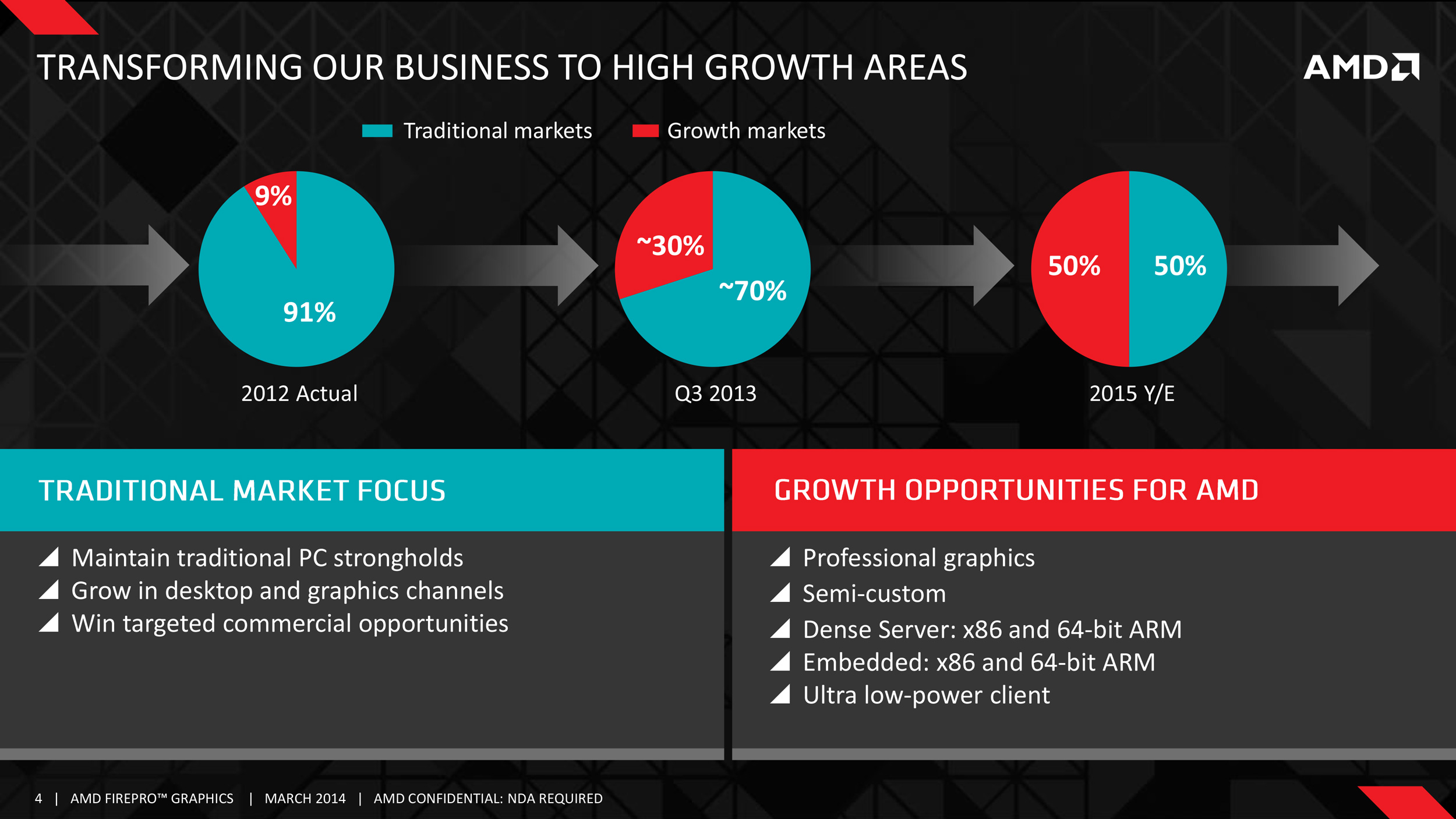
AMD is slowy backing out of the X86 battle with Intel, trying to go semi-custom, while bleeding money and manpower.
GrowthAreas.jpg


And if AMD should go bankrupt (or get aqquired) Intel will have the x86 market to themself.
The devil is in the details

http://corporate.findlaw.com/contra...agreement-advanced-micro-devices-inc-and.html

3. GRANT OF RIGHTS
3.1. AMD License to Intel. Subject to the terms and conditions of this -------------------- Agreement, AMD hereby grants to Intel a non-exclusive, non-transferable ***** worldwide license, without the right to sublicense, under AMD's Patents to: - See more at: http://corporate.findlaw.com/contra...cro-devices-inc-and.html#sthash.Yd8cnXn3.dpuf

AMD is having hard times ahead.
 
The history of cross licensing and lawsuits and such between AMD and Intel going back to the Pentium days if not before is pretty interesting reading.
 
That was why a few years ago, there was almost the biggest LAWSUIT. AMD was selling it's foundries to somebody else and going fabless. This way, (ATI) they could jump between TSMC, IBM, ect, ect to get the best price per wafer. AND
That was why a few years ago, there was almost the biggest LAWSUIT. When Nvidia made a comment that they might develop a x86 chip but some how not infringe on any of Intels x86 Patents.
 
Considering they probably started planning it somewhere around time when A64 was kicking ass of Pentium IV due to Intel running into frequency wall then AMD upper managment was even bigger bunch of utter morons than anyone suspected.

You mean that the other side never made deals with Dell and others not to buy any serious volume AMD cpu?

They might not have been rocket scientists but not all the blame for that era falls on them. What changed is that AMD actually does ARM and that might work out well since the other team still funnels money for design "wins".
 
All blame for greenlightning Bulldozer architecture falls on AMD management and there are no excuses for that.
 
All blame for greenlightning Bulldozer architecture falls on AMD management and there are no excuses for that.

It isn't as simple as that. The original Bulldozer looks to be intended for 8Ghz operation which then would explain the pipelines and its performance at the eventual 4Gz. Question then is: Did GloFo oversell their process or did AMD expect too much?

The architecture itself is very good and looking at the rationale behind it and @8Ghz it would have been a powerhouse, perhaps far better than Intel ( if linear then it would have been).
 
The original Bulldozer looks to be intended for 8Ghz operation

If this was true that was the real blunder. Expecting to be able to run your chips at more than double the frequency of your competitor (especially one who has 10 times the budget for development) at a similar power draw is ridiculous. SIO was never that much of an advantage.
 
Last edited:
Yeah 8 GHZ sounds very unlikely ;)

But something as a Phenom II would have been great at 8GHZ also :) . Basically it would camouflage all of the problems.

It is an easy discovery when you know what AMD spends on R&D and Intel then do the math ...
 
Phenom was at a wall, it had nothing left. Even as good as it was, it could add nothing more.

8Ghz was the target and again there is no clear information as to why it was and to the likely-hood of its fruition. And R&D does not speak to innovation. It only speaks to the ability to move it forward. It isn't hard to tell that AMD has a lot of innovation over the years, as in thinking outside of the box, just the Funds fall short in getting them implemented in a timely fashion. Unfortunately they have to rely on the community to get these ideas to market ie: HSA, Mantle (which is going quite well), Adaptive-sync, HBM and the like. And with all that R&D that Intel has what have they brought that wasn't just an iteration of previous tech or someone else's idea?
 
Phenom was at a wall, it had nothing left. Even as good as it was, it could add nothing more.

8Ghz was the target and again there is no clear information as to why it was and to the likely-hood of its fruition. And R&D does not speak to innovation. It only speaks to the ability to move it forward. It isn't hard to tell that AMD has a lot of innovation over the years, as in thinking outside of the box, just the Funds fall short in getting them implemented in a timely fashion. Unfortunately they have to rely on the community to get these ideas to market ie: HSA, Mantle (which is going quite well), Adaptive-sync, HBM and the like. And with all that R&D that Intel has what have they brought that wasn't just an iteration of previous tech or someone else's idea?

No , 8GHZ is so far fetched it is out of the realm of possibility. You abuse the word innovation. you might as well be a conversation bot.
 
Durquavian is right. Bulldozer/15h was originally intended to ship with 5ghz speeds at the get-go and eventually reach 8ghz. You can find documents from around 2002~2003 that explain the ideologies they had behind this around the time. Obviously the process node they had available to them wasn't anywhere near good enough to allow this, and the prior versions of Bulldozer that predated the one we eventually got in 2011 were so bad that they opted to introduce the Hexacore Instanbul dies to the consumer AM2+/AM3 platform as a sort of stopgap while they rushed to get Bulldozer out.

It was a string of terrible mismanagement at AMD for years on end that is the cause of the sticky situation that AMD finds themselves in today. K10 was late and underperforming as a result, and even had a bug or two that needed to get fixed in later revisions. Then K10.5 hit which was a much better product than its predecessor but still late as a result of its predecessor being late, and still couldn't quite topple Intel as a result. Then 15h hit and set them even further behind Intel -- the launch of Sandy Bridge to consumers in 2011 didn't help AMD's case at all.

Whomever it was that opted to poach Jim Keller from Apple should be given many high-fives. I don't claim to know how K12 & Zen will perform, but I can already assume that it will be a good deal better than 15h. He and his team will make great architectures, I'm sure of it. But it's unfortunate that such products couldn't have been in the pipeline sooner. Imagine if they would've brought him back and used his design rather than 15h back in the day. Oh well. As a result, AMD has been stuck with the Bulldozer line for years now, a uArch that was never able to reach the potential it was designed for.
 
At the end of the day I can play any game out there fine with a good graphics card the same as any Intel cpu. Maybe not as fast in fps but there is no bottleneck. I do have i7 cpu's also.
Point is an FX cpu was not a horrible choice for those who bought one. It gets the job done.
 
At the end of the day I can play any game out there fine with a good graphics card the same as any Intel cpu. Maybe not as fast in fps but there is no bottleneck. I do have i7 cpu's also.
Point is an FX cpu was not a horrible choice for those who bought one. It gets the job done.

I completely agree here which is why I have a FX8320 and FX8350. I have been saying it recently and I will say it again: in the Intel arena, the only processor that would be worth the upgrade is an 5820K. Anything below that would be a short term, slight up / side grade.
 
At the end of the day I can play any game out there fine with a good graphics card the same as any Intel cpu. Maybe not as fast in fps but there is no bottleneck. I do have i7 cpu's also.
Point is an FX cpu was not a horrible choice for those who bought one. It gets the job done.

Same here, I buy games, they run fine, windows responds instantly, the only fault I can find with my 9590 rig is it's boring it's so reliable and fast.
I actually think they picked a great time to release a so-so CPU. Years later and I still can't justify an upgrade from the best FX. I'm waiting again on software to catch up to the hardware I've got. Apparently so are a large number of other people, there is a fascinating thread on anandtech about upgrade cycles and the overwhelming response is that it's slowed down considerably due to relatively miniscule improvements in performance that really don't net any practical gains anyway since everything is "fast enough" that wasn't bottom barrel to start with in the last few years. It's not justification or rosy glasses or such but it was a convenient occurrence that might have occurred in someones calculations at AMD, who knows. I'd be genuinely surprised if I have a solid reason to buy a new CPU inside the next two years, which regardless of sales or benchmark scores, speaks well of the much maligned FX imo. I might build something else in the meantime, or get bored and rebuild my daily rig, but it'll not be for lack of performance or pleasant user experience.
 
No , 8GHZ is so far fetched it is out of the realm of possibility. You abuse the word innovation. you might as well be a conversation bot.

So do you have any real discussion points to counter? As you can see Naroon backed up my claim as far as 8Ghz, which at the time they probably thought was an eventual outcome, no matter whether it was ill-informed or not.

As far as innovation, how would you dispute Factually?
 
So do you have any real discussion points to counter? As you can see Naroon backed up my claim as far as 8Ghz, which at the time they probably thought was an eventual outcome, no matter whether it was ill-informed or not.

As far as innovation, how would you dispute Factually?

Find a financial report from AMD where there is no positive undertone, where you state something which is a "possibility" to people who want to invest money into you company you use certain tactics. That is the only way the 8 GHZ could ever come into play because there is nothing from Global Foundries or others that would even suggest that this would be possible

Google : Microsoft Innovation and get 57 million hits.

Innovation in making a CPU is something AMD did with APU currently the only thing they did right. Sadly this does not translate magically to anything that would describe your point of view about it being a possibility in the realm of the CPU.

For it to break boundaries you need something as this . Making a cpu from the same materials as others limits you to the same problems. AMD won't make a cpu that can do 8GHZ in the consumer space any time soon.

To break down Innovation for cpu look at the gpu. the gpu scales a decent amount each OEM cycle and the cpu just goes at a snails pace compared to the gpu. In other words it will be a very long time before we see a single cpu do 5 Teraflops as what is done now on 1 gpu.

There goes the innovation in the cpu market ....... There are 2 in snail race where one of the competitors is 4 millimetres ahead of the other and declared leading by light years.
 
Find a financial report from AMD where there is no positive undertone, where you state something which is a "possibility" to people who want to invest money into you company you use certain tactics. That is the only way the 8 GHZ could ever come into play because there is nothing from Global Foundries or others that would even suggest that this would be possible

Google : Microsoft Innovation and get 57 million hits.

Innovation in making a CPU is something AMD did with APU currently the only thing they did right. Sadly this does not translate magically to anything that would describe your point of view about it being a possibility in the realm of the CPU.

For it to break boundaries you need something as this . Making a cpu from the same materials as others limits you to the same problems. AMD won't make a cpu that can do 8GHZ in the consumer space any time soon.

To break down Innovation for cpu look at the gpu. the gpu scales a decent amount each OEM cycle and the cpu just goes at a snails pace compared to the gpu. In other words it will be a very long time before we see a single cpu do 5 Teraflops as what is done now on 1 gpu.

There goes the innovation in the cpu market ....... There are 2 in snail race where one of the competitors is 4 millimetres ahead of the other and declared leading by light years.

You need to open the field of view here. You are limiting innovation to hardware only. I did mention HSA, Mantle ( a little less innovative granted, as in done before) HBM. Then you can go back to 64 bit procs, that work. The 512 bit bus on the 290s that no one expected or the AIO on the 290X. Innovative generally means moving forward and at times changing the way it is done enough so the market starts to desire that change. It doesn't always mean the first to invent.

As far as the 8Ghz it doesnt have to ever rely on a sales meeting. It was the intention of the engineers and quite easy to see in the design as the intended speed. Of course we now know that it wasn't going to happen, hind-sight, but as I said looking at the design it makes everything about the design @8Ghz make sense.
 
You need to open the field of view here. You are limiting innovation to hardware only. I did mention HSA, Mantle ( a little less innovative granted, as in done before) HBM. Then you can go back to 64 bit procs, that work. The 512 bit bus on the 290s that no one expected or the AIO on the 290X. Innovative generally means moving forward and at times changing the way it is done enough so the market starts to desire that change. It doesn't always mean the first to invent.

As far as the 8Ghz it doesnt have to ever rely on a sales meeting. It was the intention of the engineers and quite easy to see in the design as the intended speed. Of course we now know that it wasn't going to happen, hind-sight, but as I said looking at the design it makes everything about the design @8Ghz make sense.

HSA Mantle do not pay the bills. Are the 8ghz engineers the same ones that have been let go in the not to distant past because that would explain things.....

And yet you fail to see beyond the 8 ghz that is why I told you before that even a Phenom II at 8 ghz would be great. It was never going to happen not any design at 8ghz. Because nearly everything scales when you ramp up the clock speed, so why would Bulldozer all of a sudden have magical things happen at 8 ghz?

Is it the same failed logic as displayed by JF-AMD when he was yelling something about boosting clock to gain IPC???

To give you a good impression if you run most of the games which are still largely not that optimized for multi core you would need a lot more then 8GHZ to beat up Intel..

Mantle on Linux would be really nice. So far a few titles been here with Mantle and lets hope they keep on coming.
 
HSA Mantle do not pay the bills. Are the 8ghz engineers the same ones that have been let go in the not to distant past because that would explain things.....

And yet you fail to see beyond the 8 ghz that is why I told you before that even a Phenom II at 8 ghz would be great. It was never going to happen not any design at 8ghz. Because nearly everything scales when you ramp up the clock speed, so why would Bulldozer all of a sudden have magical things happen at 8 ghz?

Is it the same failed logic as displayed by JF-AMD when he was yelling something about boosting clock to gain IPC???

To give you a good impression if you run most of the games which are still largely not that optimized for multi core you would need a lot more then 8GHZ to beat up Intel..

Mantle on Linux would be really nice. So far a few titles been here with Mantle and lets hope they keep on coming.

Wrong. You are looking too hard at the surface and the inane posting of diehard Intel-ites that to this day still use Cinebench 11.5 to show IPC diff when each uses a different Instruction set.

If you look at the pipelines and the per cycle process AMD = 3 Intel = 4 then you quickly see that @4Ghz why AMD is behind. They constructed the architecture to scale to 8Ghz there-by nearly doubling that per cycle process. You cant think in terms of actual clocking results and see that they were basing on future prospects that NOW we know would not come to fruition.

Ranting and raving at short-sighted references proves nothing. Look at the white pages of the designs and for-go the benches as they tell you little.
 
Phenom was at a wall, it had nothing left. Even as good as it was, it could add nothing more.

8Ghz was the target and again there is no clear information as to why it was and to the likely-hood of its fruition. And R&D does not speak to innovation. It only speaks to the ability to move it forward. It isn't hard to tell that AMD has a lot of innovation over the years, as in thinking outside of the box, just the Funds fall short in getting them implemented in a timely fashion. Unfortunately they have to rely on the community to get these ideas to market ie: HSA, Mantle (which is going quite well), Adaptive-sync, HBM and the like. And with all that R&D that Intel has what have they brought that wasn't just an iteration of previous tech or someone else's idea?

Yes the Phenom I was at a wall. AMD admitted that they "screwed the pooch" on the original Phenom I. They were going from a 90nm to a 65nm process and at the same time from the K8 to the K10. AMD admitted that they had "Thought to big on making the K10 a Monolithic Die @ 65nm", this can be seen in the Phenom II. With a Monolithic Die @ 65nm, AMD had to make to many trade-offs, it was also late to market. By the time AMD got their "Native Quad Core" to market, Intel had already caught up and had surpassed AMD.
The Phenom I didnot like overclocking " It had a Cold Bug", It was found to have a serious errant "This put AMD back another 6 months", and was AFAIK equal to or inferior to the Intel Quad Core CPU's (That had used duck tape to make Quad CPU's).
ALL of this was shown by the Phenom II @ 45nm to have been corrected.

This what Intel does with its TICK/TOCK production schedule. Take a MATURE CPU design process and drop it a node(TICK). Refine the new manufacturing process on the current last gen model. Develope and SHIP a NEW CPU design on the new manufacturing process(TOCK) before JUMPING to a new node.

1) AMD releases a NEW CPU Design and NODE @ 65nm FAIL
2) AMD releases a NEW CPU Design and NODE @ 32nm FAIL
3) AND it looks like they are "GOING FOR IT AGAIN" with the ZEN
AMD releases a NEW CPU Design and NODE @ 22nm FAIL

I will always believe, that if they have taken a little $$$ and had reduced the Phenom II to 32nm.......

Conspiracy Theorist Awake : What if AMD had taken a MATURE uarch (K10 series) and had produced it @ 32nm?????

1) The Phenom III @ 32nm with 8 (FULL) CORES and 10MB L3 cache, along with the normal tweaks that come with a new node could have been very competitive.
2) The x6 1100T was close or faster than the X8 8150 in many benchmarks.
3) The Phenom IV @ 28nm could have had 12 cores and 20MB L3 cashe.


History : AMD was smoking the Intel Pentium IV, with the A64. (Also FIRST with a IMC)
The A64 was running at 1GHz less than the P IV but still smoked it, in 8 out of 10 test. Intel states that "The Pentium IV is to HOT at 3.8GHz", so they DROP the upcoming TEJAS Revision of the Prescott uarch of the P IV. Both Intel and AMD switch to Dual core processors and then to Quad core.

AMD was producing the K8 Dual core processors at 90nm and NEEDED a CPU to "Win back the crown" from Intel. Intel had taken a betting from AMD, until they switch from the NETBURST uarch, to the Core uarch (which was based off the P III). Intel was already making Quad CPU's by taking (2) two Dual core CPU's and joining them together.(MCM
)
 
http://www.anandtech.com/show/2702/2

by Anand Lal Shimpi on January 8, 2009 12:00 AM EST

The Phenom Inspired, Core i7-like, Phenom II

Want to hear something funny? When AMD launched the original Phenom, it was a unique looking architecture, something AMD touted as a significant advantage due to its "native" monolithic quad-core design (four cores, one die). I often argued that it wasn't an advantage, simply because the performance numbers didn't back up AMD's claims. AMD never won a real world desktop benchmark because of the monolithic quad-core design.

Intel followed up with Nehalem (Core i7), a microprocessor that had a very Phenom-like cache hierarchy (four cores, private L2 caches, one large shared L3 cache), but with much better performance.

Phenom II builds upon the same architecture as the original Phenom, hardly changed, but improves on a few key limitations. This isn't a new microarchitecture, this is a 45nm shrink of Phenom. In a sense, AMD gave up on improving the original Phenom. Early on after Phenom's release AMD went head in the sand and did whatever was necessary to make the 45nm transition perfect. Deneb, as it was called internally, had to succeed - because AMD as a company wasn't going to survive on the backs of the GPU division forever. It's somewhat ironic that Intel was able to execute a better Phenom-like microarchitecture before AMD.
 
K10.5 already did get shrinked to 32nm. It was called Llano. It didn't clock any better than Phenom II did on 45nm -- in fact it clocked worse, topping out at only 3.6ghz best case scenario. It had slightly higher IPC (6~7%) but this was offset by the inferior clocking ability. They had nowhere to take the K10.5 design, it was at its wall and at end of life status. Don't forget that K10 itself was basically still K8, itself a design that originated in the late 90's and initially released in 2003.
 
Back
Top