• Some users have recently had their accounts hijacked. It seems that the now defunct EVGA forums might have compromised your password there and seems many are using the same PW here. We would suggest you UPDATE YOUR PASSWORD and TURN ON 2FA for your account here to further secure it. None of the compromised accounts had 2FA turned on.
    Once you have enabled 2FA, your account will be updated soon to show a badge, letting other members know that you use 2FA to protect your account. This should be beneficial for everyone that uses FSFT.

24-pin ATX Power Splitters

pjkenned

[H]ard|Gawd
Joined
Jan 8, 2010
Messages
1,971
Had a perhaps dumb thought but does a 24-pin power supply splitter exist? Looking at my SB builds they pull well under 200w each even at start-up. It would be awesome if there was a way to power 2 motherboards off of one 660w gold PSU or something similar.

Less fans = less power consumption/ less space required so I'm trying to optimize on this and getting noise down a bit. Probably adding one or two more machines to the farm this weekend whilst I await the SR-2.
 
even if they don't a 20 pin splitter will probably work fine so long as these are CPU only folders.
 
Don't forget, you'll need the CPU 12v connectors (not just the ATX connector) and most PSU's only have one
 
You will also need some sort of batch file to resart/shutdown simultaneously.

Restart
Code:
shutdown –m \\computername1 -f –r -t 0
shutdown –m \\computername2 -f –r -t 0
shutdown –m \\computername3 -f –r -t 0

Shutdown
Code:
shutdown –m \\computername1 -f -t 0
shutdown –m \\computername2 -f -t 0
shutdown –m \\computername3 -f -t 0
 
Yep they're all over Ebay as posted above.

Just to be the devil's advocate though—you may want to consider the efficiency curve of whatever PSU(s) you are using (if you haven't already). Depending on the models, two PSUs may be able to more efficiently power the load than one can—so the net difference in power consumption may be nullified or even the opposite of what you expect, though it would be small either way. Also, by putting the heat load from AC to DC conversion on two PSUs, you are spreading the work of removing that heat across more fans than if you used one PSU. Thus that PSU's fan(s) will have to spin faster, increasing the audio frequency of the fan noise. If all else is equal, two low-speed fans typically are quieter than one high-speed unit.
 
you can use a molex to 12V adapter for this.
Yes, but just pointing out that you'll need that specific adaptor as well.. better than waiting a week for one adaptor to arrive just to find out that you need another one (and another week)
Yep they're all over Ebay as posted above.

Just to be the devil's advocate though—you may want to consider the efficiency curve of whatever PSU(s) you are using (if you haven't already). Depending on the models, two PSUs may be able to more efficiently power the load than one can—so the net difference in power consumption may be nullified or even the opposite of what you expect, though it would be small either way. Also, by putting the heat load from AC to DC conversion on two PSUs, you are spreading the work of removing that heat across more fans than if you used one PSU. Thus that PSU's fan(s) will have to spin faster, increasing the audio frequency of the fan noise. If all else is equal, two low-speed fans typically are quieter than one high-speed unit.

As long as its a good PSU, the efficiency should be more or less constant throughout the load curve. Thats what 80Plus certification means: it has a certain efficiency at all loads from 20% to 100%. On the noise front, the noise coming from the 2 hsf's cooling 2 OC'd Sandy Bridge chips will more than overcome the difference from the PSU, so i don't think thats a real concern in this situation
 
As long as its a good PSU, the efficiency should be more or less constant throughout the load curve. Thats what 80Plus certification means: it has a certain efficiency at all loads from 20% to 100%. On the noise front, the noise coming from the 2 hsf's cooling 2 OC'd Sandy Bridge chips will more than overcome the difference from the PSU, so i don't think thats a real concern in this situation

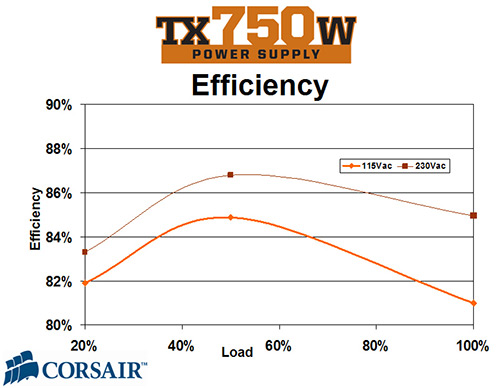
80 Plus requires certain levels of efficiency at 20%, 50%, and 100% load. While the required efficiency is 80% at those three load levels for the base 80 Plus rating, the higher ratings (Bronze, Silver, Gold, and Platinum) have different efficiency requirements at different loads. This is because the efficiency always varies (to varying degrees) from 0% to 100% load and is typically highest somewhere around 50%, as reflected in the 80 Plus requirements and in this sample efficiency curve:

PSU-CSR-CMPSU750TX_G2.jpg


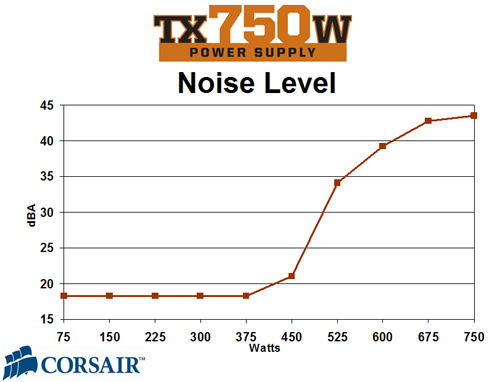
About noise—it depends in part on the fans cooling the CPUs and PSU(s). But regardless of the exact fans, the CPU fans will mask the quieter and lower-frequency noise from two lower-speed fans better than they will mask the noise from one louder and higher-frequency fan. Consider how the noise level increases as the same PSU whose efficiency is noted above has to ramp up its fan speed as load is increased:

PSU-CSR-CMPSU750TX_G1.jpg


Here we see that a 200w difference can be significant in terms of noise output. Obviously, this is just an example as I don't know what PSU(s) the OP is considering.
 
I agree in principle with your point about efficiency, thats what I'm saying. Basically by picking a "good" 80Plus power supply, you're guaranteeing yourself a certain level of efficiency. i.e. 80Plus gold guarantees you something like 85% minimum across the range. Its worth noting the scale on the TX750 curve, which shows a lot of differentiation, but is only in 2% increments, so best case at 50% load you're 85% efficient, while slightly higher and lower are around 82 or 84% respectively. Thats not a very big difference and over the useful lifetime of the hardware being connected probably won't be large enough to overcome the price difference of buying 2 efficient, smaller PSU's

As far as noise is concerned, It may or may not be an issue considering where the rigs are being situated, ambient noise levels, the specific PSU and whether or not the OP cares. If, for example, total power draw for the 2 rigs was 600W (not unreasonable, maybe even too high) while using a 750TX, then you'd be at ~38 dBA which isn't ridiculously loud as long as its not high pitched.

Basically, I think this is a good idea in principle, but there may be some issues working it out practically way before you even have to worry about efficiency or noise
 
From a practical standpoint, it work fine if you have two solid machines that never need restarting. I used to do this many years ago with old Socket A/Slot A rigs - running rwo off a 300W PSU. Starting wasn't a problem, although I seem to recall having to start in a particular sequence. Once they both were running, everything was fine unless one of the machine shut down, which cased the other one to also shut down. It definately wasn't "elegant", but we aren't really shooting for elegant now, are we?
 
What would happen if he just "hot wired" the PSU with a switch so it never shut unless he manually shut it off. In my knowledge a restart doesn't require the power to go out on most mainboards. He could shut down the OS and it would just sit there until he hit the reset button which would restart the OS or shut down the second OS and finally killed the PSU? So it sounds to me if he hot wired the PSU he could anything he wanted to either box except change hardware. Pretty interesting it sounds like in his case he is going for max density and this could raise his density to some higher level. I would tend to agree in a dollars per watt scenario so long as he can stay below 750 this could be much cheaper for power and power supplies although the cables aren't free.

Very interesting little project.
 
From a practical standpoint, it work fine if you have two solid machines that never need restarting. I used to do this many years ago with old Socket A/Slot A rigs - running rwo off a 300W PSU. Starting wasn't a problem, although I seem to recall having to start in a particular sequence. Once they both were running, everything was fine unless one of the machine shut down, which cased the other one to also shut down. It definately wasn't "elegant", but we aren't really shooting for elegant now, are we?

Who said not going for "elegant"? :)

One example of a PSU that I'm looking at (literally) is an unused Seasonic x750 sitting on my desk. Two Sandy Bridge folders would come in at under 50% load combined. Just for kicks I have a GTX 285 in one o/c SB rig folding (only folding with CPU), and I'm at <200w.

Saving $150 per box actually makes it semi-cost effective.

I was thinking of also building a custom "rack" for this purpose.
 
Back
Top