• Some users have recently had their accounts hijacked. It seems that the now defunct EVGA forums might have compromised your password there and seems many are using the same PW here. We would suggest you UPDATE YOUR PASSWORD and TURN ON 2FA for your account here to further secure it. None of the compromised accounts had 2FA turned on.
    Once you have enabled 2FA, your account will be updated soon to show a badge, letting other members know that you use 2FA to protect your account. This should be beneficial for everyone that uses FSFT.

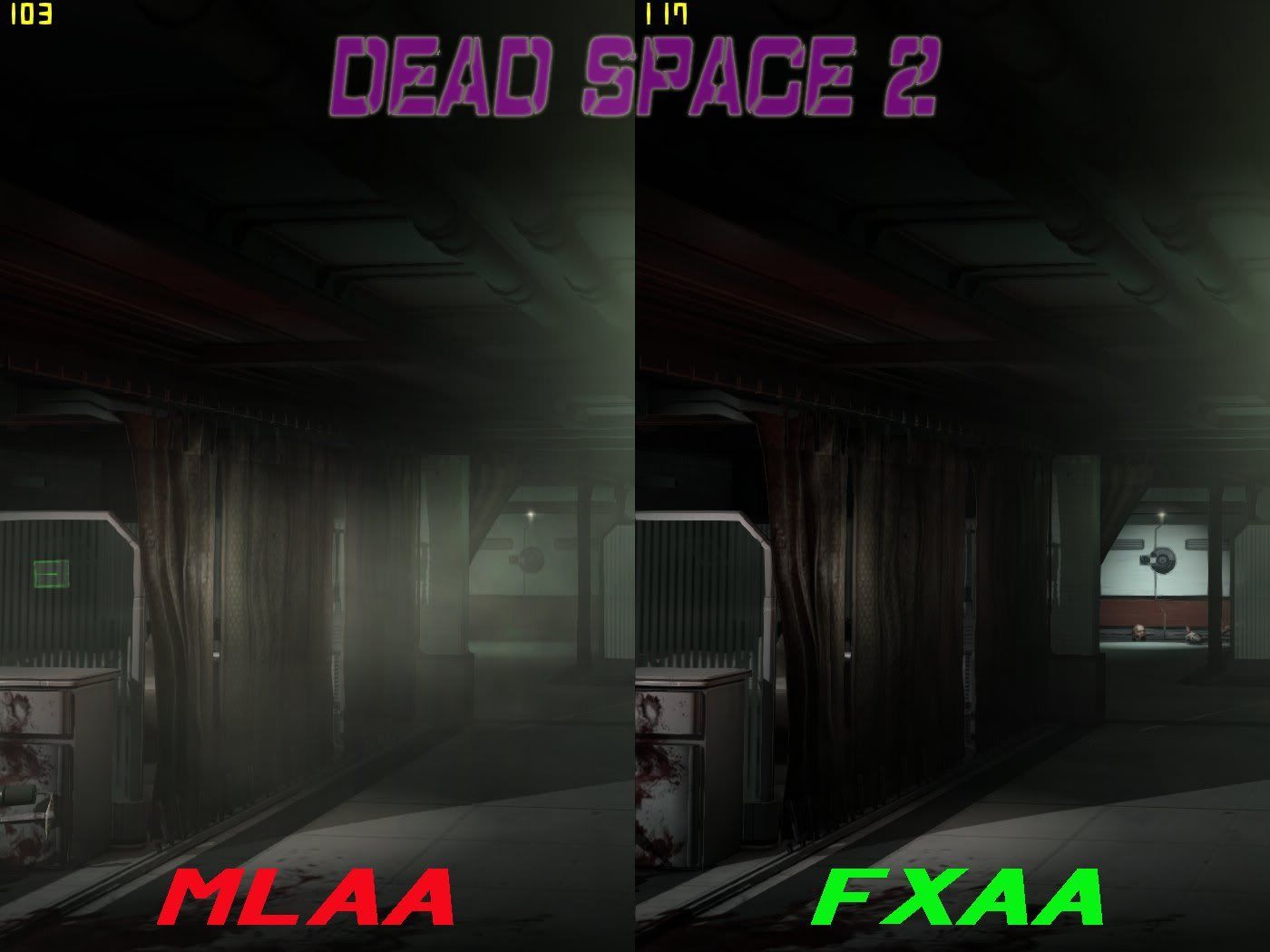
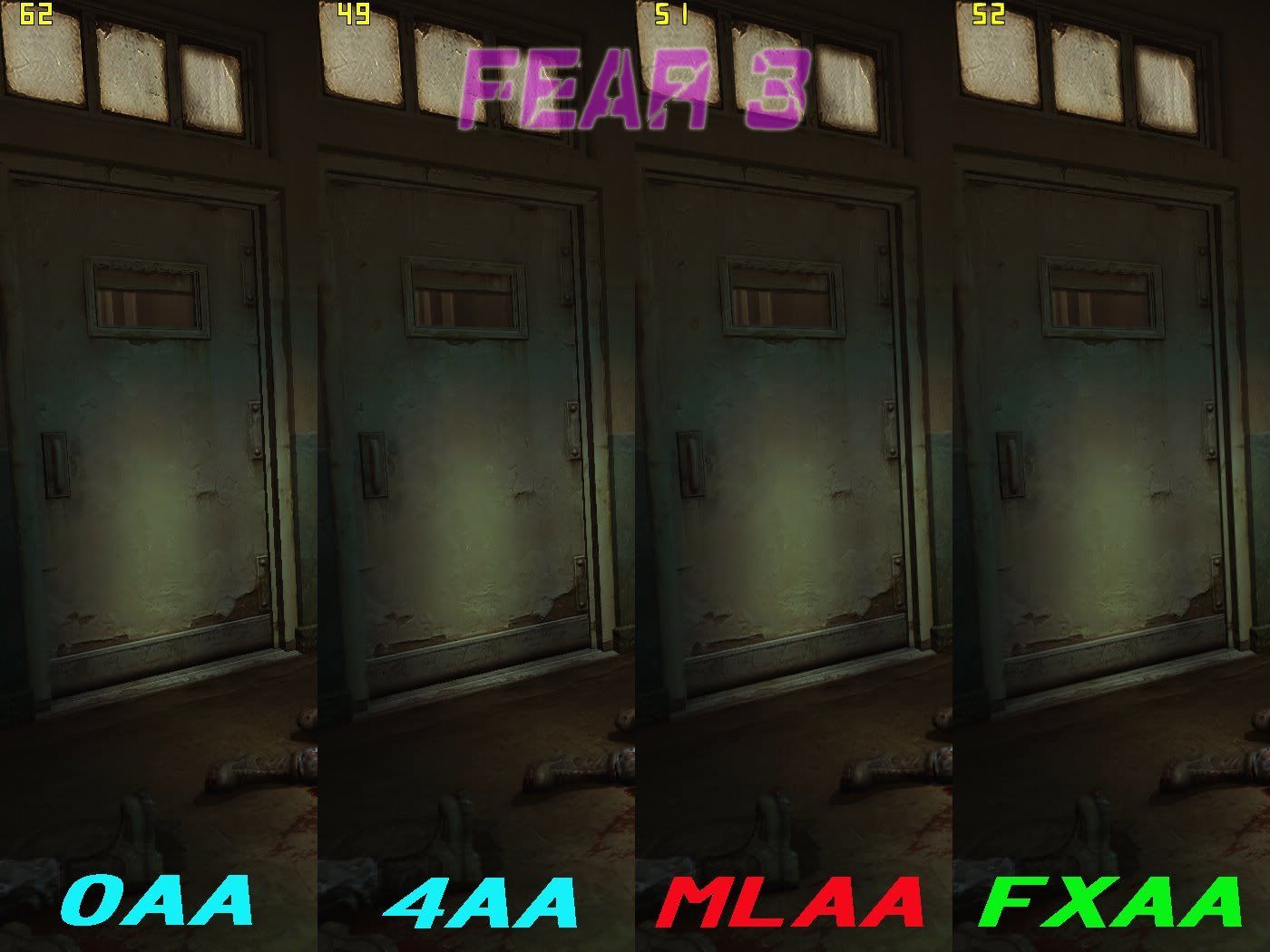
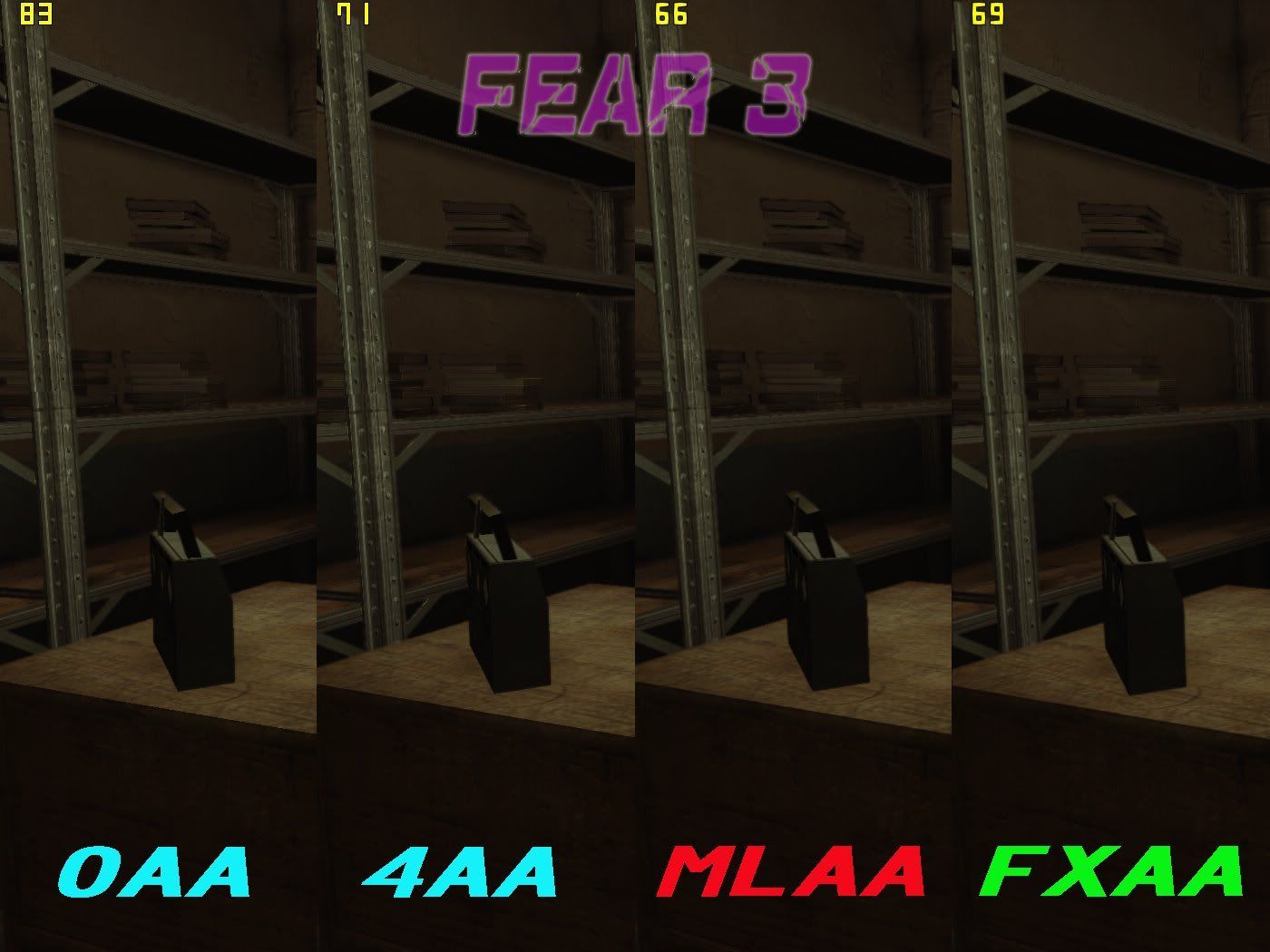
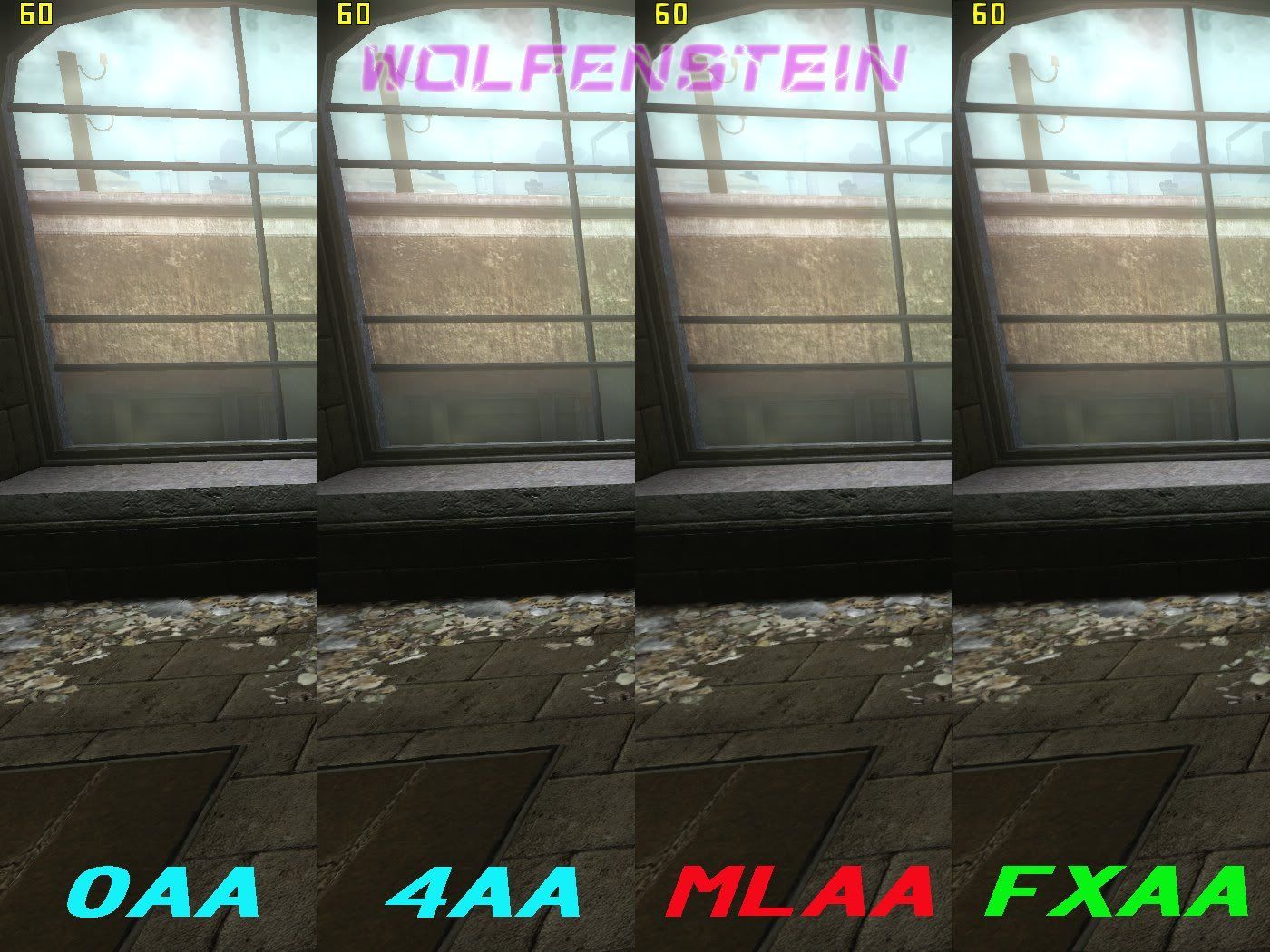
Does FXAA really beat MLAA in IQ? A little comparison…

walkingdog

n00b
Joined
Sep 3, 2008
Messages
38
Does FXAA really beat MLAA in IQ? A little comparison…


E6500, 4GB RAM, ASUS 6850
FXAA:beta version 8
MLAA:CCC 11.8
Disable all normal AA when using FXAA or MLAA
Note:modern games use check points instead of free save/load,
for those using check points the angles of polygons among pics may be a little different,
this will influence the results(jaggies), please keep that in mind.


DEAD SPACE 2
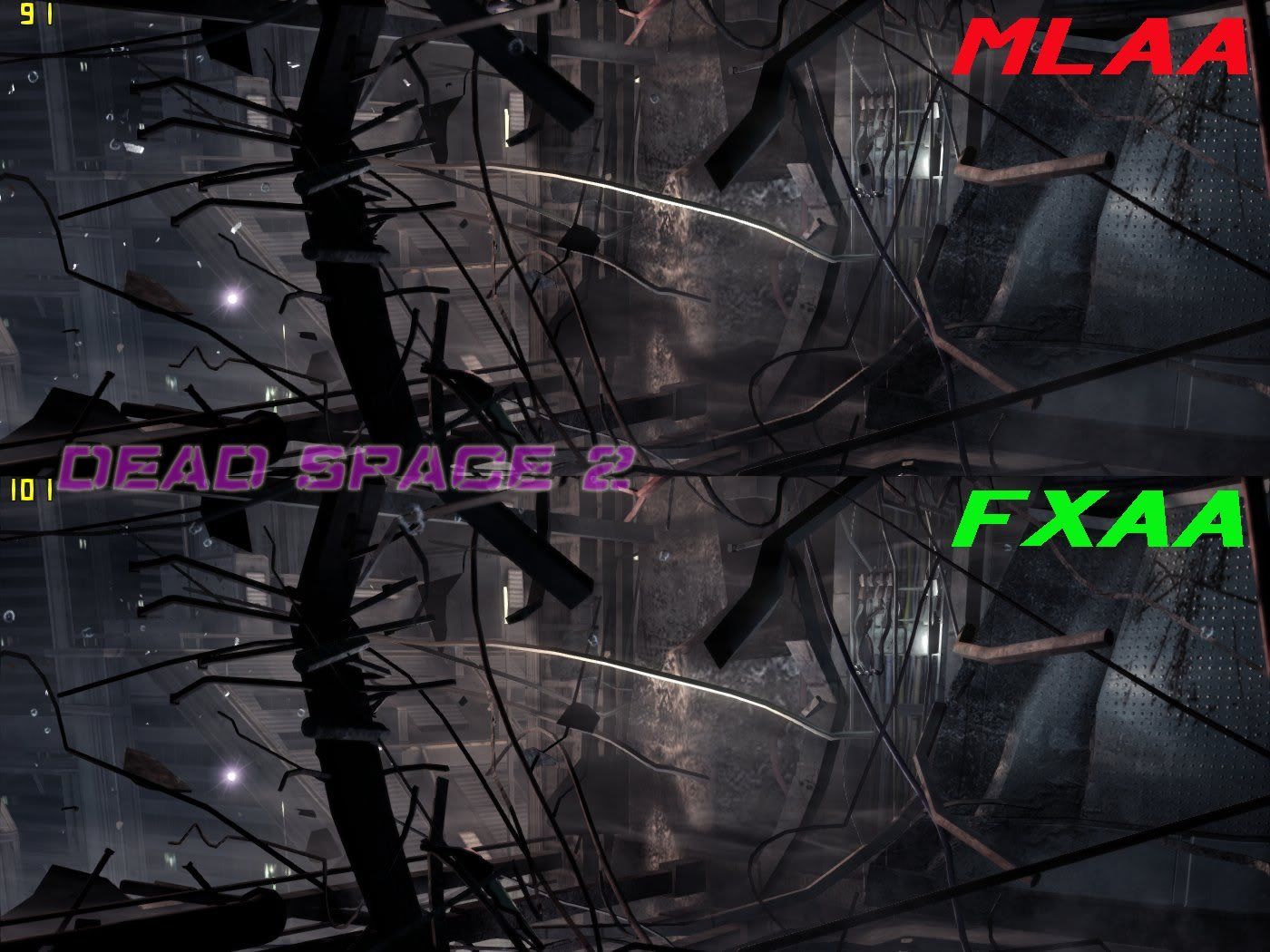
ds2-1.jpg


DEAD SPACE 2:when using FXAA, the light diffusion seems odd…
ds2-2.jpg


FEAR 3
fear3-1.jpg


FEAR 3
fear3-2.jpg


WOLFENSTEIN
wolf2-1.jpg


WOLFENSTEIN
wolf2-2.jpg


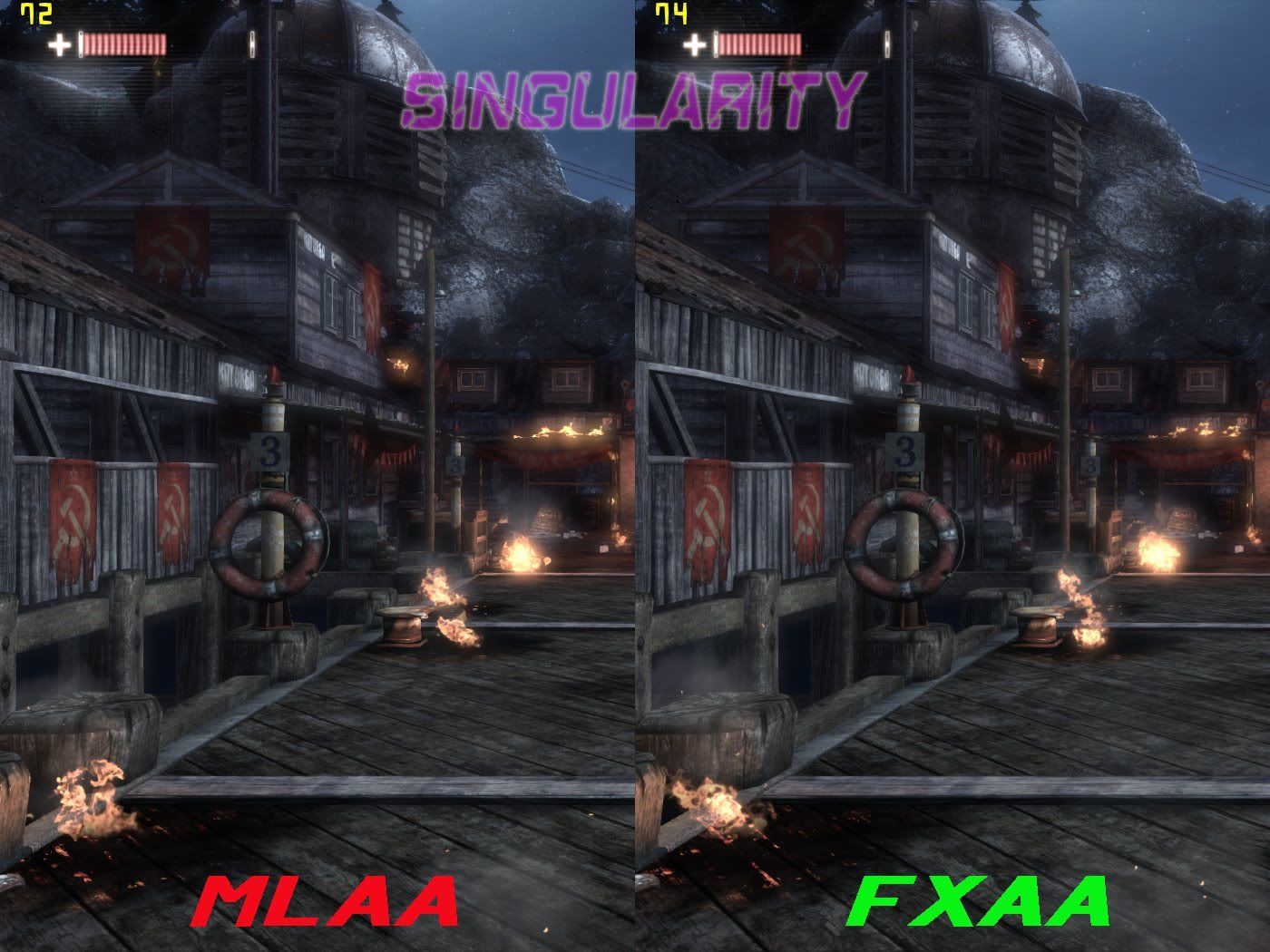
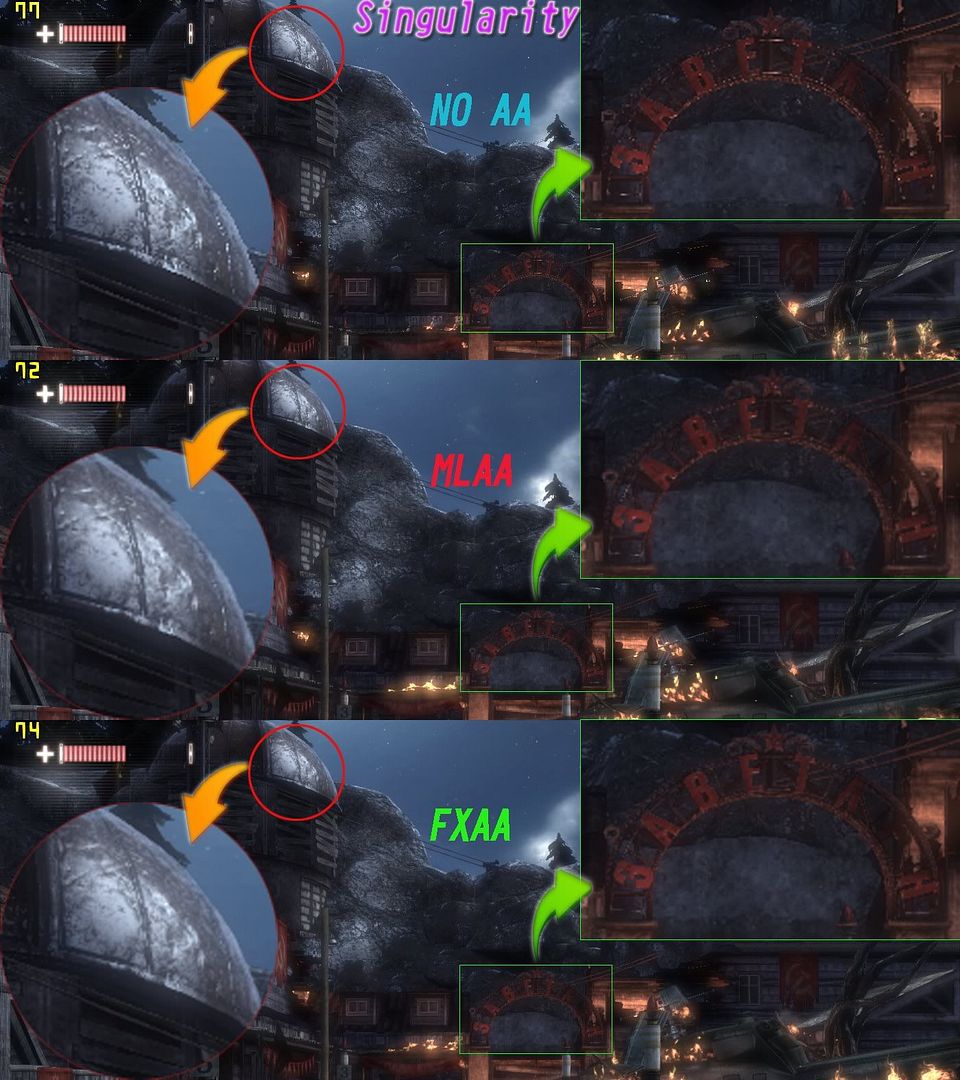
SINGULARITY(angle fixed)
Singularity.jpg


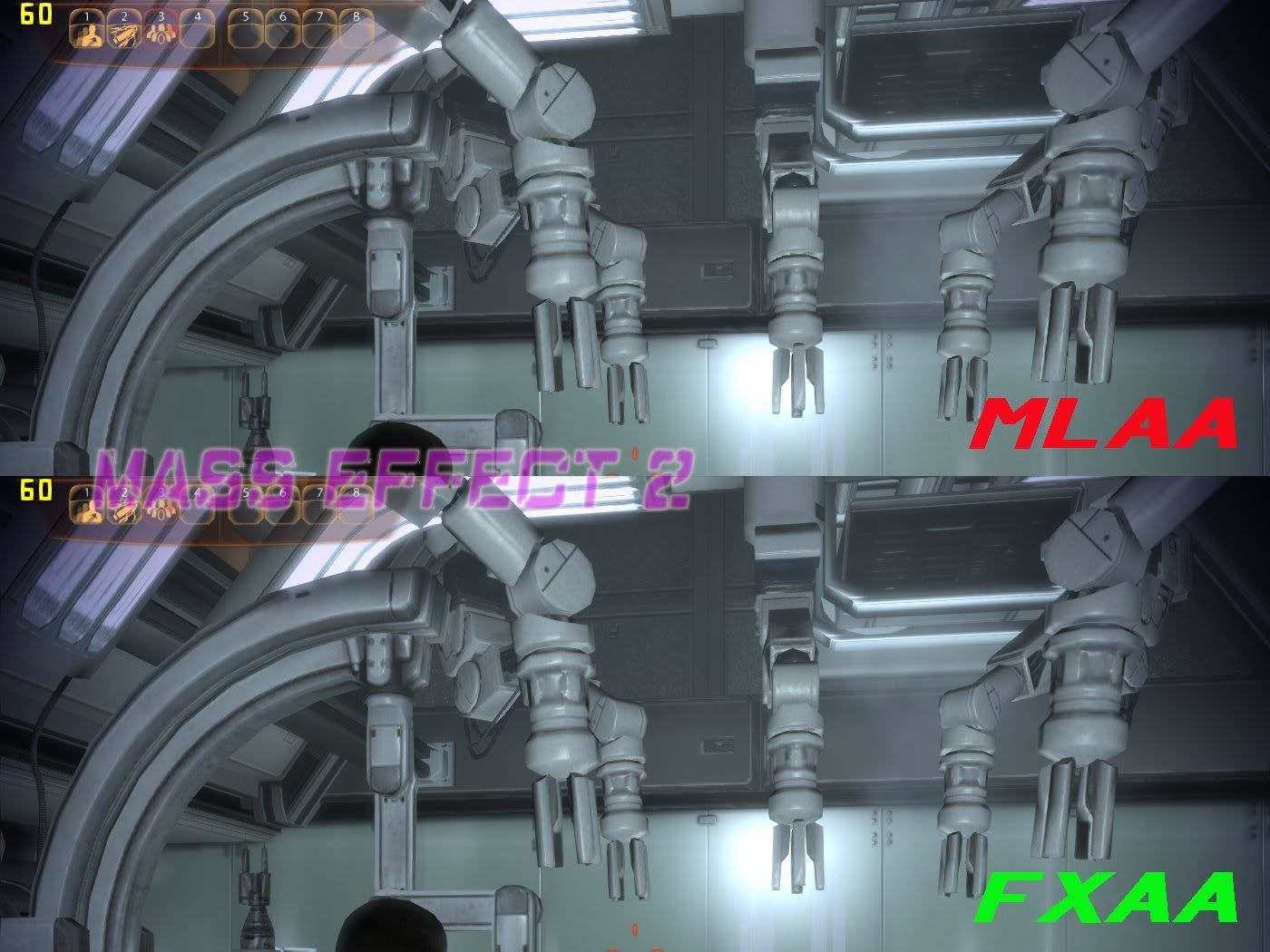
MASS EFFECT 2(angle fixed)
me2-1.jpg


MASS EFFECT 2(angle fixed)
me2-2.jpg


you can download all png files here
http://www.filedropper.com/mlaafxaa_1
 
Nice pics


This thread is a good example of why I don't really care about AA and why I buy mid-range videocards. I have to stare at a stationary picture to notice the difference. Even comparing AA off to the best version is only a small difference to me. Yeah I can see the difference (comparing off to the best) but I hardly notice it while gaming (especially in a fast paced game like most FPS)
 
Great info - first time I've really looked at pics with FXAA, it does a heck of a good job.
 
Really only seems noticeably in Deadspace though. The others are much closer - but both MLAA and FXAA seem to make the lighting a little blurrier (as expected, I guess). Still, impressive improvements for both of them in a couple of those shots.
 
lol, I must be blind at the ripe old age of 23...
 
Nice pics


This thread is a good example of why I don't really care about AA and why I buy mid-range videocards. I have to stare at a stationary picture to notice the difference. Even comparing AA off to the best version is only a small difference to me. Yeah I can see the difference (comparing off to the best) but I hardly notice it while gaming (especially in a fast paced game like most FPS)
you think you wont notice... and then you walk into a room with plants and they're super jaggy from all their leafy curves.

i cant play without at least 4xmsaa anymore.
 
This thread is a good example of why I don't really care about AA and why I buy mid-range videocards. I have to stare at a stationary picture to notice the difference. Even comparing AA off to the best version is only a small difference to me. Yeah I can see the difference (comparing off to the best) but I hardly notice it while gaming (especially in a fast paced game like most FPS)

That's surprising to hear.

Motion is when I notice jaggies the most. They're an unnatural anomaly in the moving image that instantly draws my attention.
 
Man they are both close in my opinion but I think FXAA looks slightly better. Which has the better performance impact as in the less impact? Walkingdog can you run some real world benchmarks with fXAA vs MLAA and post minimum average and maximum using both. If you have time throw in 0xAA and 4xAA.

Great thread bro!
 
In my experience with MLAA I was never too impressed. Don't get me wrong in some games it works well enough but most of the time that wasn't the case. Divinity 2 and Risen come to mind as games where I preferred no AA to MLAA.

I'm not all that impressed with FXAA in Dues EX either but it is better than nothing. I guess that the shitty textures make it more acceptable than it would normally be in other games.

Either one is no replacement for MSAA.
 
Is it me or does MLAA and FXAA look much better than 4AA?

What wasteofmind said. Due to certain choices made in engine development many games have a large number of elements that just don't work with traditional msaa. Pretty sure it's mostly to do with a technique called Deferred rendering, which is integral to Unreal Engine 3. There are ways around it but it seems not many take the time needed to fix that. Here's a fun little read up on it. http://forum.beyond3d.com/showthread.php?t=36790 In games like Bioshock pretty much anything with a shader on it wouldn't get antialiased without some user workaround, and in DX10 mode I think that the shader MLAA/FXAA solutions are all you have. *edit: After rereading that thread after so many years I'm reminded that dx10.1 was supposed to have fixed the "limitation" preventing MSAA from working, so I guess I'm going to blame consoles for this, since no one uses MSAA on consoles + dx9 era hardware the developers probably don't feel like spending the money and time needed to enable it.
 
Last edited:
I look at FXAA as the beginning of the end of AA as we know it, maybe the standardization or the "mainstream" AA.
 
Why do you have to roll your eyes? It's very true if you think about it. AA is a complex thing to most noobs, most people just say I see jaggies or I wanna get rid of them. FXAA is implemented in the game and is pretty easy and looks and performs decent. I personally like the more intricate forms, but oh well what can you do?
 
Because FXAA doesn't even do that good of a job of getting rid of jaggies. I would compare it to 2xAA. It does help with jaggies on transparency textures though but still not better than transparency multisampling.

The major downsides aside from the subpar performance is the texture blurring and the larger performance hit than than MSAA with TSAA while not looking half as good.

I have more experience with MLAA than FXAA but I know that there were a few games where I would rather use no AA than MLAA. If the textures in Dues Ex weren't so crappy that the blurring doesn't make much of a difference. I probably wouldn't use FXAA with that either.
 
Last edited:
Nice pics


This thread is a good example of why I don't really care about AA and why I buy mid-range videocards. I have to stare at a stationary picture to notice the difference. Even comparing AA off to the best version is only a small difference to me. Yeah I can see the difference (comparing off to the best) but I hardly notice it while gaming (especially in a fast paced game like most FPS)
AA makes a much larger difference when the image is moving, honestly. The jagged edges of surfaces, trees, grass, little things, etc get really aggravating in motion (for me at least). Even 2x AA can help smooth this out tremendously.
 
I tried FXAA in DS2 again and this time the lighting is good, same as MLAA,
with a few FPS penalty, so there’s no lighting problem at all.
ds2-lightning.jpg
 
In my experience with MLAA I was never too impressed. Don't get me wrong in some games it works well enough but most of the time that wasn't the case. Divinity 2 and Risen come to mind as games where I preferred no AA to MLAA.

I'm not all that impressed with FXAA in Dues EX either but it is better than nothing. I guess that the shitty textures make it more acceptable than it would normally be in other games.

Either one is no replacement for MSAA.

don't know if I'm right,
using MSAA to deal with defered shading, like STALKER or Metro 2033,
will greatly kill the performance, although MSAA can easily retain the details of textures.
 
I understand, I prefer normal MSAA myself image quality wise it still is best, if not by a small margin. But you can't help but notice all the new games since Duke Forever adopting this and implementing it in game, it kinda eliminates the need for basic users to turn on stuff or tweak shit. Hence more mainstream. But it does work and it works fast and efficient, yet maintains almost all of the image quality.
 
Last edited:
The major downsides aside from the subpar performance is the texture blurring and the larger performance hit than than MSAA with TSAA while not looking half as good.

But the whole point is that it works in games that don't support MSAA - so they aren't really competing. And I thought FXAA was a smaller performance hit in any case - that's what [H]'s testing showed, anyway.

FXAA is clearly fast. On every video card we tested, FXAA 1 was faster in F.3.A.R. than traditional 2X MSAA, and 4X MSAA. With the GeForce GTX 580 at 2560x1600, FXAA was 13.3% faster than 2X AA and 52.8% faster than 4X AA. At 1920x1200, the GTX 570 was 24.8% faster with FXAA than 2X AA, and 51.6% faster with FXAA than 4X AA. With the GTX 560 Ti running F.3.A.R. at 1680x1050, FXAA was 23% faster than 2X AA and 50% faster than 4X AA.
 
I understand, I prefer normal AA myself. But you can't help but notice all the new games since Duke Forever adopting this and implementing it in game, it kinda eliminates the need for basic users to turn on stuff or tweak shit. Hence mainstream.
I think you are dumbing it down way too much.

It's a superior AA method in many regards from a technical standpoint, and makes sense as a developer. Mainly, it's much faster than MSAA, and it can used with deferred rendering. And in all likelihood, the quality differences between FXAA and MSAA are not going to be noticeable in action the majority of the time, at least not to the extent that having no AA would be. I can see why many devs would go for MLAA/FXAA.
 
I understand it is technologically superior in some ways, but in other ways it's dumbed down, as with most technology a plus and a negative. It's definitely more developer friendly and easier to implement and just work, hence why I think it will take over the more advanced (or advanced way of selecting if you will) methods.
 
Nice to know someone has a decent AA solution for a deferred shading engine. I'm planning on writing one here pretty soon and am going to attempt implementing this for AA and see how it holds up.
 
Nice pics


This thread is a good example of why I don't really care about AA and why I buy mid-range videocards. I have to stare at a stationary picture to notice the difference. Even comparing AA off to the best version is only a small difference to me. Yeah I can see the difference (comparing off to the best) but I hardly notice it while gaming (especially in a fast paced game like most FPS)

actually, AA one of the things you notice more when the image is moving.
 
I'm not all that impressed with FXAA in Dues EX either but it is better than nothing. I guess that the shitty textures make it more acceptable than it would normally be in other games.

Note that the FXAA implemented in Dues Ex is FXAA 1, so it is certainly not the best implementation of FXAA that exists. FXAA is currently up to version 3.11. - http://timothylottes.blogspot.com/2011/07/fxaa-311-released.html

And I disagree, I think MLAA/FXAA is a replacement for traditional MSAA.
 
Nice to know someone has a decent AA solution for a deferred shading engine. I'm planning on writing one here pretty soon and am going to attempt implementing this for AA and see how it holds up.

MSAA should work in any DX11 engine. So that deferred shader excuse is a bunch of bs.

FXAA is just a lazy half asked method for implementing "anti-aliasing".

And I disagree, I think MLAA/FXAA is a replacement for traditional MSAA.

No offense but based on my experience with AMD's MLAA you would have to be blind to say that.
 
I forgot a game that should be tested-Borderlands,
I played this game with 4x msaa before and annoyed by its jaggies very much.
Now it’s no longer a problem…

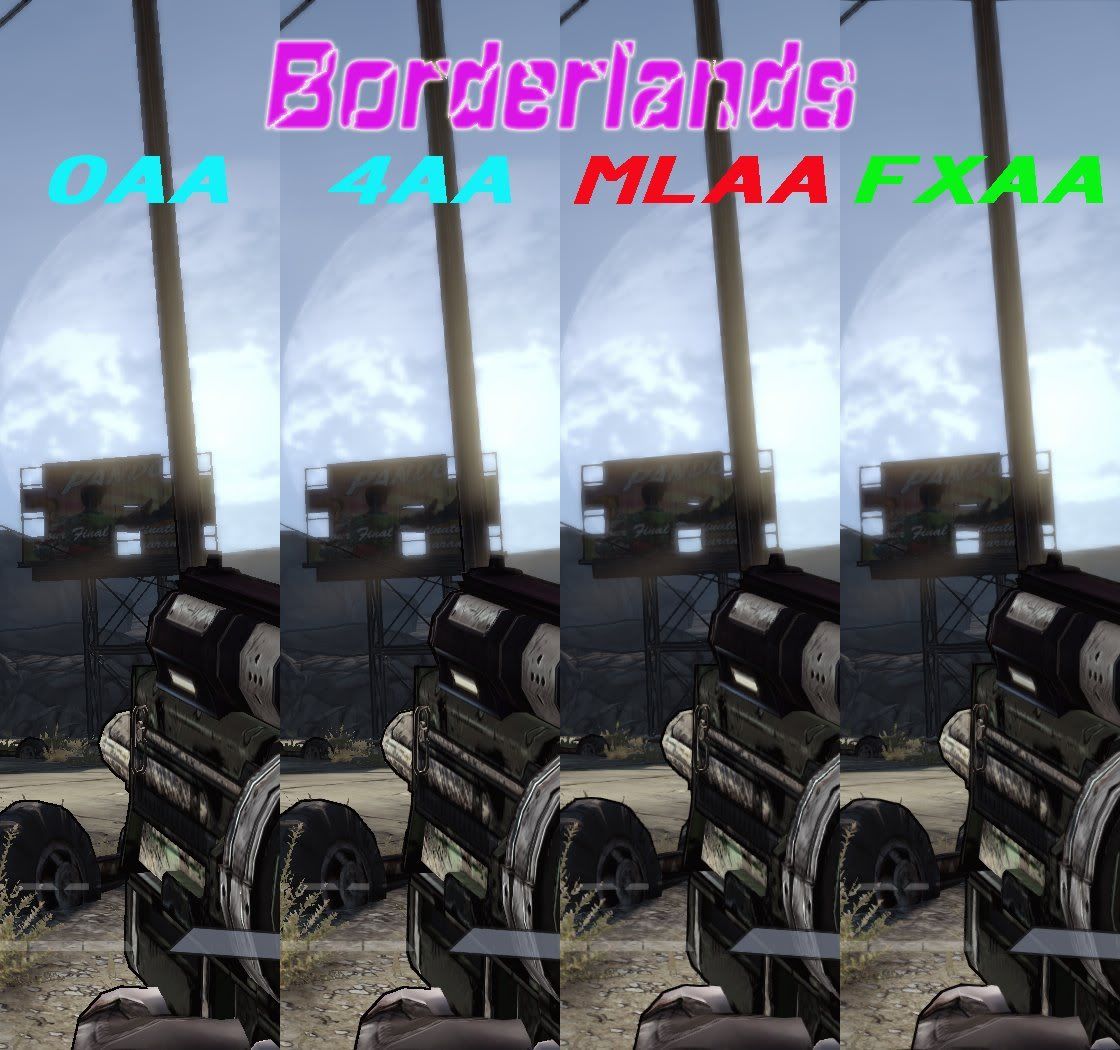
Borderlands
Borderlands-1.jpg


Borderlands:Under most circumstances I think FXAA is a little better than MLAA.
bonderlands-2.jpg


Below are some tests about gaming texture details,
I don’t hope MSAA will be gone or replaced unless one day more “beautiful” AA solutions are presented, until then, MSAA is still my first choice…

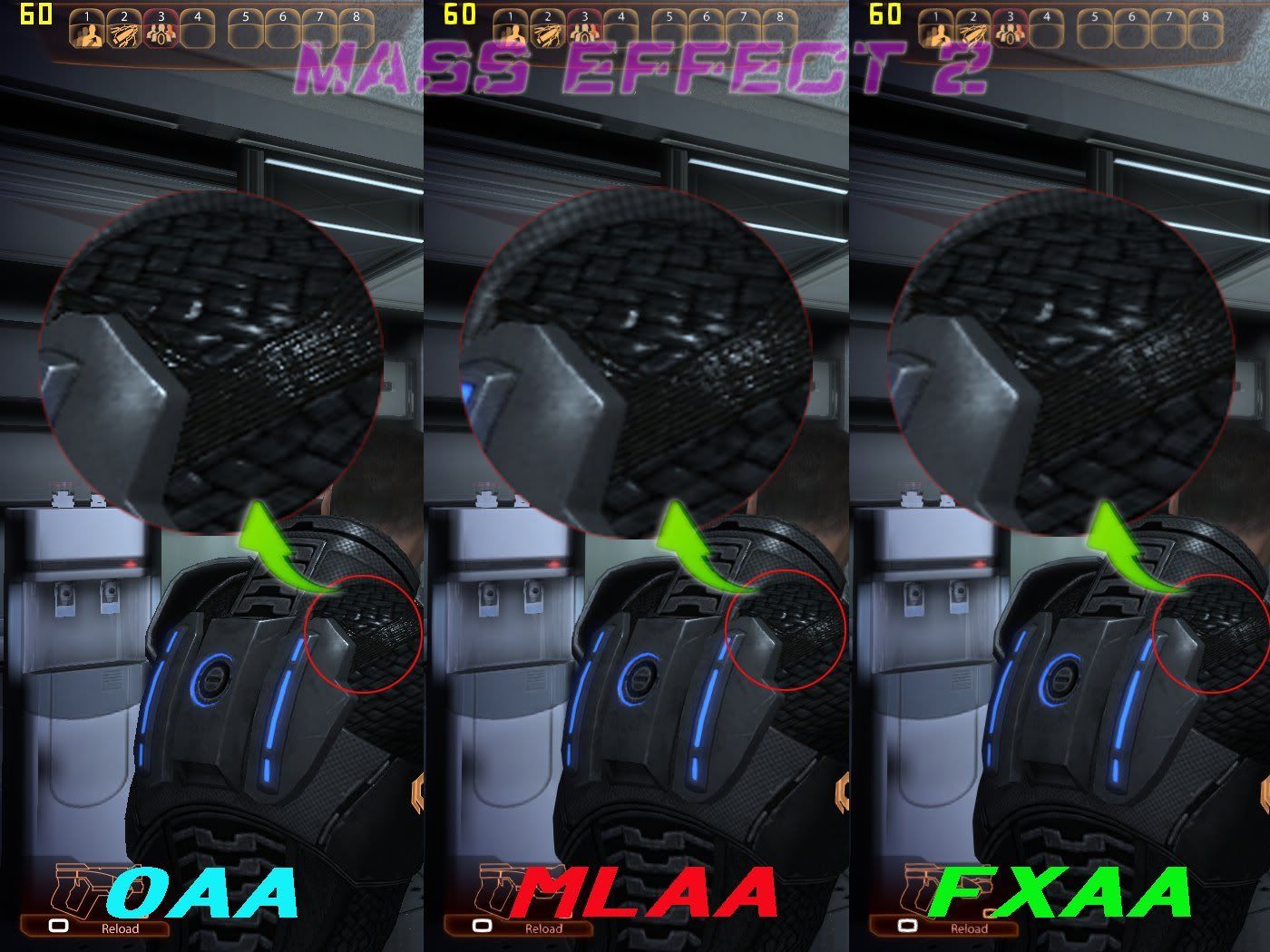
MASS EFFECT 2:”less jaggies, less details”, that’s the rule
me2-3.jpg


Borderlands
borderlands-3.jpg


Singularity:the mountains also an obvious disparity
singularity-2.jpg


PNGs here
http://www.filedropper.com/mlaafxaa2
 
Transparency AA works very well in Borderlands and does a good job of getting rid of those jaggies without blurring the textures.

I don't know about you guys but I like my high resolution textures to look high res. If you want to see just how badly MLAA can look just try a game with good textures like The Witcher 2.

I've been using MSAA for a very long time now and have become accustomed to the very crisp image that it provides. IMO either one of these methods is a step backwards.
 
To be honest ,while playing a game, I would not notice the difference. *shrugs*

Agreed. FXAA seems just a hair better than MLAA, but I think you would be hard pressed to see any real difference in-game. Both remove the jaggies better than 4X MSAA while losing only more detail...that's pretty impressive.

I guess, for me, it would come down to which one has the lesser performance hit.
 
You can't tell much from a screenshot. The only way that you can really judge is with first hand experience while actually gaming or at lest a high resolution video. Once you do that MLAA doesn't look so impressive.

Trust me 4x MSAA with adaptive AA does a better job of removing jaggies than MLAA. Sadly with AMD you can't use transparency aa with DX10 or 11 and MLAA is a pretty shitty replacement.
 
As far as I see it 3 of the game are Unreal Engine 3 titles. At present it seems to be more a test of MLAA vs. FXAA vs. MSAA under one game engine.
 
I play borderlands using MLAA and it feels good,
smoother than adaptive MSAA or SSAA.
In other forum someone said MLAA would have control issues, luckily I didn't encounter any.
I tried adaptive MSAA and SSAA, but jaggies are still there,not better than MSAA,
so I use MLAA instead and it's what I want.
I think everyone will find his best AA solutions while enjoying games~~
 
Back
Top