Burn baby burn! Another native cable down, melting at both ends.
View: https://www.youtube.com/watch?v=ofcdHlKJ9W0
View: https://www.youtube.com/watch?v=ofcdHlKJ9W0
![[H]ard|Forum](/styles/hardforum/xenforo/logo_dark.png)
Follow along with the video below to see how to install our site as a web app on your home screen.
Note: This feature may not be available in some browsers.

You people that keep defending Nvidia and the cable are straight up retarded. The fact It keeps happening and will happen more often as the cards and cable age should be very concerning for all of us.The guy who hates Nvidia managed to toast both ends of his cable on basically the best GPU and PSU on the market... Amazing, truly.

You people that keep defending Nvidia and the cable are straight up retarded. The fact It keeps happening and will happen more often as the cards and cable age should be very concerning for all of us.
I never had a card that yearly maintenance was I guess I better change the cable and hope the ends on my GPU don't melt. Or having to buy a new PSU or device I put on my card to tell me if it's going to melt or not.
Something is very wrong with everything I wrote in that paragraph as none of it should happen. The plug should never be a weak point because it's the easiest thing mathematically to calculate the safety factor on and I think we went form like a 1.8 on pcie to I think 12vhp is only 1.2. It's suboptimal power delivery for 600w and really should have been power caped at 500w but Nvidia wanted a 5090 card but at 500w it wasn't fast enough so they upped it to 600w and said o well. All 5090s should have nee two plug cards.
Burn baby burn! Another native cable down, melting at both ends.
View: https://www.youtube.com/watch?v=ofcdHlKJ9W0
They really should only be on cards that are under 500w or like you said a 30% higher safety factor would make this a no issueThey changed the socket and connectors how many times now and they still burn? I mean 8-pins burned once in a while but it was generally the faulty power delivery on the card that caused this rather than the connector itself. I always felt like if they just made the same12hpwr but 30% bigger it would turn this into a non-issue. Pins and wires too small, too close together, no load balancing on the cards that use them like we used to get on older cards. Just a whole bad plan, although I do appreciate the clean look and ease of use.
Click bite video or he really do stupid things, I am not sure.Something something "user error". Clearly Steve isn't familiar with PC building and the Thermal Grizzly monitor is wrong, because the connector design is flawless.
There have been more reports of burnt and slightly blown up 9800X3Ds than there has been of RTX 5090's. And yet, no one here sees endless threads raging against the big bad green company.The fact It keeps happening and will happen more often as the cards and cable age should be very concerning for all of us.

In his case, I'm inclined to say neither. I'm inclined to say there's a defect in the power cord, or the PSU connector. He said he's used the 5090 before for testing so it is presumably ok. Only 2 wires sending current indicates something pretty serious is wrong. I'd be inclined to blame the cable, since not only is that the part that gets moved around the most but it is also probably the cheapest/least tested.Click bite video or he really do stupid things, I am not sure.

Apples and oranges.There have been more reports of burnt and slightly blown up 9800X3Ds than there has been of RTX 5090's. And yet, no one here sees endless threads raging against the big bad green company.
That being said, no one is defending Nividia or AMD for each of their minuscule issues. And yes, a self immolated CPU or GPU out of tens of thousands is minuscule. It's even more of a nothing-buger when you factor in the fact that some of the CPU and GPU reports are clearly user error.
Oh wait, it twitched! Get'em boys!
View attachment 823532
Could you share those numbers you’ve compiled with us?There have been more reports of burnt and slightly blown up 9800X3Ds than there has been of RTX 5090's.
I'm not invested enough in this dead horse to do the research for you or anyone else, if I'm being brutally honest with you. If you are that invested, it won't take you long to find that information; since you seem to not been paying attention the last few years.Could you share those numbers you’ve compiled with us?
Yes, you have no idea of actual numbers (nor do I) so what you’re saying is simply what you feel the situation is. Got it.I'm not invested enough in this dead horse to do the research for you or anyone else, if I'm being brutally honest with you. If you are that invested, it won't take you long to find that information; since you seem to not been paying attention the last few years.
There have been more reports of burnt and slightly blown up 9800X3Ds than there has been of RTX 5090's. And yet, no one here sees endless threads raging against the big bad green company.
I'm not invested enough in this dead horse to do the research for you or anyone else, if I'm being brutally honest with you. If you are that invested, it won't take you long to find that information; since you seem to not been paying attention the last few years.
No. Based on the publicly documented cases, there have been substantially more reports of melted/burned 12VHPWR connectors than physically burned Ryzen 7 9800X3Ds.
The distinction that matters is that there have been 100+ reports of 9800X3Ds “dying”, but most of those CPUs were not burned. In Gamers Nexus’ early sample of 42 9800X3D failures, only 4 cases showed burns or physical markings. By the end of March 2025, community tracking had grown beyond 100 alleged failures, but reports included BIOS/POST problems and CPUs dying without visible damage, so they can't all be classified as burnouts.
For comparison, the 12VHPWR situation was already much larger:
Nvidia itself said it was aware of about 50 melted-connector cases globally shortly after the RTX 4090 launch. More importantly, NorthridgeFix later reported receiving 20–25 melted RTX 4090s every week, roughly 100 per month, and by April 2024 said it was dealing with roughly 200 affected cards per month. That's one repair business alone, rather than a worldwide count.
Issue Publicly reported scale 9800X3D total failure/death reports 100+ by March 2025 9800X3D reports with actual burning/physical burn marks At least several documented; only 4 of 42 in GN's early dataset RTX 4090 12VHPWR melting — Nvidia acknowledged ~50 cases by Nov. 2022 RTX 4090 12VHPWR melting — NorthridgeFix ~100 repairs/month in late 2023 RTX 4090 12VHPWR melting — NorthridgeFix later ~200 repairs/month by April 2024
So in raw numbers I'd characterize it approximately as:
12VHPWR/RTX 4090 melting: hundreds to potentially thousands of real-world incidents over its lifetime.
9800X3D physical burning: probably dozens rather than hundreds based on publicly identifiable cases, although there have been considerably more non-burning CPU failures.
There's another important difference: the infamous first severely burned 9800X3D that Gamers Nexus physically investigated appears to have been caused by the CPU being misaligned in the AM5 socket, allowing VDDCR pins to contact ground, rather than the CPU spontaneously overheating. Other later 9800X3D failures—particularly on ASRock boards—appear to be a separate phenomenon and remain harder to categorize.
So if someone is claiming “more 9800X3Ds have burned than 12VHPWR connectors,” I don't see evidence supporting that claim. The available evidence points quite strongly in the opposite direction.
If you want, I can also try to produce a best-estimate total number of burned 9800X3Ds vs melted 12VHPWR/12V-2×6 connectors through September 2026, going through the reported cases and eliminating duplicates.
Yes. After digging through the available case compilations, repair-shop data, manufacturer statements and Reddit reports, the gap looks much larger than the raw headlines suggest.
My best estimate as of 4 September 2026 is:
So I would estimate there have been roughly 10–50 times as many melted 16-pin connector incidents as physically burned 9800X3Ds.
Failure type Best estimate of physically burned/melted incidents Confidence Ryzen 7 9800X3D physically burned/scorched ~20–50 publicly documented cases Medium-low 12VHPWR / 12V-2×6 melted connector incidents at least ~450–500 documented cases High for the minimum Likely real-world 12VHPWR / 12V-2×6 total ~1,000–2,000+ incidents Medium-low
9800X3D: probably ~20–50 actual burn cases
The biggest source of confusion is that people routinely describe a dead 9800X3D as “fried”, even when there is no physical burning.
Gamers Nexus' original carefully reviewed dataset contained 42 reported 9800X3D failures. Only four of those 42 had burns or physical markings — about 9.5%. GN specifically separated the scorch-mark cases from BIOS/no-POST failures.
By March 31, 2025, the community database had grown to 108 9800X3D failure reports, but Tom's Hardware explicitly corrected its coverage to point out that those weren't necessarily dead CPUs; some were boot problems.
The problem continued growing. By October 2025, reporting around the ASRock situation was discussing roughly 300 affected systems, although again this was the broader CPU-failure problem rather than 300 burned CPUs.
There's also a particularly useful later dataset. In June 2026, one Reddit researcher searched a full year of Reddit posts and then manually removed false positives and duplicates. They found 207 AM5 X3D CPU-death reports, of which 139 involved the 9800X3D. The search criteria included dead, fried, RMA, no-POST, black-screen and burn-mark reports, so the 139 number absolutely cannot be treated as 139 burns.
And physical-burn reports definitely continued into 2026. For example, a January 2026 9800X3D showed a visible frying mark after roughly a year in an ASRock X870 Nova. Another August 2026 case showed visible burned patterns on a 9800X3D used with an ASUS X670E board.
Using the approximately 5–10% physical-damage proportion seen in the better-documented early cases against the several hundred overall failures gives a central estimate around 25–40 visibly damaged CPUs.
I'd therefore use:
9800X3D physically burned/scorched: ~20–50 cases
rather than claiming that the hundreds of "dead 9800X3D" reports were all burnouts.
12VHPWR: we can establish nearly 500 without much estimating
This side is much easier because there are some unusually good hard numbers.
First, Nvidia itself acknowledged approximately 50 melted RTX 4090 connector cases globally in November 2022. Gamers Nexus calculated that this represented roughly a 0.04–0.05% failure rate among approximately 125,000 early RTX 4090s.
Then came CableMod.
The U.S. Consumer Product Safety Commission recorded 272 reports of CableMod 12VHPWR angled adapters becoming loose, overheating and melting into GPUs. This isn't a Reddit estimate — it's the incident count used in the official February 8, 2024 recall.
That's already:
50 + 272 = 322 incidents
before counting the huge number of ordinary PSU cables and Nvidia adapters.
There's now also an ongoing community database maintained by MODDIY. Importantly, it keeps the recalled CableMod adapter incidents in a separate category, reducing the duplication problem. It currently lists 232 recalled CableMod-adapter melting cases separately.
For ordinary connector/cable incidents, its database recorded 64 12VHPWR melting cases during 2025 alone.
I counted its 2026 entries through September 3, 2026 and get approximately 81 additional 12VHPWR/12V-2×6 incidents. The database includes everything from RTX 4090s to RTX 5090s and even some Radeon cards using the connector.
It also contains another roughly two dozen qualifying cases from 2022–2024 outside its special CableMod-recall section.
After deliberately allowing for possible duplication between the Nvidia, CableMod, repair-shop and community figures, I think a defensible statement is:
And that's a floor, not an estimate of the true worldwide number.At least ~450–500 distinct 12VHPWR/12V-2×6 melting incidents are publicly documented.
The repair-shop numbers suggest the actual connector total is much higher
This is where the difference becomes striking.
NorthridgeFix was receiving approximately 20–25 RTX 4090s with melted connectors per week by November 2023 — roughly 100 per month.
By March/April 2024, that one repair business reported replacing approximately 200 melted RTX 4090 connectors in a single month and showed a box containing the removed connectors.
These weren't 200 internet posts. They were actual GPUs that had arrived at one repair facility.
And the problem didn't simply vanish. NorthridgeFix was still publishing repairs of melted RTX 4090 connectors in January 2026.
So even though I wouldn't multiply "200/month" by several years — that would make an unjustifiably large assumption — the fact that one shop alone physically handled hundreds of affected GPUs makes a worldwide total exceeding 1,000 melted connectors very plausible.
My working estimate would therefore be roughly:
12VHPWR/12V-2×6 actual melting incidents worldwide: ~1,000–2,000+, possibly substantially higher.
Bottom line
I'd revise my previous comparison to approximately:
9800X3D
12VHPWR / 12V-2×6
- Several hundred reports of CPUs dying/no longer POSTing.
- Probably ~20–50 reports involving genuine visible burning/scorching/socket damage.
- Some of those physical failures have plausible causes unrelated to the wider ASRock issue; GN's famous catastrophically burned MSI example was most likely caused by the CPU being improperly seated.
So no — the 9800X3D has not come close to overtaking 12VHPWR in physical burn incidents. Even if I took the high end of my 9800X3D estimate (50) and the absolute conservative floor for 12VHPWR (~450), the connector has about 9× as many documented physical incidents.
- ~450–500+ incidents can be substantiated relatively conservatively from documented datasets.
- Hundreds of physical repairs were handled by a single repair business.
- A reasonable worldwide estimate is 1,000–2,000+ actual melting incidents.
If we compare my central estimates — roughly 30–40 burned 9800X3Ds versus 1,000+ melted 16-pin connectors — you're looking at something closer to 25–35× as many connector failures.
And Nvidia mods have been actively deleting burned connector posts on the main Nvidia subreddit. It's been rare for me to catch one before those mods delete them, but they still pop up there now and then.Slapped it into chatgpt and here's the answer. (question was "have there been more reports of burnt 9800X3Ds than there has been of 12vhpwr cables?")
And this is only the officially recognised cases.
The extra thing it asked if I wanted to do in the bottom line.
Nope not at all the same. Nice try though. A CPU or mb having a problem inside the silicone or part of the power delivery system is something I can go well shit happens as it is a lot harder to deal with manufacturing defects that only effects some units (which btw is the only reason I didn't go with asrock and went with msi) then it is to ues math and know electrical engineering to make a power delivery system have a higher safety factor then 1.2. that's only 20% overhead when it works perfectly. So let's say each connection point is slightly worn out and at 95% of spec. Well now that 1.2 sf down to right around 1......now the plug starts heating up slightly and it gets worse till it melts.There have been more reports of burnt and slightly blown up 9800X3Ds than there has been of RTX 5090's. And yet, no one here sees endless threads raging against the big bad green company.
That being said, no one is defending Nividia or AMD for each of their minuscule issues. And yes, a self immolated CPU or GPU out of tens of thousands is minuscule. It's even more of a nothing-buger when you factor in the fact that some of the CPU and GPU reports are clearly user error.
Oh wait, it twitched! Get'em boys!
View attachment 823532
Either he will question this research as AI Slop or he will go back into hiding until he sees thisSlapped it into chatgpt and here's the answer. (question was "have there been more reports of burnt 9800X3Ds than there has been of 12vhpwr cables?")
And this is only the officially recognised cases.
The extra thing it asked if I wanted to do in the bottom line.


Not disagreeing or agreeing with the conclusion, but it would be nice if the response had direct link references to cross check all of the data.Slapped it into chatgpt and here's the answer. (question was "have there been more reports of burnt 9800X3Ds than there has been of 12vhpwr cables?")
...
If you cut/paste the question I asked into chatpgt it'll probably come up with the same/similar response with references. 4.6 set to high.Not disagreeing or agreeing with the conclusion, but it would be nice if the response had direct link references to cross check all of the data.
heck i'm still wondering why they made the new connectors pegs half the size as the 'ol standard size and at the same time, spec'd it to handle double the power?
i guess the more they burn, the more they sell?
View attachment 823787

2 12v2x6 connectors for any card that can use more than 450 watts, and 3 connectors for more than 900 watts. That's what they should do. The other thing is for the custom cards, don't tie everything into a common bus. It can even be advertised as a feature- far more robust power delivery than reference cards.The other thing that makes this even dumber, is Nvidia prevents OEMs/partners from offering a choice of connectors. If Asus or whoever offered a model with multiple 8 pins, or an actually better connector, I would have paid more given the chance.
At this rate, it looks like Nvidia is just going to keep doubling down on this failure.
Has anyone actually run the numbers on this idea. Or run a spice simulation?The other thing is for the custom cards, don't tie everything into a common bus. It can even be advertised as a feature- far more robust power delivery than reference cards.
That does seem to be an issue for the "just do separate pin loads!" crowd. The way a modern card works, I can't think how that would be done without more expensive hardware. There's no way to evenly divide the component load across pins, particularly since there are different VRMs for different things (core, memory, etc) that aren't all loaded evenly. So you'd realistically have to have the card made where the pins come in, go through a current balancing setup, then get hooked to a combined bus that goes out to all the components. It wouldn't be as cheap or easy as just knocking a resistor on a pin or separating VRMs per pin as people like to say. It would be a whole thing to balance everything.Has anyone actually run the numbers on this idea. Or run a spice simulation?
Every time i see this idea I have a hard time seeing how this would help. The theory is that each VRM gets its own pin from the connector, and the VRMs would be setup to load balance, meaning each pin would be forced to use the same amount of current even if the pin has a lot of contact resistance? Did I get that right?


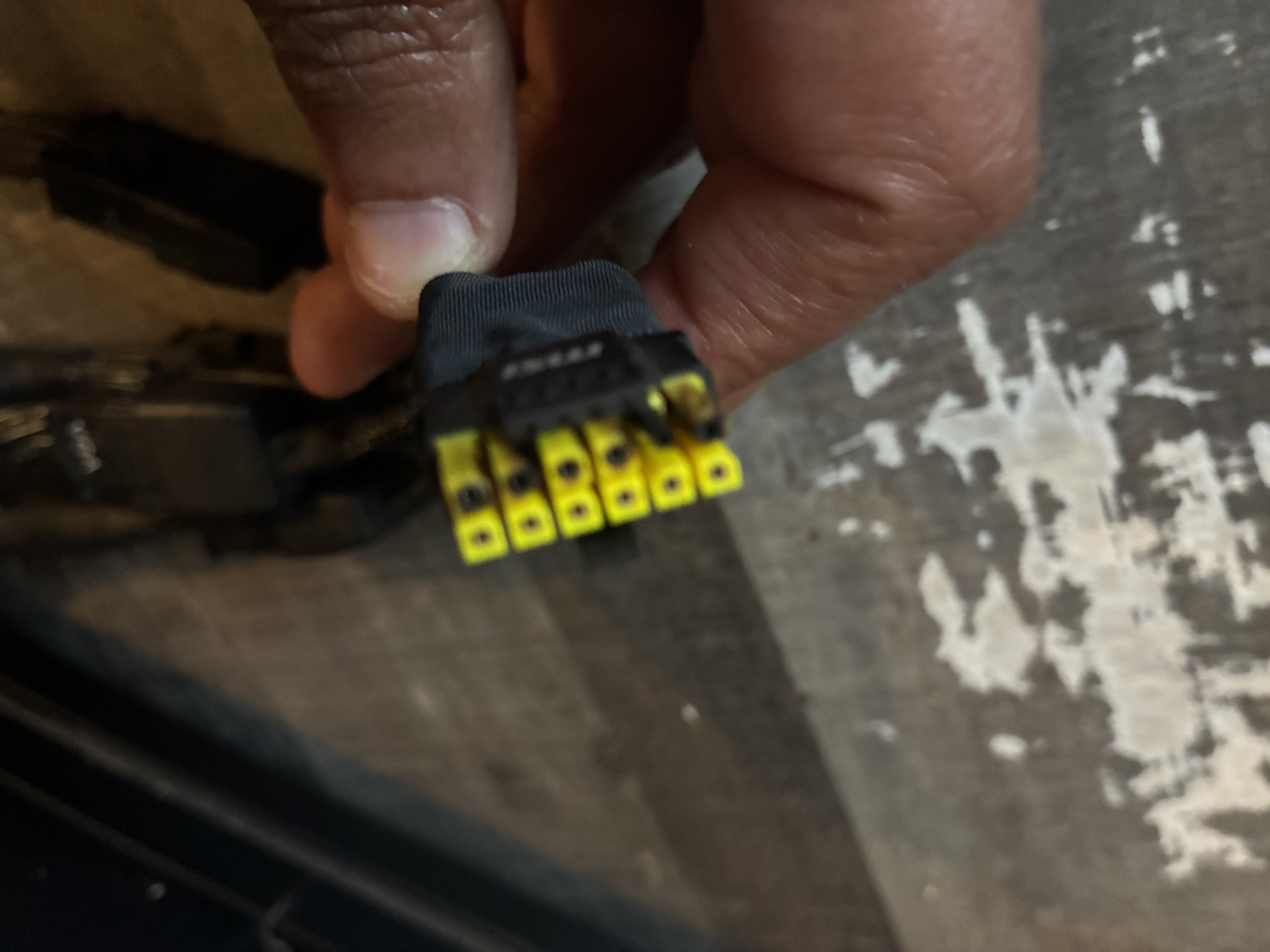
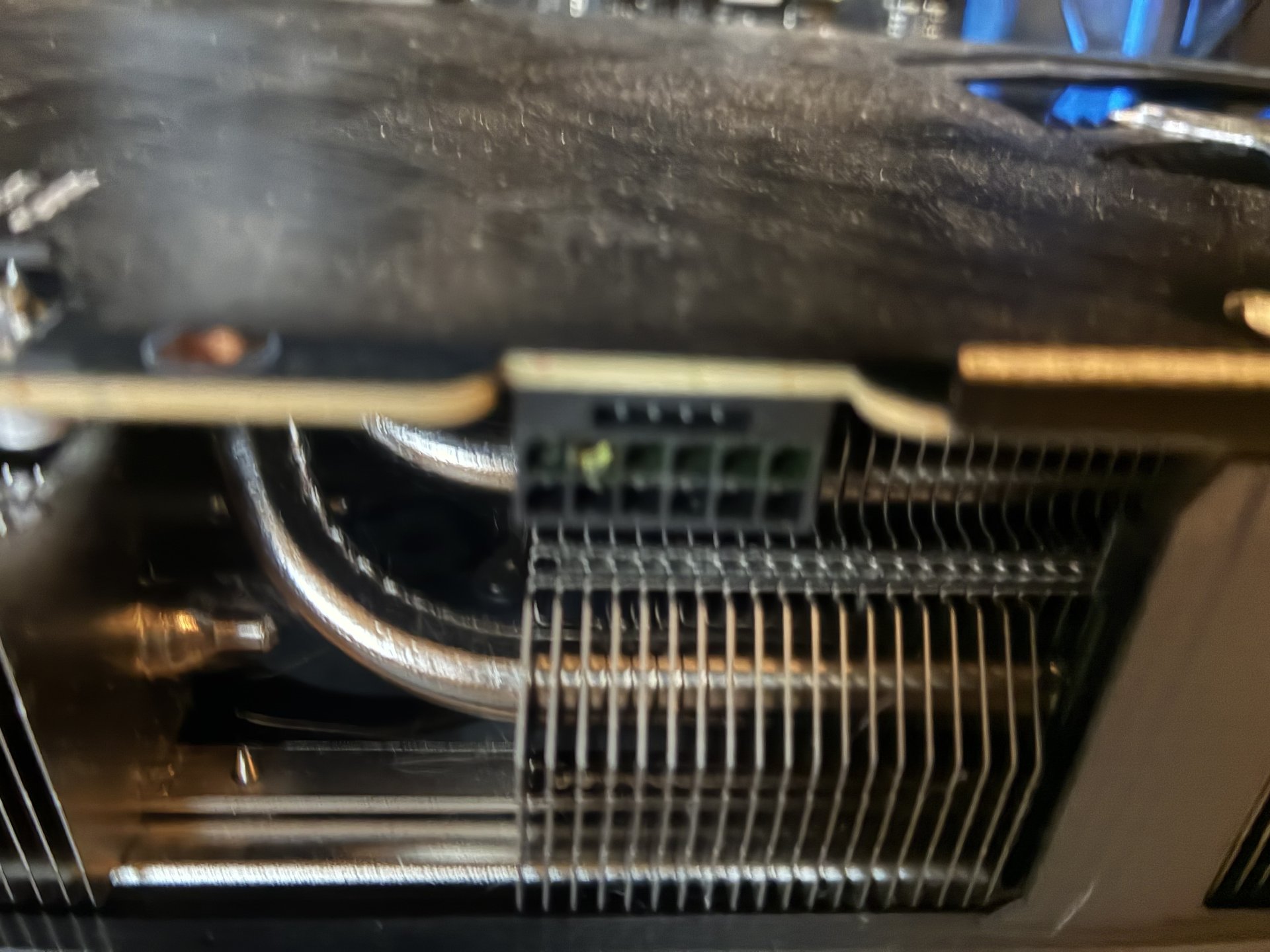
Ouch. Hopefully it's repairable. I'll be sure to have the Asus monitoring utility going whenever I get around to trying out DLSS5 & set it to shut down my rig if current goes too high on a pin.so while using dlss5 and my card drawing a ton of watts over 600+
my card got cooked just moments ago
View attachment 823924View attachment 823925
something just kept smelling funny, i thought it was meOuch. Hopefully it's repairable. I'll be sure to have the Asus monitoring utility going whenever I get around to trying out DLSS5 & set it to shut down my rig if current goes too high on a pin.
it was certainly solid streaming consistently pulling above 600 wattsOuch. Hopefully it's repairable. I'll be sure to have the Asus monitoring utility going whenever I get around to trying out DLSS5 & set it to shut down my rig if current goes too high on a pin.
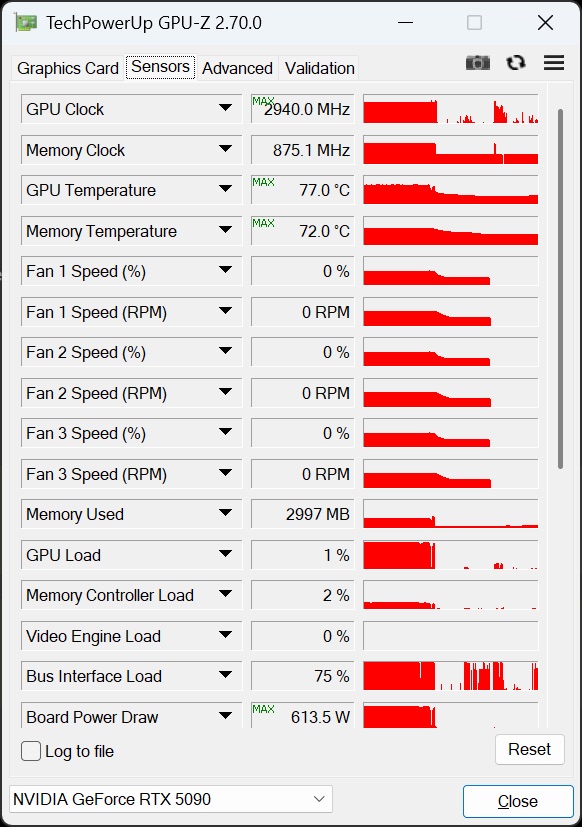
Blurry photos, but RIP.
I sleep a bit better at night after having added a TG Wireview Pro but eh, I'm still not confident I won't have issues as I intend to keep the card for a long time in this economy.
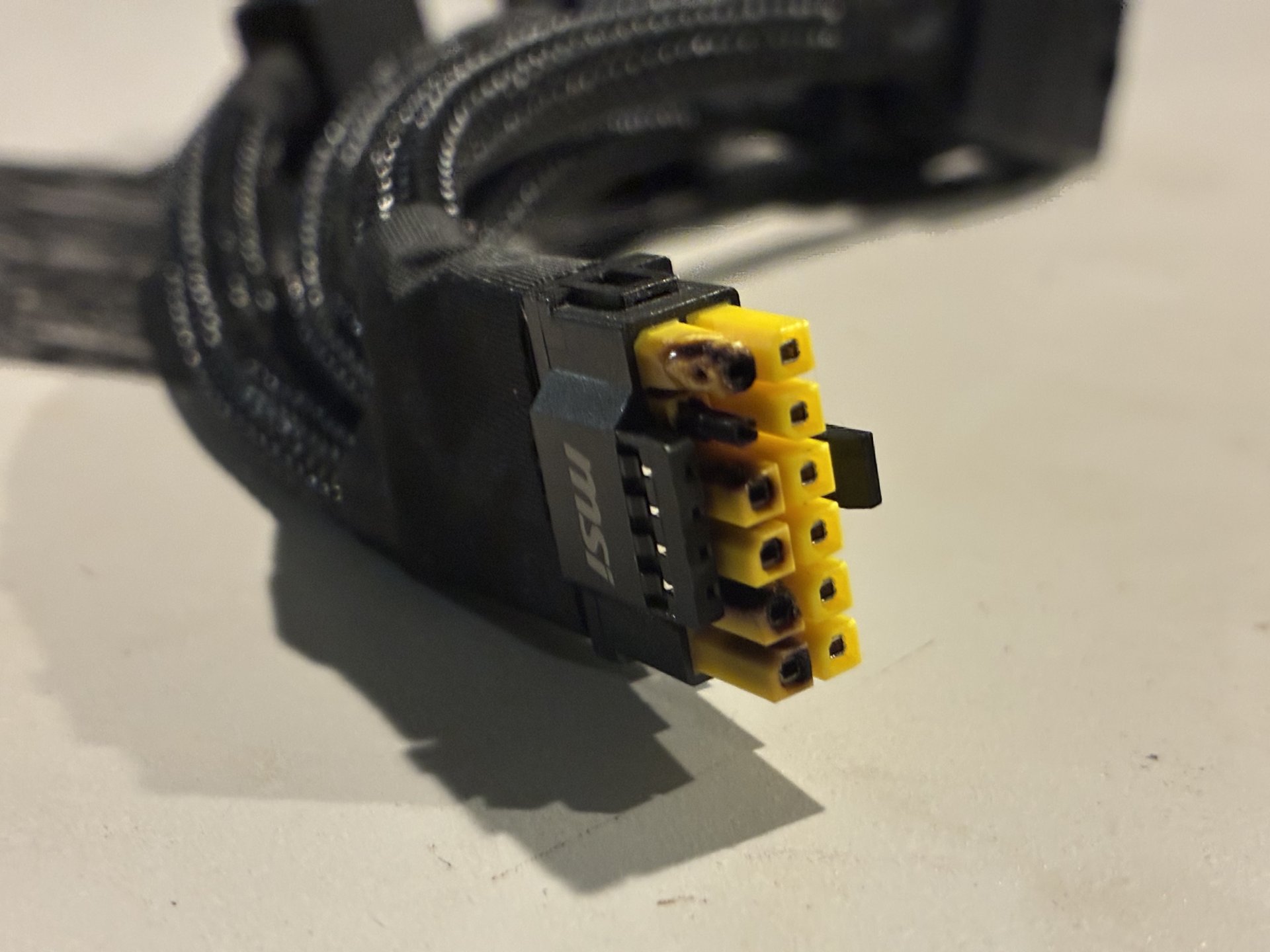
Damn, that sucks.so while using dlss5 and my card drawing a ton of watts over 600+
my card got cooked just moments ago
View attachment 823924View attachment 823925
I don't know why it's been so slow to adopt 24V's.24v = solved
You'd need new, incompatible, PSUs. With any new 12v standard, adapters are a thing. You can make one cable format work with another. Sure eventually you end up not being able to do that, you aren't getting old school 4-pin Molex to 12vhpwr. However it is a slow transition, so people don't need a new PSU.I don't know why it's been so slow to adopt 24V's.
Pressing F to pay respects.so while using dlss5 and my card drawing a ton of watts over 600+
my card got cooked just moments ago
View attachment 823924View attachment 823925