• Some users have recently had their accounts hijacked. It seems that the now defunct EVGA forums might have compromised your password there and seems many are using the same PW here. We would suggest you UPDATE YOUR PASSWORD and TURN ON 2FA for your account here to further secure it. None of the compromised accounts had 2FA turned on.
    Once you have enabled 2FA, your account will be updated soon to show a badge, letting other members know that you use 2FA to protect your account. This should be beneficial for everyone that uses FSFT.

How AI will fail

To be fair, that's what these companies are primarily pushing to the public so that's what the public knows. The other products are in the background and not being heavily advertised to most of the population because they're industry specific. If you work in medical imaging you know all about the AI use there but most of the public is clueless. If these people were actually spreading the advertising dollars around and showing everyone what some of the data centre load was serving then maybe it would help their image. But, they won't do that because they want to bump those token numbers as high as possible and the more normies they have making funny pictures of their pets the better for their token numbers. This is all to help train the AI and give a big token number to investors as to why they need those data centre dollars to be spent.

the other side of that is you have models based on LLM (transformer) architecture/model/idea that don't do language/chat at all - genomics/protein folding/robotics/finance etc use customized LLM models (yes LLM models like ATM machine 😁) - and the development/furtherment of public facing 'normie LLMs'/chatbots/etc do help further these as well edit: it's the transformers really it's using from LLMs that are then customized, not the LLMs themselves
 
Last edited:
Can anyone explain the difference between the software running in a Tesla car vs a LLM?

Same as I explain above - it has the transformer from an LLM but instead of chat it uses it to match to/decide things about physics/spatial awareness vs chat/language - so instead of in your head imagining blocks of words matching to one word/the next word/related word imagine it with things like tree/pedestrian/acceleration/etc - and it does these with images of the things like a tree or pedestrian - and it learns non-image things (like acceleration) from comparing multiple images of things (like a tree passing by) and figuring out 'acceleration' from the difference of the images and what must be happening in between them to make them look different

And just think of the transformer as the algo of matching/processing/predicting/etc

Edit: to add to that - so during training the model has no concept of 'acceleration' - it can only learn it by 'learning to run' and then 'running past a tree' to then see how that resulting 'mental head image' it acquires doing so matches the two different input images of a tree passing by - to then recognize the difference between those two photos is 'running by'/acceleration

and it learns to 'run' because at first in training it does nothing, then just sits up, then flops around a bunch of times, then gets up and falls over etc - and each successful model/run that is or closer to what the designer wants, is used for the next 'learn to get up and run' model/trial run - until through enough trial and error and 'survival of the most correct' - it learns 'running' - but also obviously with a Tesla you're giving it/the model the inputs/capabilities of a car not a human so it's 'driving' instead of 'running'

and it's not just one transformer/one algo/one matching process in total that's occurring when doing Tesla FSD - it's multiple going on simultaneously, all trained from multiple/different models - and then to coordinate/orchestrate all those different transformers/algos together in real-time is the FSD algo - which itself was modeled/trained on 'orchestrate and coordinate all these other transformers/algos together in real-time'

Double edit: and then to add even more and make it even more crazy - that initial image of 'a tree passing by' that it's fed - in order for the model to have a 3D arena to 'flop around and learn to run in' - it first has to actually design/create the 3D arena itself by 'randomly drawing/creating' the same as 'flopping around' until it accurately creates a 3D arena matching the input/tree photo that it can then learn to 'run past' until it finally matches and understands the tree photo - it's fed a bunch of descriptive/annotated and etc data attached to the inputs to help with this 'random drawing' phase (as well as the 'get up and run' phase)
 
Last edited:

d09a6a55-4535-473c-b8dc-8c7327b76302_999x1351.jpg


Economists don't know shit.
 
I remember when people said that people would never have their own personal computers in their house as well. Honestly, I do not understand the train of thought behind your argument.
This.

When the automobile came along, people opined about how that will fail because a horse can go places that the automobile can’t. Same for automatic starters. Air conditioning, who needs that when you can buy ice and ceiling fans. Electricity in the home. Total failure. Mobile phones, no one will want those. Personal computers. The internet, yeah that will go away for sure.

AI inference? Just the latest in a long line.
 
This.

When the automobile came along, people opined about how that will fail because a horse can go places that the automobile can’t. Same for automatic starters. Air conditioning, who needs that when you can buy ice and ceiling fans. Electricity in the home. Total failure. Mobile phones, no one will want those. Personal computers. The internet, yeah that will go away for sure.

AI inference? Just the latest in a long line.
I agree, but AI is something different—the things you mention are tools that can be used by humans, whereas AI will be a tool that uses humans, and depending on how it develops, this could become “scary” in some aspects.
 

Ford had to hire back former engineers to fix mistakes made by its automated systems
https://www.theverge.com/transportation/956316/ford-quality-jd-power-ranking-ai-automated-mistakes

To celebrate its new status as No. 1 in JD Power’s initial quality ranking among mainstream automakers, Ford is opening up about the challenges it has faced in recent years, especially around its reliance on automated systems in production and design. It turns out that those automated systems were not as robust as previously assumed, requiring Ford to hire experienced technicians — sometimes bringing back former employees — to correct errors made by the company’s robots.
In Ford’s view, AI is both powerful and prone to pitfalls. Its effectiveness depends entirely on the quality of the data used to train the AI models. In addition, the automaker underestimated the value of the institutional knowledge accumulated by its more veteran engineers who had worked through multiple vehicle-development cycles. And this combination of phenomena led to a drop in quality in Ford’s vehicles.
“Mistakenly, we thought that by just introducing artificial intelligence and adjusting the design requirements that we had, that that would produce a high-quality product,” said Charles Poon, VP of vehicle hardware engineering, in a briefing this week with reporters.

“Mistakenly, we thought that by just introducing artificial intelligence and adjusting the design requirements that we had, that that would produce a high-quality product.”
— Charles Poon, Ford’s VP of vehicle hardware engineering
According to Poon, some of the company’s most experienced personnel left before all of their accumulated knowledge could be fully transferred into Ford’s automated systems. That necessitated bringing back some of those employees to retrain those systems, or in some cases, mentor younger engineers who were currently struggling to maintain Ford’s vehicle quality. Poon said that Ford hired, promoted, or brought back over 350 experienced engineers to rebuild that layer of expertise. In addition to guiding younger engineers, they’ve also been tasked with improving the data collection and AI training that underpin Ford’s automated systems.
“That’s where some of our most experienced engineers have had experience solving and identifying those problems before they creep into the system,” Poon said.
Ford currently leads the industry in the number of recalls, and its quality ratings have slipped over the past several years. Those challenges became more pronounced recently, with the difficulties associated with the launches of the Explorer and Aviator, supply-chain disruptions during the covid pandemic, and the noticeable growth in the number of its vehicle recalls.
According to Ford’s COO Kumar Galhotra, the automaker eventually concluded that its approach to quality had become too fragmented. Different departments operated in silos, and the company relied heavily on a “find and fix” philosophy that focused on identifying defects after they appeared and correcting them as quickly as possible. While that approach could address immediate problems, it did not prevent those problems from occurring in the first place.
“We’re moving from that find-and-fix mentality to preventing issues before they occur,” Galhotra said. “We’re focused on enablers and early indicators versus outputs. Stop admiring the problem and start solving it.”
The transformation extends beyond vehicle hardware. Software and digital teams now work much more closely with vehicle engineering, manufacturing, and supply-chain teams, executives said. And Ford is now attempting to combine the speed and flexibility associated with software development with the rigor and validation requirements of automotive-grade engineering.
Historically, this wasn’t always the case. Ford was only discovering software bugs late in the process because it wasn’t fully leveraging the rapid iteration cycles available, Poon said. That said, the automaker couldn’t push out software updates as fast as consumer electronics companies with the mentality that it could “move fast and fix later,” Poon said. Vehicles, unlike smartphones, operate in a safety-critical environment where customers depend on software functioning correctly from the moment the vehicle is delivered. To fix this, Ford created a dedicated 40-person software quality assurance team with the sole responsibility of preventing problems before they occur.
But don’t think that Ford isn’t dedicated to integrating AI into more of its processes. The automaker says it has dramatically expanded its automated testing capabilities, adding more than 100,000 new AI-powered tests designed to identify edge cases and stress software systems under a wide range of conditions. Because the testing framework is highly automated, software changes can be rapidly revalidated even late in development, ensuring that modifications do not introduce new defects.
“Because these tests are highly automated, even if we have a late change in the software, we can rapidly run back through the entire validation process to guarantee it works perfectly well before it reaches the customer,” Poon said. “We’ve established software reliability as its own rigorous disciplines with strict metrics.”
 
Last edited:
So shocked. To be honest, I wish that NO engineers would choose work for Ford so that Ford can bury themselves in the grave they dug. Getting so sick of companies offsetting employees with AI then realizing what a stupid decision that was.
At no point the word fired/offest is in the article, the way it is phrased make it sound they are paying a fortune to bring back for a short time people that retired with full benefit already, which is common in many industry and usually as little to do with AI, just baby boomer retiring leaving gapping instutional knowledge hole, we see it in old school climatisation system and many other sector.

You will see it many case around you, people that retired in the "trades" that get to work as consultant for very large fees.
 
At no point the word fired/offest is in the article, the way it is phrased make it sound they are paying a fortune to bring back for a short time people that retired with full benefit already, which is common in many industry and usually as little to do with AI, just baby boomer retiring leaving gapping instutional knowledge hole, we see it in old school climatisation system and many other sector.

You will see it many case around you, people that retired in the "trades" that get to work as consultant for very large fees.
My apologies. My attention span for reading anything from The Verge is very short.
 
I agree, but AI is something different—the things you mention are tools that can be used by humans, whereas AI will be a tool that uses humans, and depending on how it develops, this could become “scary” in some aspects.
AI is also a tool that is used by humans.
 
I wonder if they fired the Ford executives that thought it was a good idea to replace retiring/leaving highly experienced QA engineers with unproven AI camera systems with no oversight.
 
It will be interesting to see how they handle this problem.

View: https://youtu.be/IPaMKTb5csQ


The easy answer is that THEY won't handle the problem. It'll be up to the people to handle the problem after the fact. Our technological overloads and governments are not at all concerned about safety that gets in the way of making them more money. As the video said ... none of them want to be the one to stop, or slow down, first so they'll all drive us right off the cliff. The question is whether or not the people are willing to grab the handbrake before that happens or if they're too wrapped up in picking sides in a technological and political debate to care which way the car is going.
 
https://archive.is/jqVhE

https://archive.is/jqVhE#selection-529.0-579.184

Companies Are Throttling Employees’ AI Use Because It’s Too Expensive​

Sources and leaks from Amazon, Adobe, Atlassian, Citi, and more show what is really happening with AI right now: companies are trying to reign in AI use as costs spiral out of control.

Companies across tech, entertainment, banking, and many other industries are throttling their employees’ use of AI and pleading with workers to use less powerful models to stop AI costs from spiraling out of control, according to leaked Slack chats, screenshots of internal dashboards, emails, and more material obtained by 404 Media from half a dozen companies including Atlassian, Adobe, and Amazon. In at least one case, AI spending has tripled to more than $15 million a month.
The news shows the looming fallout from companies adopting AI as quickly as possible, and AI providers’ moves to charge enterprises based on how much they use AI rather than a flat fee. Emails obtained by 404 Media even show some companies cutting off access to some AI models altogether in an attempt to stop burning through their AI tokens, and big tech companies like Adobe are ending unlimited access to Claude.
“A lot of people had ideas about how to adjust workflows with lower-reasoning models for certain tasks in order to mitigate token consumption,” an Adobe employee told 404 Media. “But I am not sure that they fully absorbed the news, and I'm not sure the full ramifications are going to be clear to everyone until it goes into effect.” 404 Media granted multiple employees at companies using AI anonymity because they weren’t permitted to speak to the press.
Citi, for example, has shut off access to Claude’s and ChatGPT’s latest models entirely, according to an internal Citi email obtained by 404 Media. That includes Claude Opus 4.6 and 4.7, and GPT-5.5.
💡
Do you know anything else about token spend inside companies? We would love to hear from you. Using a non-work device, you can message Joseph securely on Signal at joseph.404 or Emanuel at emanuel.404
“These models consume significantly more AI Credits per interaction and have been the primary driver of elevated enterprise consumption,” the email reads. The email says Citi disabled the models on June 24 and plans to re-enable them on July 1.
Before shutting off access, Citi sent employees another email asking them to not use the more powerful models unless they absolutely had to.
⚠️ Action needed: Choose the right model for the task (reduce Opus 4.7),” one section of the email reads, referring to one of Claude’s more recent, and token hungry, models. Since AI tokens are now pooled across Citi, the email says, developers with heavier AI-assisted workflows draw more from the shared pools, while lighter users ideally contribute their unused portion, freeing it up for the developers who may need their tokens. “We need everyone to be intentional about model selection to ensure fair access for all users across the enterprise.”
The email points again to Opus 4.7, saying, “Every interaction with Opus 4.7 (and other models in its class such as GPT 5.5) consumes significantly more credits than standard or mid-tier models.” It then provides a breakdown of what Citi employees should use each model for: GPT-5.3-Codex for quick questions, explanations, or simple code generation; the same model or Claude Sonnet 4.6 for code review and “standard chat;” then higher models like Claude Sonnet 4.6 for “architectural reasoning.”


Citi’s changes come directly in response to GitHub moving from a flat subscription model to a usage-based billing one in June, according to the email. The email says Citi is also monitoring daily Copilot usage to find “excessive or anomalous usage patterns early” and has budget controls in place. Citi told 404 Media it has not disabled models and the company is not taking steps to curb usage by allocating workers a certain number of AI tokens. This is despite the email and other screenshots clearly showing Citi blocking access to certain models.
Atlassian, the company behind the popular software product development tool Jira, recently ended unlimited use of AI tools at the company and introduced a dashboard where employees can track how much their AI use costs the company. 404 Media has seen the dashboard, which shows Atlassian went from spending $5 million on things like AWS, Google Cloud, and OpenAI LLMs in the month of August 2025, to more than $15 million in May 2026. The company is on track to spend more than $120 million on AI tools for the fiscal year, the dashboard shows. Atlassian told 404 Media these numbers don’t accurately reflect its AI usage, but declined to say which of the figures were wrong and how.
“I’ve seen a lot of people complaining that they changed their workflow to maximize AI usage, and now they can run out in 2-3 days, especially when using agents or similar or using the latest Claude model. Lots of angsty messages in Slack like ‘now how do I do my job,’” an Atlassian employee told us. “For what it's worth I think it’s insane they were allowing huge amounts of spending on it before, it was only a matter of time before that had to end.”
Inside GitHub things are a bit different. Employees don’t have a limit on token spend, but workers were recently told the company is looking into decreasing token spend by using open source models, a GitHub employee said. The employee told us that GitHub plans to test user-based billing, meaning budgeting AI tool use to individual people instead of teams, projects, or unlimited usage.
At Adobe, unlimited Claude access is not being renewed and will expire on June 30, an Adobe employee said. Workers there were told instead, in essence, try to get everything you can done before that date.
As 404 Media previously reported, Amazon recently shut down an internal company leaderboard which ranked employees based on how much they used AI tools at work. Multiple Amazon employees told us they suspect Amazon shut down the leaderboard because it was encouraging wasteful and expensive AI usage. After Amazon shut down the leaderboard, 404 Media saw a discussion on Amazon’s internal Slack where an employee shared a screenshot showing they had hit a token limit employees seemingly didn’t know existed previously.
“Crazy, we go from no more leaderboard to actual usage limits in two weeks,” one Amazon employee said in a reply on Slack.
An Amazon spokesperson told 404 Media in an email “We encourage employees to use and experiment with AI, and our guidance around AI usage hasn't changed.”
Other companies have burned through their AI tokens. An employee at an entertainment company told 404 Media, “We hit our limit for ChatGPT token use this month for the first time. One developer used almost half the entire company’s allocated pool with no obvious ROI [return on investment].”
Last week 404 Media reported consulting giant Accenture found that much token usage, or ‘chewing,’ is not from supercharged engineers creating lots of code, but people converting PDFs into presentation slides. Accenture is seeing “soaring token spend” among its clients, according to leaked audio 404 Media obtained.
There is an obvious irony—or cold calculation—in Accenture pointing this out. In the audio, senior Accenture staff explained they told their clients to adopt AI as quickly as possible. Now that AI costs have skyrocketed or become unpredictable, Accenture is positioning itself also as the solution to that problem, with one of the employees saying Accenture has a new opportunity regarding its clients: “to really think about token economics.”
Accenture continues to use AI internally for trivial projects, though. Screenshots obtained by 404 Media show an internal tool that lets employees predict which team will win the World Cup. The tool was made with AI, a source with knowledge of the tool said.
“They are still trying to ram AI down our throats at all levels and areas of work,” the source said. “Everyone seems to be trying to outdo each other in finding new ways to waste water and no one is telling us to slow down.”
Adobe, GitHub, and Accenture did not respond to requests for comment.
 

Tesla caps employee AI spending at $200/week except for Grok​

https://electrek.co/2026/07/02/tesla-caps-employee-ai-spending-200-week/

Tesla told staff it will impose a $200-per-week limit on employee AI spending starting July 6, according to an internal memo reported by The Information (paywall).

The cap lands just months after Tesla pushed employees to use AI more aggressively, a sign that even companies betting their future on the technology are struggling to control its costs.

From adoption push to spending cap in months​

The reversal is fast. Over the past six months, Tesla leadership worked to move scattered employee AI usage onto a companywide approach with approved models and formal security policies, then quickly followed with guardrails on spending, according to people who worked with the technology.

Some teams even built internal dashboards that ranked employees by token consumption to encourage more usage. That encouragement worked a little too well: software engineers were often consuming “thousands of dollars’ worth of tokens each week,” according to two people familiar with the usage. Under the new policy, workers will need sign-off to spend above $200 per week, though the memo says the tally excludes beta versions of xAI products.

In short, Musk is forcing Tesla to cut its AI spending except for spending that goes into the pockets of his other company.

Tesla’s whiplash mirrors a broader pattern across corporate America. Uber capped employee spending at $1,500 per month after burning through its entire 2026 AI budget by April. Meta, Amazon, and Walmart have all introduced caps or pushed workers toward cheaper models as token-based billing exposes them directly to the cost of every prompt. What’s striking with Tesla is how compressed the arc was, given that it initially lagged some tech giants in formalizing AI usage in the first place.

The xAI catch​

The most revealing detail is what the cap leaves out. The $200 limit excludes beta versions of xAI products, which conveniently steers heavy users toward Elon Musk’s own AI company rather than rivals.

Musk has spent months nudging Tesla staff toward tools tied to his web of companies. After his AI lab began working closely with Cursor in April, he emailed the entire company encouraging employees to try Composer, Cursor’s coding model. SpaceX is now set to acquire Cursor’s parent Anysphere for $60 billion, an all-stock deal expected to close in the current quarter. Tesla engineers also became early testers for unreleased versions of Grok and Composer, with xAI product lead Andrew Milich running feedback discussions in internal Teams channels.

Here’s the problem: it isn’t working. Despite the internal push, Grok is not popular among Tesla staff, with many using Anthropic’s Claude instead, according to four people. That tracks with Tesla’s own product history. We reported last year that Tesla’s Grok integration didn’t even interface with the car’s functions, and Musk himself later admitted xAI was “not built right” just weeks after Tesla invested $2 billion into it.

AI is now the whole thesis​

The internal rollout is high-stakes because Tesla’s entire valuation now rests on AI. Musk has said Tesla’s future value depends on deploying AI at scale across its Robotaxi network and Optimus humanoid robot, not on selling cars, and the company’s revenue has mostly stalled over the past two years.

Tesla has moved beyond engineering, too. It released Nova, an AI tool trained on internal data, to help standardize practices from looking up holidays to troubleshooting factory-line issues. VP of vehicle engineering Lars Moravy said Tesla is folding AI into engineering through an agent with access to the company’s engineering expertise and using AI to detect defects on vehicles coming off the line.

Ford recently did the same and had to hire back QA specialists after realizing that AI was missing quality issues.

The AI security tightening is its own story. Starting in the spring, Tesla restricted access to models outside its internal “Bottle Rocket” platform on company laptops and networks, and held sessions warning staff not to feed confidential data into non-approved systems, part of a company famous for aggressively guarding against leaks, according to the new report.

Electrek’s Take​


Top comment by gary oblock


Look, there are some truly amazing things that can be done by only using AI, like determining how protiens fold. I say more power to those that use AI like this. But for other things, like writing computer code, I think it should never be used. First, it uses immense amounts electricity. Everyone on a site like this knows how important reducing our carbon footprint is. Also, people are quite capable of writting computer code and every dollar spent on something like AI written code is a dollar less going into the general standard of living. The people that might benefit from AI job displacement are not those displaced, rather it's those at top of the corporations and those that own large shares of the corporations that will benefit. The people displaced are not likely to ever earn as much as they did before being displaced. All those dollars spent on AI's power bills will never touch a human hand again.

This is a small operational story that says a lot about the state of Musk’s AI empire.

Tesla spent six months gamifying token consumption, ranking engineers on leaderboards to push adoption, and is now slamming on the brakes because the bill got out of hand. That’s not a considered strategy, it’s the same overcorrection playing out at Uber, Meta, and Walmart, except Tesla is the company telling investors AI justifies a trillion-dollar-plus valuation. If you can’t manage a few thousand dollars of weekly token spend per engineer, questions about scaling AI across a Robotaxi fleet and millions of Optimus robots are fair.

The carve-out for xAI beta products is the main story. Tesla is using an expense policy to funnel employees toward Grok and Composer, the in-house tools, while its own engineers quietly prefer Claude. When you have to use spending limits to win internal market share for your product, that’s not a vote of confidence in the product. It’s the same pattern we’ve watched for two years: Musk siphoning Tesla resources and talent toward xAI, now with the added twist that Cursor is about to belong to SpaceX too.
 
The men selling a competitive product to anthropic and openAI critic their model and sell is.... using the word "admit" here is really strange, he push his alternative.

Palentir does not need the AI bubble to not pop (using some definition of it), they are perfectly fine using open weight model running inside the clients building for what they do all the value they create as an interface user of a model (like Hasan point out in the intro)
 

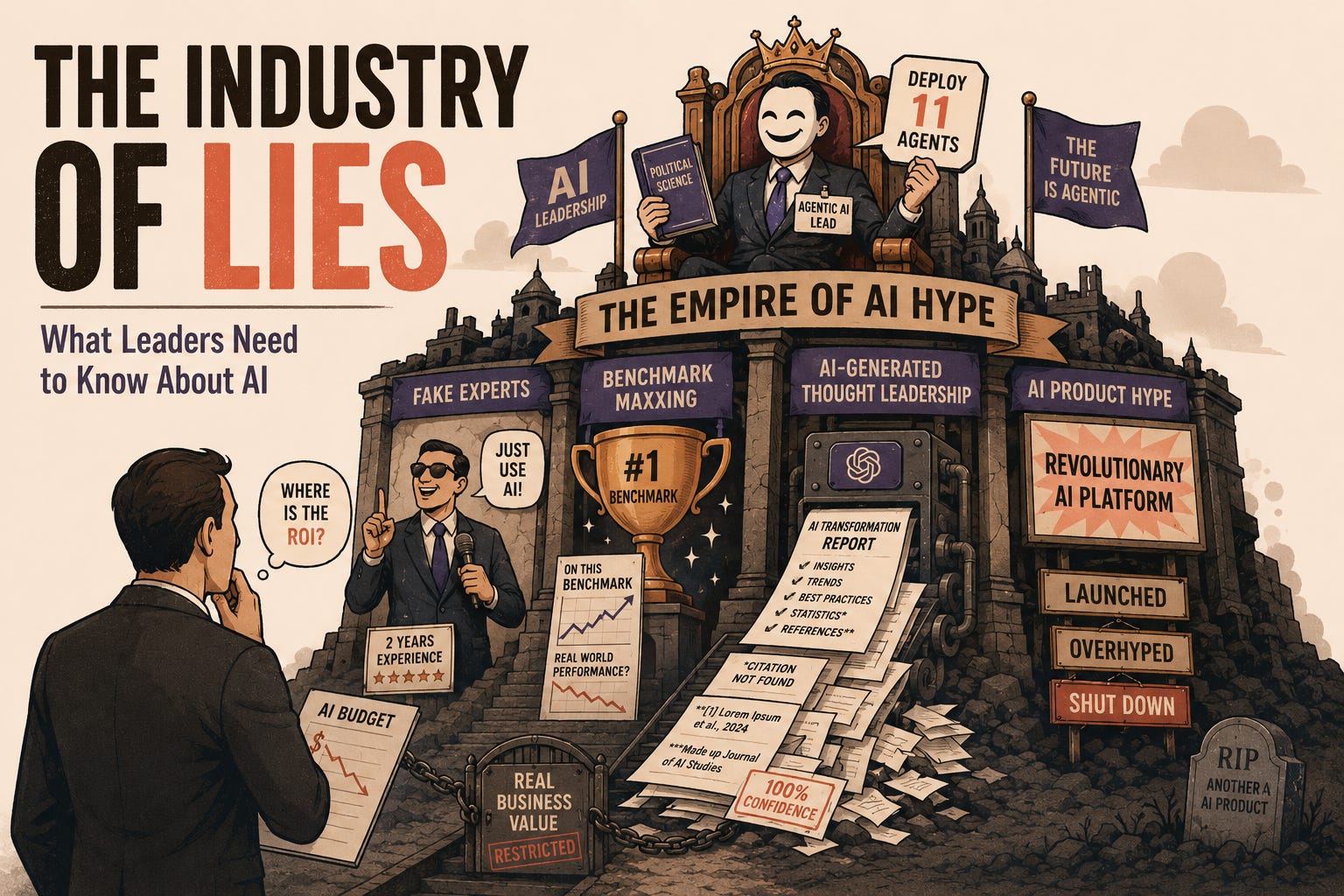
The Industry of Lies, or What Leaders Need to Know About AI​

https://msukhareva.substack.com/p/the-industry-of-lies-or-what-leaders

On unpredictable costs, failed PoCs, resistant employees, and the infrastructure that is not there​


The other day I talked to a department lead who was very eager to adopt AI and introduce it to his employees. He did not have a technical background, and his entire department consists of experts in an area completely unrelated to AI.
He asked me what he should know about AI as a people’s leader, and what the most frequent reasons an AI use case fails are.
s%2F567bddcd-1c45-47a9-9e5b-2c1147a88c1a_1536x1024.jpg

AI is the industry of lies. (image generated by chatGPT)
Since that conversation, I have been thinking about it. What should a people’s leader practically know? Obviously, not that AI is so transformative and revolutionary — they have been hearing that in dozens of presentations. In fact, AI has been somewhat forced on employees:
Accenture now tracks how often senior employees utilize artificial intelligence on a weekly basis, according to recent reports. The firm links these adoption metrics to promotion opportunities for veteran staff, to ensure they embrace the growing role of technology in the workplace.
In recent years, AI has turned into an industry of lies: benchmaxxing, hallucinated consulting reports, overpromising, underdelivering, AI experts who have never heard of a loss function — barely any other area is as filled with lies as AI.
It is not easy to comb through these braids of lies.
What are the real things one needs to know? That is what this article is about.
In this article, I will refer to LLMs as AI, because that is what is frequently understood by it. So further on, we talk exclusively about state-of-the-art LLM-based approaches.

AI is not cheap

One needs to budget for it, and, without proper controls, an AI application that is actually useful can end up costing more than a full-time employee. The other problem is that the prices are not predictable. Three months ago, one might have budgeted roughly €1,100 a month for GitHub Copilot Enterprise for a team of 30 developers. Now, that same budget might not be enough for a single heavy user: since GitHub switched to usage-based billing in June 2026, costs are calculated per token at the API rate of whichever model handled the request — and as reasoning models become the default, individual monthly bills are already being reported in the hundreds. How much one actually needs to budget is also hard to predict: there is no reliable way to calculate the cost upfront.
es%2Fad857354-1761-492a-9e38-3c0af239d47f_1476x540.jpg

$500M on consumption in a month
Many AI tools — particularly coding assistants and enterprise platforms — have moved from flat subscriptions to consumption-based pricing, which means one pays per million tokens. AI APIs are affected too even though they have always been consumption-based. The cost of those tokens has been going up. Anthropic's Claude Fable 5 ships with a new tokenizer that generates roughly 30% more tokens from the same input text, meaning the same system prompt and conversation history that cost 10,000 tokens yesterday costs 13,000 today, with no change in what you're sending. OpenAI's GPT-5.5 is priced at double GPT-5.4 on every billing line.
One can pay per million tokens up to $50.
How much can one do with a million tokens? That is something impossible to predict.
The price includes reasoning tokens — the internal deliberation of the LLM when trying to solve a problem. A response that looks like 500 tokens in the output may have consumed 50,000 or more. The price of every request depends to some extent on the skill of the programmer to word tasks in a way that helps the LLM reason less and produce the solution faster. But, in general, prompting skill is not the decisive factor. What matters more is how much context is sent with every request: the whole chat history, agent descriptions, tools, MCP servers, and system prompts — all of it is billed on every single call. But the most important factor is luck. If the LLM happens to generate the right reasoning traces quickly, you save money. If it does not, it can ramble indefinitely trying to self-correct. The choice of model also matters: some reason longer than others. The banned Fable could burn $50 or more from a single prompt easily.
No one can tell you that your employees need X tokens a month. The best way to figure this out is to calculate what is economically feasible for you: the trade-off between productivity and cost. If your developers run out of quota within three days, two things will happen: they will ship much slower for the rest of the month, or they will use their private accounts. 68% of employees already use personal AI accounts for work tasks, with 57% of them entering sensitive company data and the average cost of a shadow AI data breach is $4.2 million.
All in all, the important steps here are: make the prices and quotas transparent to your team; train developers in best practices for reducing token consumption — prompt optimization, context management, and caching alone can cut costs and consider alternative options, e.g., local deployment of a MiniMax model. A local model will not entirely replace proprietary models, but you can route simpler tasks to them to keep costs down.

Benefit from the heavy competition in AI

AI has become a highly competitive space. Anthropic, OpenAI, and Google are constantly challenging each other. Chinese providers are undermining Western prices massively — releasing capable models available locally, on the cloud, or via API. OpenAI is considering drastic price cuts to avoid losing enterprise market share to Anthropic. You should keep an eye on all of this, diversify your providers, and renegotiate offers.
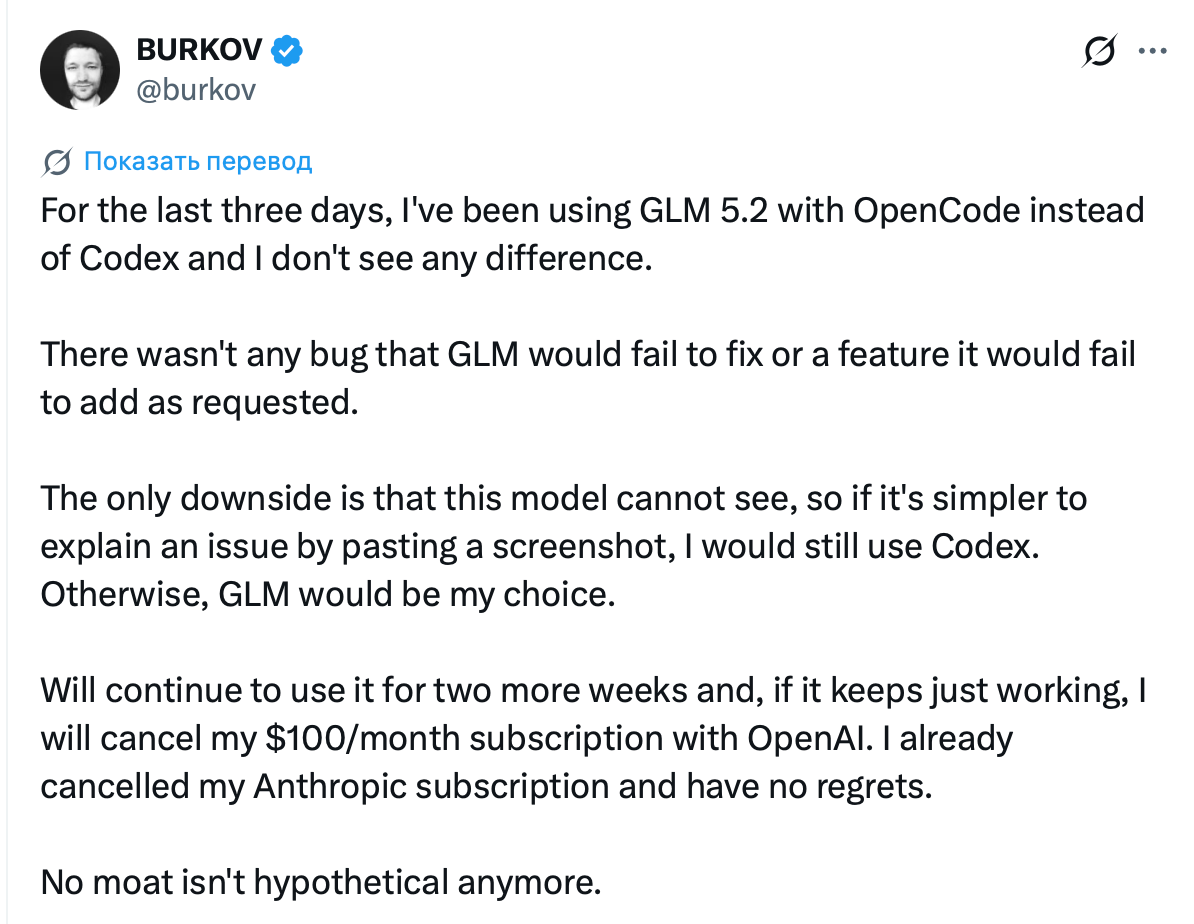
I have met many companies that simply use the provider their developers picked one or two years ago. By switching, you could prevent shadow AI, have uninterrupted access to models, and save thousands. For example, GLM-5.2 — an open-weight model released three days ago by Z.ai — costs $1.40/1M input tokens and $4.40/1M output tokens. It just claimed the #1 spot on Design Arena, a crowdsourced HTML design benchmark, beating Claude Fable 5 (which, at $50/1M output tokens, is currently unavailable due to a US government export control order — though give it some time). As Andriy Burkov, author of The Hundred-Page Machine Learning Book series, put it on X: he’s been running GLM-5.2 with OpenCode instead of Codex for three days and “doesn’t see any difference” and has already cancelled his Anthropic subscription.
es%2Fc1bdef42-0930-4f40-bdc2-6e1d9593ac95_1194x924.png

That said, it is still not that easy: force your developers to use a model too weak for their tasks and you will create massive technical debt. Replacing a strong proprietary model with a cheap open-weight alternative risks a far greater drop in product quality than the cost saving justifies. Consult your internal experts, introduce rigorous evaluation pipelines, and rely on validated research and reliable benchmarks. AI Realist offers a service to help companies optimise their AI stack and consumption but whether you choose us or not, go in with a clear understanding of the risks: underperforming models, data privacy constraints, the overhead of maintaining your own infrastructure, throughput, and more.


https://www.linkedin.com/posts/msuk...he-industry-of-share-7480034172926001152-uXTm

1783440480130.png


The Industry of Lies, or What Leaders Need to Know About AI​

https://msukhareva.substack.com/p/the-industry-of-lies-or-what-leaders

On unpredictable costs, failed PoCs, resistant employees, and the infrastructure that is not there​


https://www.linkedin.com/posts/msuk...he-industry-of-share-7480034172926001152-uXTm

View attachment 813790
The big banks, money market and hedge funds, as well as insurance companies are leveraging their bets on the AI bubble. When the collateral behind the AI bubble is NVIDIA and Micron, hold onto your butts. It's a big circle jerk, and everyone else is in the middle.
 
Samsung under 7x forward P/E, Micron at 6.36, trailings in the low 20s

Everything in that space is so cheap....... everyone just waiting for the bricks to fall.
 
Samsung under 7x forward P/E, Micron at 6.36, trailings in the low 20s

Everything in that space is so cheap....... everyone just waiting for the bricks to fall.
Man, I wish I had the leverage to short like Michael Burry is doing for Micron.
 
seem risky to me because of cheap Micron stock is right now, 1 trillion sound like a lot of course, but for a company that made 35 billions of gross profits last quarter... it is really cheap. you need to get the timing right
 
Chinesse innovation can look way more efficiant than it actually is from the outside, as we do not see the 50-100 failures for each success story, they are simply 100% unknown of the outside worlds.

There was 300-400 Chinese ev car manufacturer at the starting line, lot of capital destruction to find out the top 5 winners, those winner are so good because they had to go throught the most competitive open market bloodbath in the world (and learned a giant amount of things to not do that does not work from the hundreds of failures around them) and individually they do look lean from the start as they were, but as a whole endavour not necessarily that much more efficiant that silicon valley.

Chinese Ai probably look like this has well inside in, as for deepseek model efficacy for what we know had less efficiant inference than what google gemini was about to launch (which was probably already using MoE and others advancement who are all based on google papers, they were openly by 1.5 pro launch) at the time and certainly nothing special now (same for kimi or glm 5.2):
valimyjxrw3h1.png
 
Back
Top