![[H]ard|Forum](/styles/hardforum/xenforo/logo_dark.png)

XoR_
2[H]4U
- Joined
- Jan 18, 2016
- Messages
- 2,154
It will be very hard to hit 480 or 500fps in modern games though. I have 360Hz QD-OLED and it is nice and dandy but only in older games.Here we go. A Samsung QD-OLED running at 500Hz.
https://www.techpowerup.com/329212/...s-first-27-inch-500-hz-qd-oled-gaming-display
Think we will finally have unnoticeable mouse lag?
In modern games even if I butcher render resolution using temporal upscaling I am not able to utilize anywhere near monitor's full "capacity". And temporal anything means there will be some motion related blurring unfortunately.
Even the best GPU you can buy like RTX 4090 struggles with 240fps native. Best CPU with best GPU and all running at 720p - there is no chance in some games to get even 200fps...
Yeah, and even with 500fps motion clarity in at least some aspects will still be superior on CRT even if it is just running 60fps game at 60Hz refresh rate.Trying to brute force something that a CRT does so effortlessly. Doubt even a 5090 will be enough against 500Hz.
Heck, in some aspects CRT at 60Hz is superior to CRT at 120Hz. There is this unreal feeling with CRT at low refresh rate - like motion is more clear than even in reality.
Of course in some other aspects even without any strobing/BFI etc. motion at very high refresh rate is clearer.
Input lag is also much better on modern displays. For competitive games modern OLEDs are already better than CRT.
OLED is definitely very nice.Doubt even a 5090 will be enough against 500Hz. And I imagine we can forget about ever getting true multi-scan back.
That said, an OLED can be nice on its own terms. Queue another plug for 4K combined with the late great OLED Motion Pro...
Heck, to my sensibilities when I get optimal 120fps on my 360Hz QD-OLED is for all intents and purposes enough where it comes to input lag and motion blur and motion clarity. 240fps I would say easily surpass CRT for actual gameplay. Motion isn't as sharp visually but it is better technically.
----
Personally where it comes to OLEDs I am waiting for something with actually good BFI/strobing implementation.
OLEDs can technically do so much better than what we see.
IMHO what we see is total BS
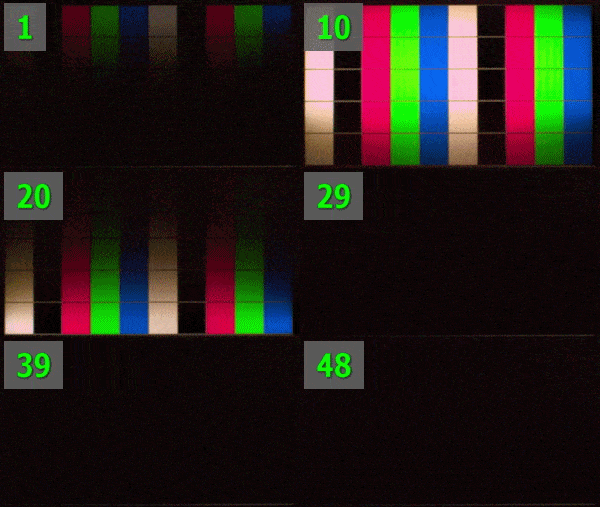
Som monitors have BFI but do it wrong. We should not draw full frames and then draw black frames because we need to first buffer the frame so add input lag and then are power/brightness limited. Instead frame should be drawn in thin horizontal bars which would allow lines to be drawn as they are received without lag and at much higher brightness.
Technically modern OLEDs should be able to hit 2ms or even 1ms "strobe time" with brightness easily surpassing CRTs and all without adding input lag.
All it would require is manufacturers actually focusing on this feature.
Another thing: for input lag reduction we should have BFI implemented on GPUs and not rely on monitors.
If GPU did BFI then we would at least skip the whole part where frame is fetched by monitor at longer frame times and instead it is displayed immediately at faster scan-out. Monitors when they do BFI not only fetch frame but also unnecessarily also fetch the whole frame where they only need half of it so BFI in this case adds input lag.
Also with GPU driven BFI it should be possible to have form of VRR - maybe not free from brightness fluctuations but we are already not free from brightness fluctuations with VRR anyways... besides: it is actually bad for input lag to run games without frame rate limiter anyways.
Anyways, IMHO GPUs should do BFI. It haven't made any sense when we used CRTs or LCDs but for OLEDs it is no brainer.
-----
BTW. After 3 years of sitting unused I started using my FW900
Not for PC but for PS5 for at least some games. If game runs at 60Hz and runs solid 60fps and the game has lots of scrolling and such it makes perfect sense to play it on CRT and then it looks glorious.
Also unfortunately where it comes to strobed displays something like VGA CRT is the only solution that is truly lag-less. Something like OLED monitors don't really have any (at least significant) input lag but each and every strobed solution has at least some input lag. Best case scenario it is like one frame of input lag on top of what given TV/monitor normally has. HDTV CRTs have unfortunately terrible processing and add lag, not to mention they tops at 720p/1080i and on the other hand HDMI to VGA converters and VGA CRTs have virtually zero lag - so in this sense in this case VGA CRT will be always superior.


 . The one thing I don't miss is how massively bulky it was.