• Some users have recently had their accounts hijacked. It seems that the now defunct EVGA forums might have compromised your password there and seems many are using the same PW here. We would suggest you UPDATE YOUR PASSWORD and TURN ON 2FA for your account here to further secure it. None of the compromised accounts had 2FA turned on.
    Once you have enabled 2FA, your account will be updated soon to show a badge, letting other members know that you use 2FA to protect your account. This should be beneficial for everyone that uses FSFT.

RIAA Uses “Pirated” Code On Its Website

HardOCP News

[H] News
Joined
Dec 31, 1969
Messages
0
The RIAA uses pirated code on its website? Say it isn't so! ;)

It turns out that even the most vocal anti-piracy advocates are guilty of infringing the copyrights of others on the Internet. TorrentFreak has discovered that the websites of the music industry groups RIAA and BPI have removed the copyright notices from popular web software, violating the open source licenses these scripts are distributed under.
 
This presupposes that the RIAA actually stands on any kind of principle. They don't. They are nothing more than predators.
 
tl;dr

RIAA and BPI used jQuery and a plugin and did not including the licensing information. The situation has already been rectified on both sites.
 
tl;dr

RIAA and BPI used jQuery and a plugin and did not including the licensing information. The situation has already been rectified on both sites.
*including = include
 
tl;dr

RIAA and BPI used jQuery and a plugin and did not including the licensing information. The situation has already been rectified on both sites.

How much opportunity do those who come under the guns of the RIAA get a chance to rectify their situation first?
 
Meh. Not really a big deal. This stuff happens all the time, especially when javascript/css is minified/compressed/concatenated, etc. Often times comments get stripped out in the process. I've been guilty of the same thing on more than one occasion. And think about it this way. How many people actually bother to look at the source anyway? Practically no one does except web developers and other people who are very familiar with most or all of the major javascript libraries. I can spot jquery and its various plugins without the copyright notice, and I would never think the website in question is trying to steal the code and pass it off as its own. Hell, the filename itself gives it away.
 
For every stolen line of code they should get 10 years of jail time, and pay $100k. Seems only fair, since this is what they do to people.
 
tl;dr

RIAA and BPI used jQuery and a plugin and did not including the licensing information. The situation has already been rectified on both sites.

Licensing information does not get removed automatically.

By your logic, we can pirate all we want and if we get caught, we can just buy all those songs/movies and "situation would be rectified." :rolleyes:
 
Licensing information does not get removed automatically.

By your logic, we can pirate all we want and if we get caught, we can just buy all those songs/movies and "situation would be rectified." :rolleyes:
I'm sure the makers of jQuery could go sue the RIAA for lost revenue for removing the licensing information and I'm sure the judge will award them all $0 that they lost because of it :rolleyes:
 
Licensing information does not get removed automatically.

By your logic, we can pirate all we want and if we get caught, we can just buy all those songs/movies and "situation would be rectified." :rolleyes:

In some cases, yes it does. Developers don't generally remove license text from files downloaded by the browser because they intend on stealing the code and passing it off as their own work. They do it because it's extra unnecessary bytes that every single client has to download, and it serves pretty much zero purpose for the end user. Joe Blow visiting site XYZ doesn't give a damn what javascript library you are using or what the license is. The licensing is there for the developer so they know what they can and cannot do with the code. The end user doesn't need to see it. Yes, I realize that most licenses require the text to remain intact for the end user, but I contend that it is completely stupid and pointless to have such a requirement.

I think a fair compromise is to have a reduced version of the copyright notice for minified versions. Here is a good example with jquery:

Uncompressed version:

Code:
/*!
 * jQuery JavaScript Library v1.10.2
 * http://jquery.com/
 *
 * Includes Sizzle.js
 * http://sizzlejs.com/
 *
 * Copyright 2005, 2013 jQuery Foundation, Inc. and other contributors
 * Released under the MIT license
 * http://jquery.org/license
 *
 * Date: 2013-07-03T13:48Z
 */

Compressed version:

Code:
/*! jQuery v1.10.2 | (c) 2005, 2013 jQuery Foundation, Inc. | jquery.org/license
//@ sourceMappingURL=jquery.min.map
*/

Also notice the beginning /*! in the comment. That tells most minifiers to skip over the license when doing its compression. The plugins in question on the RIAA site just had /*, missing the exclamation point. The license was most likely removed by an automated process.
 
Meh. Not really a big deal. This stuff happens all the time, especially when javascript/css is minified/compressed/concatenated, etc. Often times comments get stripped out in the process. I've been guilty of the same thing on more than one occasion. And think about it this way. How many people actually bother to look at the source anyway? Practically no one does except web developers and other people who are very familiar with most or all of the major javascript libraries. I can spot jquery and its various plugins without the copyright notice, and I would never think the website in question is trying to steal the code and pass it off as its own. Hell, the filename itself gives it away.

It may not be a huge deal, but it's not nothing either. This may happen all the time, but then so does people pirating music. Not to mention, this happens all the time to people not suing people for using pirated software/music/movies.
 
So, let me get this straight, if a multi$ association pirates something then we go into selective mode and "come on, they wouldnt make any money anyway, big deal".

Isn't that the very arguement that most people who download games or music or movies make? The fact that they wouldn't buy it anyway so they are not taking away anyone's money?

I'm confused here, please enlighten me. If you carry a huge budget and an army of idiots to do your deeds, the rules in the name of which you act do not apply to you?
 
So, let me get this straight, if a multi$ association pirates something then we go into selective mode and "come on, they wouldnt make any money anyway, big deal".

Isn't that the very arguement that most people who download games or music or movies make? The fact that they wouldn't buy it anyway so they are not taking away anyone's money?
I'm not going to support the RIAA's actions, but trying to draw parallels with pirating really isn't really worth while. One is taking something that costs money, the other is using something that was free to begin with and removing the comments which have the licensing in it.

It's not like the RIAA saying "we wouldn't have bought it anyway".
 
I'm sure the makers of jQuery could go sue the RIAA for lost revenue for removing the licensing information and I'm sure the judge will award them all $0 that they lost because of it :rolleyes:

Somehow I don't think argument wouldt work when the RIAA sues someone and they simply say "The only reason I downloaded it is because it was free, I wouldn't pay for that, so hence they lost $0 by me pirating it"
 
Somehow I don't think argument wouldt work when the RIAA sues someone and they simply say "The only reason I downloaded it is because it was free, I wouldn't pay for that, so hence they lost $0 by me pirating it"
Except the stuff RIAA sues people for does have a value, hence they can assign (an absurdly high) value to the losses. Whether you were going to pay that value or not is irrelevant, it has a value. The jQuery creators can't sue for monetary losses because there are no monetary losses (as far as I understand it).
 
How much opportunity do those who come under the guns of the RIAA get a chance to rectify their situation first?

Some -- I think a lot of those copyright watch dogs send out automated email warmings/alerts basically aking to 'Hello. I'm from XYZ and am the copyright owner of XYZ. You are sharing 'Breaking Bad [S01-S05] COMPLETE!! PLUS!' on your system. Please remove this file from your system and stop sharing it immediately, blah blah blah. However, once they've gotten the the point of suing, there's little chance to rectify the situation. Except in forms of extortion: 'We won't take you to court, if you pay $5,000 to an unmarked P.O. Box style'.
 
For every stolen line of code they should get 10 years of jail time, and pay $100k. Seems only fair, since this is what they do to people.

No one at the RIAA believes in fairness, and politicians only believe what the RIAA pays them to believe.
 
Except the stuff RIAA sues people for does have a value, hence they can assign (an absurdly high) value to the losses. Whether you were going to pay that value or not is irrelevant, it has a value. The jQuery creators can't sue for monetary losses because there are no monetary losses (as far as I understand it).
Yeah but just because there are no monetary losses doesn't mean it doesn't have value. The value could be as simple as "Fuck you I am the one who wrote this awesome work of art, it came from MIT which is the bestest school in the world everyone needs to know this!" And by removing the credit, as per the ToS :D, they removed the "value" of the product.
 
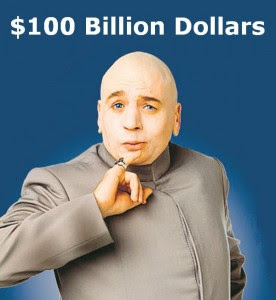
Based upon inflation and well since Works of art are priceless as they claim they owe the artist......


100-billion-dollars-276x300(1).jpg
 
Yeah but just because there are no monetary losses doesn't mean it doesn't have value. The value could be as simple as "Fuck you I am the one who wrote this awesome work of art, it came from MIT which is the bestest school in the world everyone needs to know this!" And by removing the credit, as per the ToS :D, they removed the "value" of the product.

Lets see how well they go suing for the amount of "fuck you", I'm sure they'll manage to keep legal fees down to "blow me" and hopefully the judge will agree with them on "that's what your Mum said last night". :p
 
They should be sued for the maximum possible because there is no way to know how much damage has been done.
 
They should be sued for the maximum possible because there is no way to know how much damage has been done.

We've already established the most they can sue for is "fuck you" :p
 
did they actually pirate anything? it sounds like the copyright wasn't being included in the site but not that they actually stole the software.

but the comments here seem to think they actually stole the software.
 
I'm not going to support the RIAA's actions, but trying to draw parallels with pirating really isn't really worth while. One is taking something that costs money, the other is using something that was free to begin with and removing the comments which have the licensing in it.

It's not like the RIAA saying "we wouldn't have bought it anyway".
It isn't just about money, its attribution and securing the license terms. Part of the reason for those licenses so no one absorbs the code and starts charging for it. Why is the originator asking for the price to be $0 any different than the originator asking for the price to be $5 or $10? There was no immediate money damage, but these attributions are like advertizements or resumes and you cost someone future work potentially. And you're disregarding the originator's/owner's desire on the disposition of the material. The same right someone has to expect XX dollars to be enforced is the same right that someone expecting it to be $0 dollars should expect. Stripping license info, jeopardizes that or shifts a burden onto the originator to actively pursue someone who violate the license.
 
So, let me get this straight, if a multi$ association pirates something then we go into selective mode and "come on, they wouldnt make any money anyway, big deal".
Not all but a few of the defenders sound like RIAA personnel. Now you know what they do with their booty. Surf the web all day.
 
Except the stuff RIAA sues people for does have a value, hence they can assign (an absurdly high) value to the losses. Whether you were going to pay that value or not is irrelevant, it has a value. The jQuery creators can't sue for monetary losses because there are no monetary losses (as far as I understand it).

Since jQuery has no value (lol), then why is RIAA using this useless piece of library? Don't go that way.
 
It isn't just about money, its attribution and securing the license terms. Part of the reason for those licenses so no one absorbs the code and starts charging for it. Why is the originator asking for the price to be $0 any different than the originator asking for the price to be $5 or $10? There was no immediate money damage, but these attributions are like advertizements or resumes and you cost someone future work potentially. And you're disregarding the originator's/owner's desire on the disposition of the material. The same right someone has to expect XX dollars to be enforced is the same right that someone expecting it to be $0 dollars should expect. Stripping license info, jeopardizes that or shifts a burden onto the originator to actively pursue someone who violate the license.
I never said it was right, I just don't think meaningful parallels can be drawn with your typical casual pirate. If the jQuery creators want to sue them over it, go for it, I just don't see them getting much out of it.

I don't think any worth while comparisons can be drawn with piracy for various reasons. One being the monetary value. Another being that the website creators probably didn't even know what happened and once they did, they remedied it. People pirating stuff are told time and time again that it's wrong, they're often sent warning letters before any actual legal action is taken. The only case that might have been similar was where a parent was sued over their kid downloading something, though I can't remember whether they were sent warnings and things first.
 
Since jQuery has no value (lol), then why is RIAA using this useless piece of library? Don't go that way.

Sorry, I thought I made it clear, "monetary value". If the jQuery creators want to sue for it, then more power to them, I think they'll struggle because the software was free and open source and the website creators fixed the problem when they were made aware of it.
 
Back
Top