![[H]ard|Forum](/styles/hardforum/xenforo/logo_dark.png)
Navigation
Install the app
How to install the app on iOS
Follow along with the video below to see how to install our site as a web app on your home screen.
Note: This feature may not be available in some browsers.
More options
You are using an out of date browser. It may not display this or other websites correctly.
You should upgrade or use an alternative browser.
You should upgrade or use an alternative browser.
Pentium Dual-Core P
- Thread starter greyx
- Start date
cannondale06
[H]F Junkie
- Joined
- Nov 27, 2007
- Messages
- 16,180
a Pentium Dual Core is a butchered Core 2 duo.

- Joined
- Feb 3, 2004
- Messages
- 26,988
Are they really better than Core2Duo ?
Someone said that Pentium Dual-Core are a newer generation.
Thanks.
They are newer yes, but better?..No
They have a slower FSB and less cache than the Core2Duo chips.
There is nothing wrong with them, and they are perfectly good chips that will work great in many applications.....but better than a Core2Duo...nope, that's not a true statement
cannondale06
[H]F Junkie
- Joined
- Nov 27, 2007
- Messages
- 16,180
less cache and smaller fsb so clock for clock it is slower than Core 2 duo. now there are many different Core 2 duo iterations too so a newer Pentium Dual Core could easily match or be faster than some older Core 2 duos. it would really come down to the exact model Pentium Dual Core and Core 2 duo being compared."butchered" ?
Explain, please.
Thanks again.
Ok, it's about Intel Pentium Dual Core P6200 ( Notebook )
I asked someone, and he said that this CPU is better than Core2Duo. Hard to say, i said.
Let's compare this Intel Pentium Dual Core P6200 with Core2Duo T6670 or 6600

I wanna but a laptop, but not for gaming. Only for web browsing, some movies, music, pictures, IM and whatever.
Sometime, but rare and not at the professional level, pics / video / movies editing.
I asked someone, and he said that this CPU is better than Core2Duo. Hard to say, i said.
Let's compare this Intel Pentium Dual Core P6200 with Core2Duo T6670 or 6600
I wanna but a laptop, but not for gaming. Only for web browsing, some movies, music, pictures, IM and whatever.
Sometime, but rare and not at the professional level, pics / video / movies editing.
cannondale06
[H]F Junkie
- Joined
- Nov 27, 2007
- Messages
- 16,180
all "Pentium Dual Core" cpus at this point are based off of Core 2. P6200 is not a Pentium Dual Core, it is a Pentium.The newer Pentium Dual-Cores are not based off of the Core 2 Duo architecture.
A P6200 is faster than a T6670 or T6600, as it is an Arrandale. It's the same architecture as the first generation Core i series.
all "Pentium Dual Core" cpus at this point are based off of Core 2. P6200 is not a Pentium Dual Core, it is a Pentium.
Who is right now ?
http://www.gadgets-freak.biz/intel-pentium-p6200-dual-core-processor-review-2-13ghz/
Ok guys, so, would you recommend this laptop ?
http://www.market.bit2u.biz/en/note...D_Intel_Pentium_Dual_Core_P6200_2_13GHz_.html
all "Pentium Dual Core" cpus at this point are based off of Core 2. P6200 is not a Pentium Dual Core, it is a Pentium.
Split hairs much?
It says Pentium in it's name, and it's a Dual Core processor. So sorry.
cannondale06
[H]F Junkie
- Joined
- Nov 27, 2007
- Messages
- 16,180
its the wording that gets confusing. the "Pentium Dual Core" is a specific line of cpus that were based off the Core 2 duo architecture.
cannondale06
[H]F Junkie
- Joined
- Nov 27, 2007
- Messages
- 16,180
and don't act like a jerk just because I am trying to help him not be confused. again the "Pentium Dual Core" is a specific line of cpus that were based off the Core 2 duo architecture.Split hairs much?
It says Pentium in it's name, and it's a Dual Core processor. So sorry.
IntelEnthusiast
Intel Enthusiast Team
- Joined
- Feb 21, 2011
- Messages
- 534
The Intel® Pentium® Dual Core processors are designed to be an entry level processor of our current processor microarchitecture. So if it was an older generation processor it could have been based off the Intel Core 2 Duo architecture. Now understand since these processors may have been released later in the lifespan of that architecture there maybe early models that are not as fast as the Pentium Dual Core processor when it was released.
a Pentium Dual Core is a butchered Core 2 duo.
The only *butchering* that Pentium Dual-Cores (and the Celeron Dual-Core, for that matter) realistically have is to the on-die cache (which is halved, or even quartered in the case of the Celeron DC). However, both chopped C2D variants overclock like Visigoths after pillaging Starbucks.
If you don't run applications needing large amounts of cache (and let's face facts - most folks don't) or want tall overclocks, neither Pentium DC or Celeron DC is a bad bet.
I've had two Celeron DCs - the Conroe-based E1200, and the Wolfdale-based E3400 I have today - and the only time my *applications* have suffered was when I moved from nForce630i (which could overcrank even an E1200 like crazy) to G41 (which put that same E1200 pretty much on lockdown). In other words, chipset issue - not CPU issue.
I don't have the bragging rights that owners of the E8400 (the unchopped version of the same CPU) would have; however, I do have more Andrew Jacksons (his picture is on the USD $20) in my bank account, not to mention that I could probably overclock the full-up Wolf owner into the turf (given the same hardware).
Also, if all of LGA775 is going away (pretty much a certainty, and this year) why in the world would you get spendy on a socket on its last life? (When the last of Intel's bargain quad-cores went away, I hadn't planned on any CPU upgrades until I did a complete rebuild with Sandy Bridge - and I still had the E1200 at that time. Then along came the chipset issues with Sandy, and now, the resultant gouging and motherboard shortages. Still, the issue of overspending on a dead-end socket exists. Being as I'm limited pretty much to retail due to paying cash the real CPU options were darn few. E7500? No VT-x; the large cache would be the only benefit. E5400, the Pentium DC? Same issues as E7500 - lack of VT-x. That leaves E3400 - ironically, the last Celeron left standing in the socket, as well as that with the tallest stock clocking. It has VT-x support - which, as I pointed out, the Pentium DC and even C2D alternatives both lack - which means that I can run practically *any* OS that allows it in a VM. (Desktop OSes, server OSes, even Apple server OSes.) The 2.6 GHz stock clock means it's still no slouch at desktop or even gaming (not many games, even today, are CPU-cache pigs). Besides, it cost me a mere $40USD. A real bargain, even if you don't overclock.)
cannondale06
[H]F Junkie
- Joined
- Nov 27, 2007
- Messages
- 16,180
OP asked a fairly simple question and I gave him a fairly simple answer. he did not originally ask about a specific model or mention anything about upgrading. he simply wanted to know which was better. when he wanted to know what I meant by butchered I explained that. feel free to keep being overly dramatic about your personal feelings that a Core 2 duo is not worth it over the Pentium Dual Cores or other "butchered" Core 2 derivatives. for gamers such as myself the 30% clock for clock advantage the E8xxx series had over the earlier Pentium Dual Cores was well worth it though.
The Intel® Pentium® Dual Core processors are designed to be an entry level processor of our current processor microarchitecture. So if it was an older generation processor it could have been based off the Intel Core 2 Duo architecture. Now understand since these processors may have been released later in the lifespan of that architecture there maybe early models that are not as fast as the Pentium Dual Core processor when it was released.
True.
There have been, however, some seeming *ringers* among both the Pentium DC, and even Celeron DC, lines, which turned them into basement bargains.
My own Celeron DC E3400 is a case in point.
No - it is not clocked at stock as high as the uncut E8400 Wolfdale it's based on. However, the reduced on-die cache means it is also not as prone to overheating at the tallest of overclocks as the E8400, either. Even better, it can use all the same thermal-management tools (both hardware and software) that apply to the E8400.
Result - it overclocks higher as a percentage of stock, and in terms of absolute frequency - compared to E8400. Even better, it's half - or less - E8400's price.
While high-end applications can be (and, in the case of high-end editing and CAD software, often are) hungry for as much CPU on-die cache as they can use (in those cases, I find myself recommending an Intel quad-core, such as your current and previous-generation i5 or i7), the older C2D may have made sense. However, the vast number of productivity applications, and even the vast majority of games, are not such cache (CPU, that is) pigs. Even multitasking many such applications is not overly taxing - not of the CPU, anyway.
For average folks, running the average application mix, even a quad-core is overkill. Even throw in multitasking, it would still be overkill. (Intel is actually going to have a real dilemma, going forward, as even the i5 non-K variants would be overkill, being as pricewise they will be competing not with previous-generation Intel qual-cores, but the previous-generaiton *dual-cores* from Intel, and quad-cores from AMD.) Budgets are still tight, and unless you plan on doing some lower-end K-models, there may not be much mainstream uptake in the second-gen Core i-series. Still, I can see the problem Intel has - the Celeron DC and Pentium DC were indeed basement bargains, and doubtless kept some from buying higher-end CPUs instead.
Look at it this way, though - Intel has a reputation for bang-for-the-buck, from the top of the CPU line down to the bottom. Basically, it wasn't just the high end that got Intel where it is today.
OP asked a fairly simple question and I gave him a fairly simple answer. he did not originally ask about a specific model or mention anything about upgrading. he simply wanted to know which was better. when he wanted to know what I meant by butchered I explained that. feel free to keep being overly dramatic about your personal feelings that a Core 2 duo is not worth it over the Pentium Dual Cores or other "butchered" Core 2 derivatives. for gamers such as myself the 30% clock for clock advantage the E8xxx series had over the earlier Pentium Dual Cores was well worth it though.
I came in like I did because you have been coming into any thread where someone looks lower than the midrange (doesn't matter whether it's CPUs, GPUs, what-have-you) and basically tried not only to rain on their parade, but get them to spend more money that they not only may not have, but where it may, in fact, be unnecessary.
And comparing Conroe-based Pentium DCs to *any* Wolfdale-based CPU (whether C2D, Pentium DC, or even Celeron DC, such as my E3400) is apples-to-oranges. Wolfdale is a better design than Conroe. Clock cycle for clock cycle, it has better performance than Conroe. Throw in better thermal-management at the CPU die than Conroe, and I would be hard-pressed to recommend Conroe over Wolfdale (where both CPU types, with identical feature sets, exist) - and I've had Celerons of both sorts.
And what sort of games do you run, and what sort of cooling system are you using, that you need that extra overclock headroom? (And why can't a Wolfdale-based Celeron DC or Pentium DC be a workable alternative, or was it that they weren't around at the time? I'm quite aware that E3400 came out *after* the original Wolfdale C2Ds.)
CPU lines change, and what may have been the case when you made your choice may not be plausible, or even possible, today. (Wolfdale-based C2Ds aren't exactly easy to find these days, even mail order, unless you buy used.)
cannondale06
[H]F Junkie
- Joined
- Nov 27, 2007
- Messages
- 16,180
again he asked a question and I answered it. why do you have to be so defensive about your components? my pc is hardly cutting edge and I am not here to brag about anything. I will give somebody the best advice based on their needs and budget.
cannondale06
[H]F Junkie
- Joined
- Nov 27, 2007
- Messages
- 16,180
no not everything with the Pentium name in it is netburst. have you even looked at this thread?Anything with the name Pentuim in it is old and shitty netburst.
The cpus have to go over the fsb to talk to each other while the newer core 2 stay at their internal speeds doings so
no not everything with the Pentium name in it is netburst. have you even looked at this thread?
The Pentium D [ 2 ] brand refers to two series of desktop dual-core 64-bit x86-64 microprocessors with the NetBurst microarchitecture manufactured by Intel . Each CPU comprised two dies , eachcontaining a single core, residing next to each other on a multi-chip module package.The brand's first processor, codenamed Smithfield , was released by Intel on May 25,2005
http://en.wikipedia.org/wiki/Pentium_D
No I haven't
cannondale06
[H]F Junkie
- Joined
- Nov 27, 2007
- Messages
- 16,180
no one is talking about Pentium D. Pentium Dual Core is a cut down Core 2 duo. the Pentium P series dual core cpu in notebooks is based of Westmere architecture.The Pentium D [ 2 ] brand refers to two series of desktop dual-core 64-bit x86-64 microprocessors with the NetBurst microarchitecture manufactured by Intel . Each CPU comprised two dies , eachcontaining a single core, residing next to each other on a multi-chip module package.The brand's first processor, codenamed Smithfield , was released by Intel on May 25,2005
http://en.wikipedia.org/wiki/Pentium_D
No I haven't
no one is talking about Pentium D. Pentium Dual Core is a cut down Core 2 duo.
oh you mean the Pentuim M based stuff. It follow up the Pentuim D (which was also a dual core) and came from the Pentuim III. my bad for bringing up the first Pentuim dual cores (which was crappy you can't argue bout that Netburst yuk)
cannondale06
[H]F Junkie
- Joined
- Nov 27, 2007
- Messages
- 16,180
the Pentium M stuff is different too and has nothing in common with the other cpus I was just talking about. but now you see the Pentium name itself is tied to many different architectures not just netburst.oh you mean the Pentuim M based stuff. It follow up the Pentuim D (which was also a dual core) and came from the Pentuim III. my bad for bringing up the first Pentuim dual cores (which was crappy you can't argue bout that Netburst yuk)
Look here:
http://ark.intel.com/Product.aspx?id=50176
That Pentium P6200 that the OP asked about is an Arrandale chip. Basically a mobile i3-330M with no HyperThreading.
http://ark.intel.com/Product.aspx?id=50176
That Pentium P6200 that the OP asked about is an Arrandale chip. Basically a mobile i3-330M with no HyperThreading.
Last edited:
the Pentium M stuff is different too and has nothing in common with the other cpus I was just talking about. but now you see the Pentium name itself is tied to many different architectures not just netburst.
my apologies I fell asleep this morning. Core 2 architecture are based on the Pentuim M. Thats why I mentioned Pentuim M
No, the Core 2 architecture is not based on Pentium M.my apologies I fell asleep this morning. Core 2 architecture are based on the Pentuim M. Thats why I mentioned Pentuim M
Are they really better than Core2Duo ?
Someone said that Pentium Dual-Core are a newer generation.
Thanks.
Pentium Dual-Core = 45nm (smaller die)
Core2Duo = 65nm (large die)
So the Pentium Dual-Core runs cooler, and has more room to O.C. than the Core2Duo. But less cache. Around 2mb.
The Core2Duo generally has a larger L2 cache. Around 4mb+
The Celeron Dual Cores have even less cache. Around 512kb.
Core2Duo is WAY OVERPRICED in today's economy.
cannondale06
[H]F Junkie
- Joined
- Nov 27, 2007
- Messages
- 16,180
older Pentium Dual-Core cpus are 65nm and Core 2 duos for the last 3 years are 45nm. in fact Core 2 duo went 45nm before most Pentium Dual-Core cpus did. the Core 2 duos have larger front side bus and, depending on models being compared, can have significantly more cache. and no the Pentium Dual-Core does not oc any better than the newer Core 2 duo. and even when you do oc them they would have to be clocked much higher to make up for the lack of cache in in many apps such as games. you would have to get an E2200 to 5.0 to match an E8500 at 3.8.Pentium Dual-Core = 45nm (smaller die)
Core2Duo = 65nm (large die)
So the Pentium Dual-Core runs cooler, and has more room to O.C. than the Core2Duo. But less cache. Around 2mb.
The Core2Duo generally has a larger L2 cache. Around 4mb+
The Celeron Dual Cores have even less cache. Around 512kb.
Core2Duo is WAY OVERPRICED in today's economy.
Last edited:
older Pentium Dual-Core are 65nm and Core 2 duos for the last 3 years are also 45nm. the Core 2 Duos have larger front side bus and can can have significantly more cache. and no the Pentium Dual-Core does not oc any better than the newer Core 2 duo. and even when you do oc them they would have to be clocked much higher to make up for the lack of cache in in many apps such as games. you would have to get an E2200 to 5.0 to match an E8500 at 3.8.
I'm trying to answer the question short and sweet not write a book about every skew released since 2006 man
If a CPU runs cooler it will OC more.
Also E6600 2.4ghz stock 4MB cache runs 45-55 degrees, conversely a E2180 2.0 Ghz stock 1MB cache runs 35-45 degrees. If you use SPEEDSTEP it will also run cooler when idle or web browsing etc. peace dude.
cannondale06
[H]F Junkie
- Joined
- Nov 27, 2007
- Messages
- 16,180
right but you left out significant facts and made the Core 2 duo look like it was on an old process, ran hotter and was little to no better than Pentium Dual-Core. that simply isnt true because Core 2 duo went to 45mb 3 years ago while many Pentium Dual-Core cpus stayed 65nm for a while longer. the Pentium Dual-Core cpus that run cooler also perform significantly worse clock for clock. its really just going to come down the exact cpus being compared as there are so many different models for both Core 2 duo and Pentium Dual-Core. anyway as you can see the OP actually was looking at a laptop with a Pentium cpu based on new i3 architecture in the end.I'm trying to answer the question short and sweet not write a book about every skew released since 2006 man
If a CPU runs cooler it will OC more.
Also E6600 2.4ghz stock 4MB cache runs 45-55 degrees, conversely a E2180 2.0 Ghz stock 1MB cache runs 35-45 degrees. If you use SPEEDSTEP it will also run cooler when idle or web browsing etc. peace dude.
- Joined
- Feb 6, 2006
- Messages
- 13,984
I'm trying to answer the question short and sweet not write a book about every skew released since 2006 man
If a CPU runs cooler it will OC more.
Also E6600 2.4ghz stock 4MB cache runs 45-55 degrees, conversely a E2180 2.0 Ghz stock 1MB cache runs 35-45 degrees. If you use SPEEDSTEP it will also run cooler when idle or web browsing etc. peace dude.
That's simply not true. There's been plenty of processors that run cool, but don't overclock worth a damn.
The question is simple is a Pentium P6200 (which is based on Core i3's) faster clock for clock than the earlier mobile Core 2 Duos? Yes it is.
There are some higher speed Core 2's that as a whole are faster, but only because they're clocked significantly higher.

elm669
2[H]4U
- Joined
- Jul 8, 2003
- Messages
- 2,467
After reading this thread I decided to dig out my benchies I did a while back. Its between a 2.13ghz conroe (e6400) 2.00ghz merom and a 2.2ghz penryn the results were actually suprising.
First up is my original conroe rig from back in the day (2007)

not bad for its age but my 2.66ghz A64 HTPC keeps up with it quite handily lol
then my Merom T7300 lappy @ 2.00ghz:

Doesn't have the clock frequency of the other chips but makes up for it with twice the cache
Then my brothers e-machines laptop, Says Intel Pentium on the logo:

1/2 the cache of the conroe and 1/4 the cache of the merom but the arch updates and extra clock speed even it out
for shits and giggles I decided to throw in my brothers old Q8200 desktop rig:

Higher clock speed and fsb help it take the lead above the others but it still has the same cache per core as a conroe.
Conroe e6400 2.13ghz, 2mb L2, 266 fsb:
31.205 sec 1m pi
12657 mips alu
3189/4703 mflops
Merom T7300 2.00ghz, 4mb L2, 200fsb
23.884 sec 1m pi
12782 mips
3219/4752 mflops
Penryn 2.2ghz, 1mb L2, 200fsb
26.510 sec 1m pi
13070 mips
3551/5297 mflops
Yorkfield Q8200 2.33ghz 2mb L2, 333fsb
22.860 sec 1m pi
14074mips
3811/5870 mflops
First up is my original conroe rig from back in the day (2007)
not bad for its age but my 2.66ghz A64 HTPC keeps up with it quite handily lol
then my Merom T7300 lappy @ 2.00ghz:
Doesn't have the clock frequency of the other chips but makes up for it with twice the cache
Then my brothers e-machines laptop, Says Intel Pentium on the logo:
1/2 the cache of the conroe and 1/4 the cache of the merom but the arch updates and extra clock speed even it out
for shits and giggles I decided to throw in my brothers old Q8200 desktop rig:
Higher clock speed and fsb help it take the lead above the others but it still has the same cache per core as a conroe.
Conroe e6400 2.13ghz, 2mb L2, 266 fsb:
31.205 sec 1m pi
12657 mips alu
3189/4703 mflops
Merom T7300 2.00ghz, 4mb L2, 200fsb
23.884 sec 1m pi
12782 mips
3219/4752 mflops
Penryn 2.2ghz, 1mb L2, 200fsb
26.510 sec 1m pi
13070 mips
3551/5297 mflops
Yorkfield Q8200 2.33ghz 2mb L2, 333fsb
22.860 sec 1m pi
14074mips
3811/5870 mflops
Celeron < Pentium < Core. That is how Intel likes it.
True. And under normal circumstances, that indeed makes sense.
However, not everyone needs top of the line. In fact, sometimes, it would be difficult to justify even midrange. The justification gets harder when money is an issue.
It was why the dual-cores (Celeron DC, Pentium DC, even C2D and i3) exist. They aren't midrange CPUs (not any more) - that's i5 turf.
The four CPUs in the budget line (in that order) are largely ranked in terms of on-die cache (from least to most). The fly in the ointment is the two middle sections (Pentium Dual-Core and Core 2 Duo) - there are CPUs in both groups that lack VT-x - a feature that some Celerons (such as my own E3400) have. Then you have a decision to make - what's more important?
That is indeed why the application mix is critical to what CPU makes better sense. If you do a lot of virtualization, VT-x would doubtless be more important than a large hardware CPU cache (which is the reason that Celeron DCs like not just E3400, but baby-brother E3300 got built). The very fact that E3400 today costs the same as E1200 did when I bought that CPU new, and that it has VT-x support (which E1200 lacks) and has a faster clock at stock make it a real basement bargain. (You read right - I run it at bone-stock. In fact, I had actually run it underclocked for three days.) It actually fits my apps better than several C2D models (with larger amounts of on-CPU cache) because of the VT-x support that it has (and they lack) - one C2D that it kicks to the curb is the E8200.
Gamers usually don't think in terms of hardware virtualization - developers, however, generally do. (So do helpdesk folks, and LAN administrators.)
No, the Core 2 architecture is not based on Pentium M.
yes it is.
I'm trying to answer the question short and sweet not write a book about every skew released since 2006 man
If a CPU runs cooler it will OC more.
Also E6600 2.4ghz stock 4MB cache runs 45-55 degrees, conversely a E2180 2.0 Ghz stock 1MB cache runs 35-45 degrees. If you use SPEEDSTEP it will also run cooler when idle or web browsing etc. peace dude.
no it won't
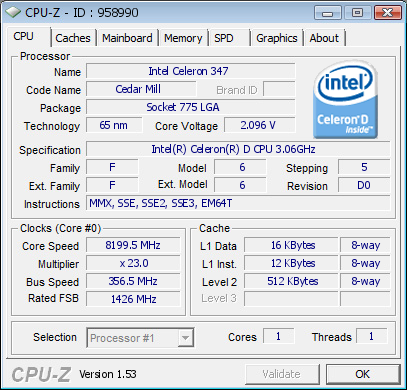
True. And under normal circumstances, that indeed makes sense.
However, not everyone needs top of the line. In fact, sometimes, it would be difficult to justify even midrange. The justification gets harder when money is an issue.
It was why the dual-cores (Celeron DC, Pentium DC, even C2D and i3) exist. They aren't midrange CPUs (not any more) - that's i5 turf.
The four CPUs in the budget line (in that order) are largely ranked in terms of on-die cache (from least to most). The fly in the ointment is the two middle sections (Pentium Dual-Core and Core 2 Duo) - there are CPUs in both groups that lack VT-x - a feature that some Celerons (such as my own E3400) have. Then you have a decision to make - what's more important?
That is indeed why the application mix is critical to what CPU makes better sense. If you do a lot of virtualization, VT-x would doubtless be more important than a large hardware CPU cache (which is the reason that Celeron DCs like not just E3400, but baby-brother E3300 got built). The very fact that E3400 today costs the same as E1200 did when I bought that CPU new, and that it has VT-x support (which E1200 lacks) and has a faster clock at stock make it a real basement bargain. (You read right - I run it at bone-stock. In fact, I had actually run it underclocked for three days.) It actually fits my apps better than several C2D models (with larger amounts of on-CPU cache) because of the VT-x support that it has (and they lack) - one C2D that it kicks to the curb is the E8200.
Gamers usually don't think in terms of hardware virtualization - developers, however, generally do. (So do helpdesk folks, and LAN administrators.)
the E8600 what a chip that was and still is
No, it's not. It's a new architecture. The Core Duo CPUs were based on an improved version of the Pentium M design, but the Core 2 CPUs are not the same. Also, learn to use the edit button.yes it is.
- Joined
- Feb 6, 2006
- Messages
- 13,984
No, it's not. It's a new architecture. The Core Duo CPUs were based on an improved version of the Pentium M design, but the Core 2 CPUs are not the same. Also, learn to use the edit button.
He didn't say they were the same. He said Core 2 was based on the Pentium-M. Which it is, unlike Netburst which was a radical departure from the P6 architecture. Core Duo is an enhanced Pentium-M, but it's basically the same architecture. Core 2's architecture improves upon them further.
Last edited: