
Navigation
Install the app
How to install the app on iOS
Follow along with the video below to see how to install our site as a web app on your home screen.
Note: This feature may not be available in some browsers.
More options
You are using an out of date browser. It may not display this or other websites correctly.
You should upgrade or use an alternative browser.
You should upgrade or use an alternative browser.
The NEW Aqua Goodies!
- Thread starter theseeker
- Start date


Arcygenical
Fully [H]
- Joined
- Jun 10, 2005
- Messages
- 25,066
Wow that's beautiful.
And no risk of corrosion either, seeing as the radiator's external
And no risk of corrosion either, seeing as the radiator's external
Wow that's beautiful.
And no risk of corrosion either, seeing as the radiator's external
i don't understand why the rad being external would cut down on corrosion
no offense .. i probably just don't get it
Arcygenical
Fully [H]
- Joined
- Jun 10, 2005
- Messages
- 25,066
i don't understand why the rad being external would cut down on corrosion
no offense .. i probably just don't get it
Because there's no common electrical ground connecting the aluminum and copper pieces.
The best way to prevent corrosion is to get rid of the ground... either by spacing your radiator out with nylon washers, or using nylon screws. If the copper block and the aluminum radiator are allowed any sort of metallic pathway, they will corrode. Without this path, they will not.
- Joined
- Aug 30, 2004
- Messages
- 772
Because there's no common electrical ground connecting the aluminum and copper pieces.
The best way to prevent corrosion is to get rid of the ground... either by spacing your radiator out with nylon washers, or using nylon screws. If the copper block and the aluminum radiator are allowed any sort of metallic pathway, they will corrode. Without this path, they will not.
So you're saying that the external radiator is not grounded? How do you know this? It looks to me like there's a 4-pin molex connection on the PCI bracket, which could pass a ground to the AquaDuct very very easily - does AquaComputer specifically note that this ground makes no contact with any metals inside the AquaDuct?
Also, I'm no expert, but I wasn't under the impression that a ground was required for corrosion to occur - I had thought that all you needed was two metals (with different galvanic potentials) that are connected electronically in the presence of an electrolyte - which to me means that if you've got copper pipes and aluminum blocks with the same coolant running through them, you need to add a load of anti-corrosion additive.
Arcygenical
Fully [H]
- Joined
- Jun 10, 2005
- Messages
- 25,066
So you're saying that the external radiator is not grounded? How do you know this? It looks to me like there's a 4-pin molex connection on the PCI bracket, which could pass a ground to the AquaDuct very very easily - does AquaComputer specifically note that this ground makes no contact with any metals inside the AquaDuct?
Also, I'm no expert, but I wasn't under the impression that a ground was required for corrosion to occur - I had thought that all you needed was two metals (with different galvanic potentials) that are connected electronically in the presence of an electrolyte - which to me means that if you've got copper pipes and aluminum blocks with the same coolant running through them, you need to add a load of anti-corrosion additive.
Hrm... So the aquaduct uses PSU power does it? I was unaware of that. In that case, yes, there's almost certainly a ground.
. I could have sworn it used an external adapter when I read the thread ~6 months ago.And by "ground" I do mean electrical pathway connecting the two metals. It is essentially a ground. If the copper pipes and the aluminum blocks arn't connected by some sort of metal (or steps are taken to prevent this connection) nothing can occur.
Well, I'm sure taking the unit apart, and including some well placed rubber washers would prevent the rad from touching ground.
- Joined
- Aug 30, 2004
- Messages
- 772
Even if it used an external adapter or it's own PSU, isn't it common practice to pass a ground?Hrm... So the aquaduct uses PSU power does it? I was unaware of that. In that case, yes, there's almost certainly a ground.
You use absolutes too liberally. While the coolant is not the same as a metal rod connecting the two metals, the coolant can conduct electricity - so to a limited extent, you still have an electrical connection between the metals.And by "ground" I do mean electrical pathway connecting the two metals. It is essentially a ground. If the copper pipes and the aluminum blocks arn't connected by some sort of metal (or steps are taken to prevent this connection) nothing can occur.
Certainly not a bad idea, but again I have not been under the impression that a metal connection is required for corrosion to occur.Well, I'm sure taking the unit apart, and including some well placed rubber washers would prevent the rad from touching ground.
Arcygenical
Fully [H]
- Joined
- Jun 10, 2005
- Messages
- 25,066
Even if it used an external adapter or it's own PSU, isn't it common practice to pass a ground?
Common practice... maybe, but if it can avoid the corrosion problem, I would have left this common practice out, in favour of increased reliability.
You use absolutes too liberally. While the coolant is not the same as a metal rod connecting the two metals, the coolant can conduct electricity - so to a limited extent, you still have an electrical connection between the metals.
Right, but by definition... Corrosion doesn't happen unless there's an anode/cathode pair connected electrically, and submersed in an electrolyte. There has to be an electrical connection between the components other than the conductive solution (from what I've read, I could be wrong, but most people seem to agree with this). The coolant is the electrolyte solution, it shouldn't act as the electrical connection as well.
Certainly not a bad idea, but again I have not been under the impression that a metal connection is required for corrosion to occur.
See quote below:
Australian Stainless Steel Coalition (lol) said:Galvanic corrosion can only occur if the dissimilar metals are in electrical contact. The contact may be direct or by an external pipe or wire or bolt. If the dissimilar metals are insulated from each other by suitable plastic strips, washers or sleeves then galvanic corrosion cannot occur. Paint is not a reliable separator from direct contact although painting all of the noble metal is quite effective. Painting the active metal causes drill holes at coating defects.
A corrosion cell is basically a battery. Normal batteries don't produce any current unless they're bridged at both terminals by an electrical conductor. They will lose power over time (due to the very unstable chemicals used inside them) but this is a totally different beast.
Talk about goop!

You think they put enough on the chip?

After about 10 minutes it looks better.

This is what I am starting with. I know it is messy but I have been waiting for the AC gear and a new MB from eVGA. I must admit their RMA process works very well. The MB was working fine but I went for the RMA to address the Quad Core issues as I will most likely upgrade my CPU later in the year. I know it is overkill, but the CPU is cooled with a new gen AC 360 RAD mounted in the bottom of the case and the GPU's will be cooled with the Aquaduct. Hopefully AC will produce a NB and SB block and I can add those into the loop. I will keep you posted. BTW, the Aquaduct, while big, is like a work of art and made exceptionally well.
You think they put enough on the chip?
After about 10 minutes it looks better.
This is what I am starting with. I know it is messy but I have been waiting for the AC gear and a new MB from eVGA. I must admit their RMA process works very well. The MB was working fine but I went for the RMA to address the Quad Core issues as I will most likely upgrade my CPU later in the year. I know it is overkill, but the CPU is cooled with a new gen AC 360 RAD mounted in the bottom of the case and the GPU's will be cooled with the Aquaduct. Hopefully AC will produce a NB and SB block and I can add those into the loop. I will keep you posted. BTW, the Aquaduct, while big, is like a work of art and made exceptionally well.
can you use any chipset block for the SB and or any NB block for the NB or do they have to be designed for this board. im looking into getting an evga but would wanna water cool it. is it worth doing the mofset as well?
DD is the only one I know of that makes a NB block and I have not found any other manufacturers that offer any blocks.
Erasmus354
[H]F Junkie
- Joined
- Mar 12, 2004
- Messages
- 9,450
You can still get a common ground through the water.....because you know.....water is conductive.....
Radiator > Water > Waterblock > Grounding ring on motherboard
Radiator > Water > Waterblock > Grounding ring on motherboard
Arcygenical
Fully [H]
- Joined
- Jun 10, 2005
- Messages
- 25,066
You can still get a common ground through the water.....because you know.....water is conductive.....
Radiator > Water > Waterblock > Grounding ring on motherboard
So the water can act as both the electrolyte AND the ground?
I was under the impression that this isn't the case.
You can still get a common ground through the water.....because you know.....water is conductive.....
Radiator > Water > Waterblock > Grounding ring on motherboard
H20 is conductive and I was wondering when someone would mention that.
H20 is conductive and I was wondering when someone would mention that.
actually H20 isn't
actually H20 isn't
Tell that to Curly Joe.
Bathtub full of water-electric radio-radio falls into bathtub
Arcygenical
Fully [H]
- Joined
- Jun 10, 2005
- Messages
- 25,066
But can the water act as both the
Electrolyte
and
The Electrical connection?
Who cares if water conducts electricity (of course it does, if it didn't it wouldn't be an electrolyte) can it act as BOTH of the above?

Electrolyte
and
The Electrical connection?
Who cares if water conducts electricity (of course it does, if it didn't it wouldn't be an electrolyte) can it act as BOTH of the above?
Arcygenical
Fully [H]
- Joined
- Jun 10, 2005
- Messages
- 25,066
I knew that I should have posted this in AC thread.
I heart your aquaduct Seeker, I'm just trying to clear this corrosion bit up. I'm not 100% sure myself.
I heart your aquaduct Seeker, I'm just trying to clear this corrosion bit up. I'm not 100% sure myself.
I could care less about the corrosion argument. I do not own these components long enough for dust to gather! Life is too short people.
The Aquaduct is beyond words.
Please post this in the AC thread as we just want to hear about AC goodness and skip the BS.
My mistake! Please shoot me a PM as I have stored a few goodies for you.
tylerdustin2008
[H]ard|Gawd
- Joined
- May 6, 2006
- Messages
- 1,834
Have any temps yet?
Have any temps yet?
I have them now. I returned home three hours ago to find no leaks, yea!
I powered everything up and ntune (nmonitor) reported something quite amazing and something I am still scratching my head over. My idle temps with stock eVGA air cooling were 69-71C and now my idle temps are 43-45C. I have had two scotches, but this is hard to believe.
I am currently running Orthos overnight to check out the system settings and I will post my findings tomorrow along with pics. In the meantime, its back to the scotch and a very thick ribeye! Cheers.
woah! is that 2 8800gtx's and your cpu? wow! what rad are you using?
Two rads the Aquaduct 360 and the Aqua Extreme 360.
Arcygenical
Fully [H]
- Joined
- Jun 10, 2005
- Messages
- 25,066
oh. i may need another then. my triple rad wouldnt cope. i reckon a triple and a single?
Should do it unless you're Vmodding.
well my loop at the end of the year will look something like this:
Pump---Cpu block (quad core @ 3ghz i hope)---Motherboard blocks---Gfx blocks (overclocked but not overvolted)---rad---res---pump....
would it cope?
im happy to get another single....
Pump---Cpu block (quad core @ 3ghz i hope)---Motherboard blocks---Gfx blocks (overclocked but not overvolted)---rad---res---pump....
would it cope?
im happy to get another single....
Arcygenical
Fully [H]
- Joined
- Jun 10, 2005
- Messages
- 25,066
well my loop at the end of the year will look something like this:
Pump---Cpu block (quad core @ 3ghz i hope)---Motherboard blocks---Gfx blocks (overclocked but not overvolted)---rad---res---pump....
would it cope?
im happy to get another single....
Well, the GTX's should put max of 200w of heat out (400 for both of them) and the quad core might push 160 or so... So 560w.
Considering 4 120mm radiators can effectively maintain a 10c delta with a 600w heat-load, you should be fine.
Arcygenical
Fully [H]
- Joined
- Jun 10, 2005
- Messages
- 25,066
cool. dont forget the mobo blocks. so if i go cpu---mobo---rad (small)---gfx blocks---big rad...etc...
A NB generally has a thermal output of 50w max, so you're still fairly set.
ikellensbro
[H]ard|Gawd
- Joined
- Feb 14, 2004
- Messages
- 1,410
Well, this thread has gone OT quite a bit, but I think this (nearly 3 year old) article explains things fairly well: http://overclockers.com/tips1153/index03.asp
No matter what, a $5 or $10 investment in a decent corrosion inhibitor is very cheap insurance when you're dealing with a couple hundred dollars (or more) in a loop.
Nice temps so far with the Aquaduct & 2nd 3x120 rad. But we need pics (not of corrosion) of that thing in action.
No matter what, a $5 or $10 investment in a decent corrosion inhibitor is very cheap insurance when you're dealing with a couple hundred dollars (or more) in a loop.
Nice temps so far with the Aquaduct & 2nd 3x120 rad. But we need pics (not of corrosion) of that thing in action.
Was over at Sharka this afternoon and took some pics for all you who enjoy a little Aquacandy every now and then. Dang, now I have to go work an extra day or two so I can afford one of these beauties. I think it would look great with a Lian-Li snail case.
The only thing I am not very happy with is the last picture that voids your warranty for opening it up. If I am paying that kind of moula I am definitely opening it up as that is half the fun!
And last, but not least, I think there only about 6 of the 360 XT's and about 7 of the 240's left.
$550 may seem expensive at first sight, but think about what you get: An Aquaero, an Eheim 600 pump that can be OC'd just like the Aquastream, a 360 size late model radiator, three German 120mm fans, a super duper plexi topped reservoir, a flow indicator, a pair of G 1/8 shut-off valves, USB cable, Serial cable with a slot connector to bring power from the computer that doubles as the entrance/exit of your tubing, about 6 feet of black tubing, a bottle of AC Fluid, and of course this thing is rock solid. And lastly you get the benefits of the world renown Aquasuite water cooling control software.

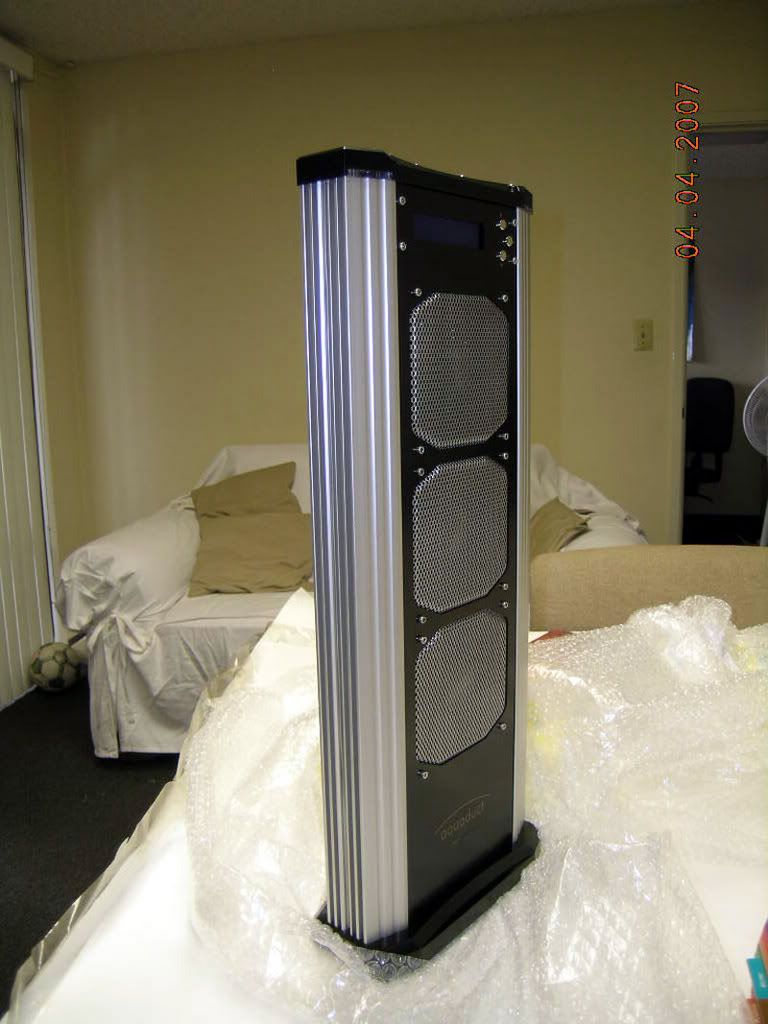
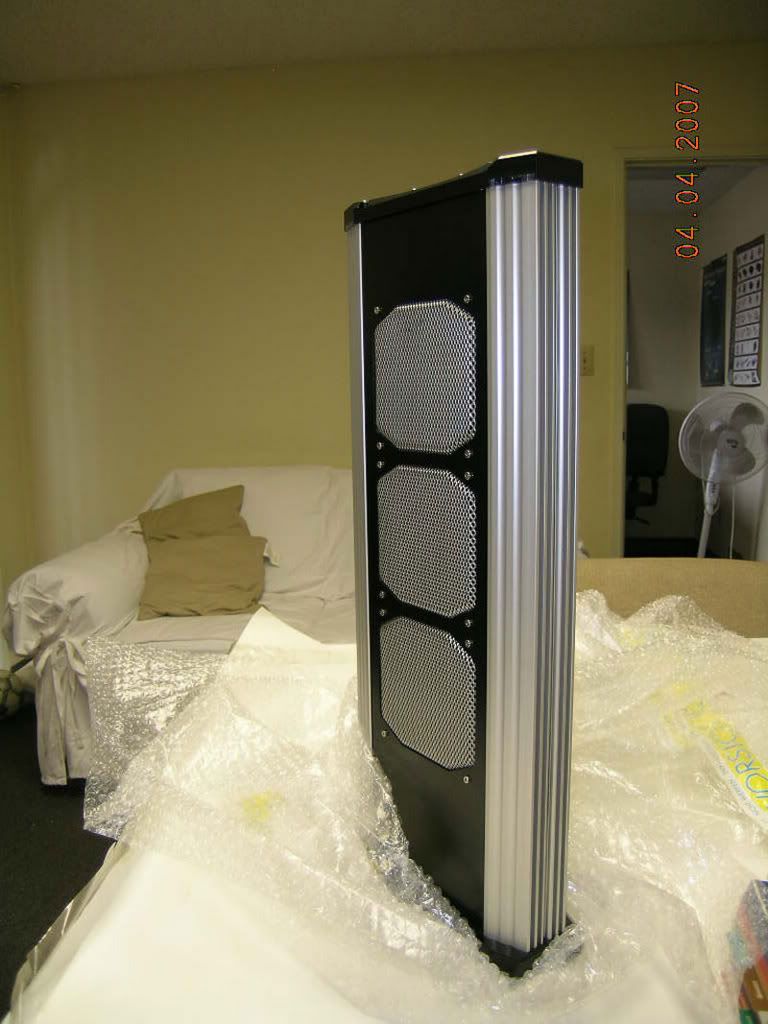


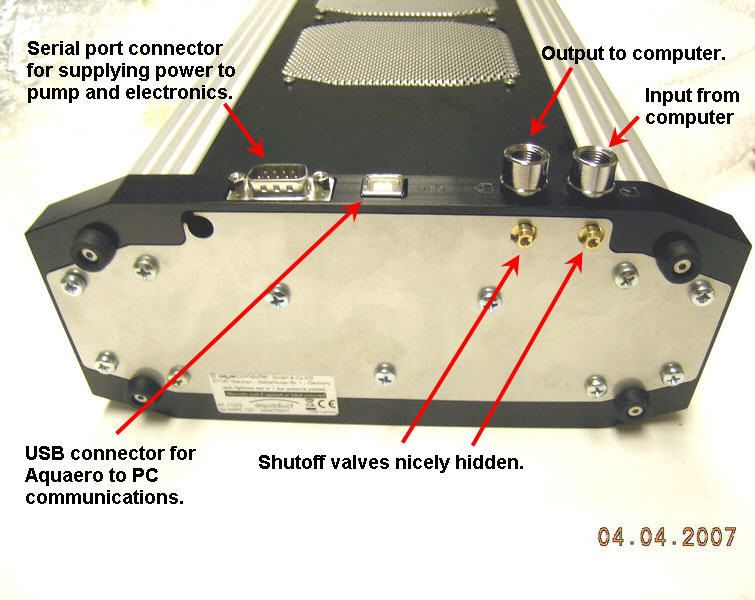

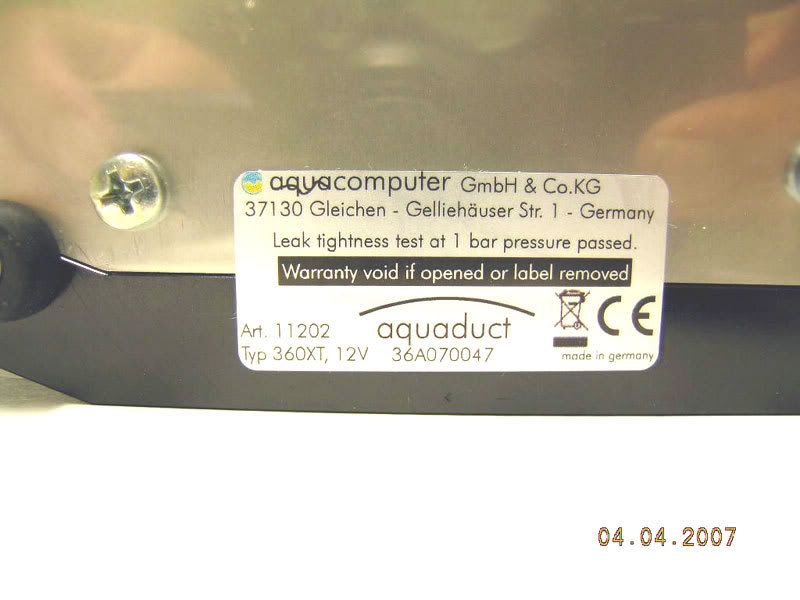
The only thing I am not very happy with is the last picture that voids your warranty for opening it up. If I am paying that kind of moula I am definitely opening it up as that is half the fun!
And last, but not least, I think there only about 6 of the 360 XT's and about 7 of the 240's left.
$550 may seem expensive at first sight, but think about what you get: An Aquaero, an Eheim 600 pump that can be OC'd just like the Aquastream, a 360 size late model radiator, three German 120mm fans, a super duper plexi topped reservoir, a flow indicator, a pair of G 1/8 shut-off valves, USB cable, Serial cable with a slot connector to bring power from the computer that doubles as the entrance/exit of your tubing, about 6 feet of black tubing, a bottle of AC Fluid, and of course this thing is rock solid. And lastly you get the benefits of the world renown Aquasuite water cooling control software.