![[H]ard|Forum](/styles/hardforum/xenforo/logo_dark.png)
Navigation
Install the app
How to install the app on iOS
Follow along with the video below to see how to install our site as a web app on your home screen.
Note: This feature may not be available in some browsers.
More options
You are using an out of date browser. It may not display this or other websites correctly.
You should upgrade or use an alternative browser.
You should upgrade or use an alternative browser.
Single SSD to Raid 0 performance
- Thread starter tnynyn
- Start date
drescherjm
[H]F Junkie
- Joined
- Nov 19, 2008
- Messages
- 14,933
I would expect a slight performance decrease by moving to RAID0. Why is that you ask? 4K low queue depth does not benefit at all from raid (unless you have a controller like LSI MegaRaid + fastpath). On many controllers 4K performance will reduce a little (though probably not noticeable). Since 4K dominates a lot of application performance you can expect performance for the most part to be near the same. Although if you do load GB files sequentially all day this will show a large benefit but that will for the most part not be what most applications do.
Last edited:

- Joined
- Apr 15, 2005
- Messages
- 22,092
I wouldn't bother with RAID0. I'd be much more inclined to get a single larger SSD than 2+ smaller capacity units.
Or use one SSD for the OS, any productivity apps like Office, etc and the other SSD for things like games, music, misc documents/files, etc.
Or use one SSD for the OS, any productivity apps like Office, etc and the other SSD for things like games, music, misc documents/files, etc.
bacon vest
n00b
- Joined
- Mar 27, 2008
- Messages
- 18
I can't say really about real world performance but while working with a buddy on his build he started with an 840 Pro 128 and picked up a second when he had some extra cash. On the single got somewhere around 530 transfer with some bench program (don't remember which) and after setting it up in the array benched it at over 1000. Sorry I can't say if it really boosted any loading performance on games or anything else as one was already really freakin' fast, and I didn't get much time to play with his build.
- Joined
- Apr 15, 2005
- Messages
- 22,092
Yep, it certainly is tempting. You can still take advantage of the deal, just use it as a second separate drive. 

- Joined
- Aug 3, 2004
- Messages
- 24,345
you wont notice any performance different unless working with massive files, gigs in size.
I have a RAID 0 SSD configuration.
The main bottleneck is the Intel PCH. I'm on Intel P67 chipset for RAID. If I had a LSI RAID card with onboard RAM, the performances would fly. But since I have no TRIM and no dedicated RAID controller, performances are exactly the same as when I had only one SSD.
I RAIDed them to get 256 GB of space. I have two Crucial M4 128 GB. Could JBOD too, but I work with a lot of big files too. So yes, in sequential speeds, I see the performance improvement, but for anything else, I don't see it. Would need an LSI RAID card to see it, but at a beautiful price too. Anyway, today's SSDs are really fast. If you want even more speed, get PCI-Express SSD directly.
The main bottleneck is the Intel PCH. I'm on Intel P67 chipset for RAID. If I had a LSI RAID card with onboard RAM, the performances would fly. But since I have no TRIM and no dedicated RAID controller, performances are exactly the same as when I had only one SSD.
I RAIDed them to get 256 GB of space. I have two Crucial M4 128 GB. Could JBOD too, but I work with a lot of big files too. So yes, in sequential speeds, I see the performance improvement, but for anything else, I don't see it. Would need an LSI RAID card to see it, but at a beautiful price too. Anyway, today's SSDs are really fast. If you want even more speed, get PCI-Express SSD directly.
omniscence
[H]ard|Gawd
- Joined
- Jun 27, 2010
- Messages
- 1,310
I doubt that the bottleneck is the PCH in your case. P67 already has DMI 2.0, so your bandwidth limit is rougly 2 GB/s. If I compare the IOPS my Samsung 840 Pro SSDs on Intel PCHs and LSI HBAs, the PCH usually has a little bit higher random QD1 performance. For sequential accesses, they are more or less the same.
Of course you cannot compare that to a 700$ RAID controller with RAM and BBU to that. Those can do write-behind caching at PCIe speeds.But for random reads, which are the most important performance metric for desktop systems, those controllers do not make such a large difference, especially with only 2 SSDs.
For RAID0 it is commonly suggested to take at least 256 GB SSDs, as the smaller models are often internally bandwidth-limited.
Of course you cannot compare that to a 700$ RAID controller with RAM and BBU to that. Those can do write-behind caching at PCIe speeds.But for random reads, which are the most important performance metric for desktop systems, those controllers do not make such a large difference, especially with only 2 SSDs.
For RAID0 it is commonly suggested to take at least 256 GB SSDs, as the smaller models are often internally bandwidth-limited.

- Joined
- Aug 20, 2008
- Messages
- 7,437
I have 2 Crucial M4 64GB SSDs that I have had for awhile and I was thinking about selling them used and buying a Toshiba Q or a Samsung EVO 256GB size but instead I opted to put them in RAID 0 for a decent
size OS partition and I'm happy with the results and have got alot of use out of these SSDs.
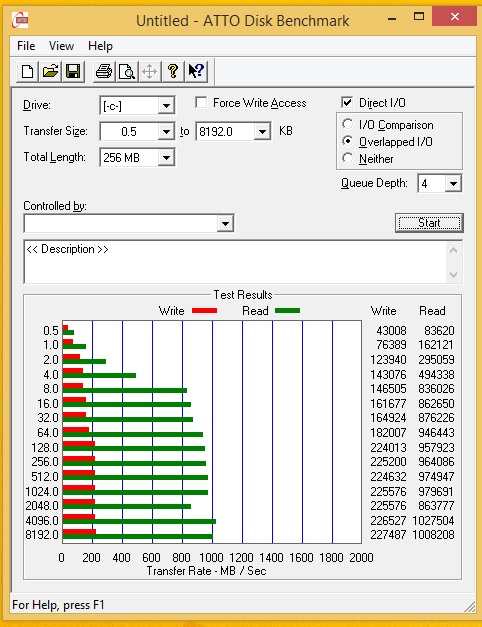
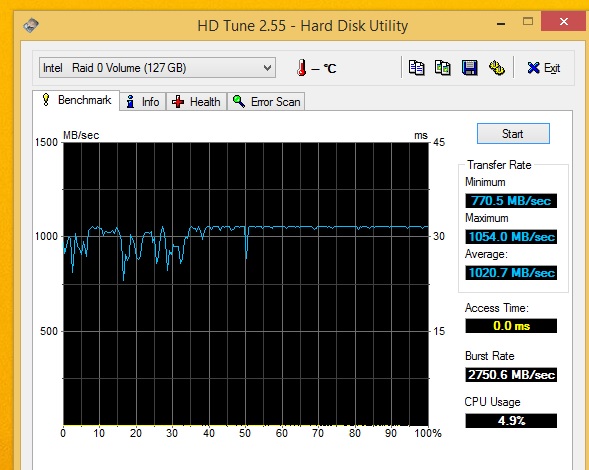
Not the fastest write speeds but the read times is awesome.
120GB is a good size for an OS partiion and I have room to put UT3 and CS GO in it as well.
This is my main OS partition for my Asus Maximus VI Impact build in my sig.
size OS partition and I'm happy with the results and have got alot of use out of these SSDs.
Not the fastest write speeds but the read times is awesome.
120GB is a good size for an OS partiion and I have room to put UT3 and CS GO in it as well.
This is my main OS partition for my Asus Maximus VI Impact build in my sig.