• Some users have recently had their accounts hijacked. It seems that the now defunct EVGA forums might have compromised your password there and seems many are using the same PW here. We would suggest you UPDATE YOUR PASSWORD and TURN ON 2FA for your account here to further secure it. None of the compromised accounts had 2FA turned on.
    Once you have enabled 2FA, your account will be updated soon to show a badge, letting other members know that you use 2FA to protect your account. This should be beneficial for everyone that uses FSFT.

Quad core really any better?


To be more precise I've seen no real gains in any games by going from dual core to quad core outside of running low resolution benchmarks which don't account for much in the real world. If I were to go by that data I've seen games that benefit from 8 cores. The picture changes quite a bit as you increase the resolution of the games. in which case any Core 2 Duo or Core 2 Quad over 3.0GHz or so won't generally see massive gains in CPU speeds. It's all GPU bound at that point.

I've seen some gains in some games at 4.0GHz on Core 2 Quad's and Core 2 Duo's but usually the difference isn't going to make something unplayable on a given card suddenly playable if that's the only variable altered.
 
alot more apps are writting in support for quad core as you get down the line it becomes alot more useful. Dont forget though in windows you can assign apps to specific cores. So if it doesn't natively run on 4 cores you can allocate it to the 4th core by hand if needed.
 
That article is almost outdated.

The newer Quads (e.g. Q9400) are super fast and run cooler. The newer quads have the 0 type stepping. Very fast.

The newer R0 and E0 stepping quads run no faster at stock speeds than the older C1 chips.
 
The newer R0 and E0 stepping quads run no faster at stock speeds than the older C1 chips.


The speed doesn't change but the way the CPU gets there does. The newer stepping technolgoy is more power efficient and cooler. Which means less resistance which makes it maintain its powerband much better.
 
More power efficient and cooler does NOT mean less resistance. In fact if something only uses 35 watts at the same voltage as something that uses 70 watts to do the same work the resistance is double for the 35 watt CPU.

Learn Ohms law and dont compare CPUs to Car engines.
 
The speed doesn't change but the way the CPU gets there does. The newer stepping technolgoy is more power efficient and cooler. Which means less resistance which makes it maintain its powerband much better.

Powerband? It's not a motor.
 
The speed doesn't change but the way the CPU gets there does. The newer stepping technolgoy is more power efficient and cooler. Which means less resistance which makes it maintain its powerband much better.

When you don't know what you're talking about, you really shouldn't say anything.
 
More power efficient and cooler does NOT mean less resistance. In fact if something only uses 35 watts at the same voltage as something that uses 70 watts to do the same work the resistance is double for the 35 watt CPU.

Learn Ohms law and dont compare CPUs to Car engines.


Literally the best reply I have seen in weeks :D
 
More power efficient and cooler does NOT mean less resistance. In fact if something only uses 35 watts at the same voltage as something that uses 70 watts to do the same work the resistance is double for the 35 watt CPU.

Learn Ohms law and dont compare CPUs to Car engines.


Don't tell me you are an electrical engineer. :D

If so you need do a little more studying.

There is alot going on in a CPU.

Heat will definitely slow down conductors in a CPU and heat will effect resistance. Resistance isn't an absolute constant in an energized electrical device.

Different materials react differently to heat in an electricaly charged state.

Yes electrical sine waves have "powerbands", areas in a sine wave where a "clean" and stable power state is acheived.

I can see that some of you don't know much about electrical theory.
 
Don't tell me you are an electrical engineer. :D

If so you need do a little more studying.

There is alot going on in a CPU.

Heat will definitely slow down conductors in a CPU and heat will effect resistance. Resistance isn't an absolute constant in an energized electrical device.

Different materials react differently to heat in an electricaly charged state.

Yes electrical sine waves have "powerbands", areas in a sine wave where a "clean" and stable power state is acheived.

I can see that some of you don't know much about electrical theory.

FIrst of all, there's no sine waves in a CPU. Everything is square. And conductors don't have a speed. Also heat lowers resistance. So a CPU that runs cooler would have higher resistance and use less power.
 
but they feel special when they think they've told some1 they're wrong :(

Though really I don't think stepping is a matter to consider for this OP.
 
What about the electrical power that feeds it?

It converted to 12vdc and filtered to limit the remains of the original sine (called ripple) to as small a value as possible. The 12vdc comes from the PSU is allowed up to 0.12v of ripple (and a good power supply keeps it far below that). By the time it converted to 1.2v by the voltage regulator that feeds the CPU, the ripple is suppressed down from 0.12v to 0.012v, under ideal conditions of course. In reality there of course would be variance, but we're dealing the theory aren't we?
 
Don't tell me you are an electrical engineer. :D

If so you need do a little more studying.

There is alot going on in a CPU.

Heat will definitely slow down conductors in a CPU and heat will effect resistance. Resistance isn't an absolute constant in an energized electrical device.

Different materials react differently to heat in an electricaly charged state.

Yes electrical sine waves have "powerbands", areas in a sine wave where a "clean" and stable power state is acheived.

I can see that some of you don't know much about electrical theory.

woulda been much cleaner to just say oops I was wrong than to follow-up with an even more vague and derailed comment with no useful info in it :)
 
but... back to the original topic which was lost a long time ago:

"My purposes for this computer will be Video editing, rendering"

once again, the small premium you pay for going quad is 100% worth it for a rendering machine, end of story. If we want to argue electrical engineering, sine waves, and powerbands, we can create another thread :)
 
My CR125 has a powerband. :) But I don't think Honda makes CPU's for PC's.
 
but... back to the original topic which was lost a long time ago:

"My purposes for this computer will be Video editing, rendering"

once again, the small premium you pay for going quad is 100% worth it for a rendering machine, end of story. If we want to argue electrical engineering, sine waves, and powerbands, we can create another thread :)


I didn't mean for this to happen.
I agree with you.

I do think that the stepping technology used in the Quad Cores should be considered in how it operates. I have not been able to find any type of "white paper" put our from Intel that documents the electrical performance of the new E0/R0 stepping but it seems like all the reviews that have measured temps and power usage claim that the new stepping technology in certain revised CPUs are more energy efficient and are cooler. They also claim that they can be overclocked more easily.

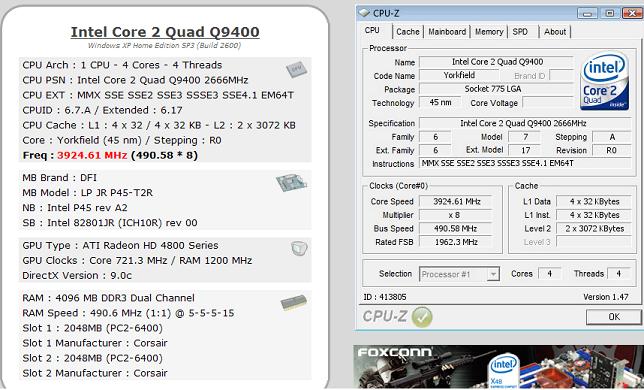
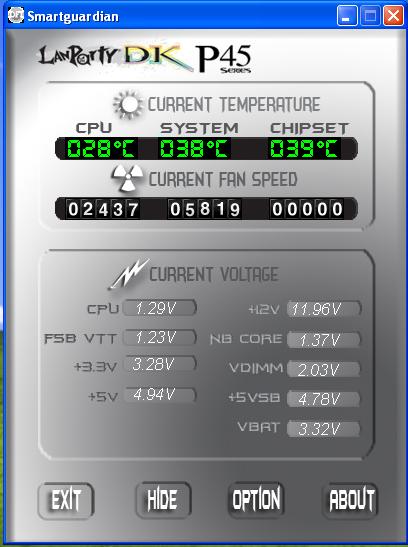
I had a Q9400 for almost 2 weeks. The temps seemed low. I'm don't claim to be great tweaker but I do enjoy tweaking. The Q9400 with R0 stepping was easier to OC than a Q9550 with C1 stepping which I also had. I'm using a DFI P45 JR T2RS MB.

Some proof of my own:

Q9400

490FSBQ9400.JPG


490FSBfastQ9400.JPG


http://valid.x86-secret.com/show_oc.php?id=413805


http://www.techpowerup.com/gpuz/5d9h7/
 
all the reviews that have measured temps and power usage claim that the new stepping technology in certain revised CPUs are more energy efficient and are cooler. They also claim that they can be overclocked more easily.

No personal proof is needed of this. It's pretty much accepted that newer CPU models and steppings usually have a trend toward more efficiency and easier OC's, although not always. Whether G0, E0, R0 or any other 0 is better, all the equivalent quads will be better for the OP's suggested primary use vs a dual core. Even a 2 year old Q6600 at 3.6 which is very common will be better than a brand spanking new E8600 at above 4.0 with newer steppings/architecture/efficiency/cooling/etc for a much lower price as a rendering machine.
 
It's still a good read and it's related to the thread.

Where did I say otherwise? I was only making the point that you're vastly exaggerating the power usage and temperature improvements with the E0 stepping. There's essentially no practical difference between C0/C1 and E0/R0 aside from overclocking headroom, but you're talking about the new chips like they're the second coming.
 
but you're talking about the new chips like they're the second coming.


:D


I didn't realize that. It's all a matter of interpretation. :D


Everything that I have read leads me to believe that the revised chips that use the improved stepping technology are a little better. :)
 
Everything that I have read leads me to believe that the revised chips that use the improved stepping technology are a little better. :)

A little better, yes. But certainly not the massive improvement you've been making them out to be, which is what everyone has been trying to tell you.
 
To be more precise I've seen no real gains in any games by going from dual core to quad core outside of running low resolution benchmarks which don't account for much in the real world. If I were to go by that data I've seen games that benefit from 8 cores. The picture changes quite a bit as you increase the resolution of the games. in which case any Core 2 Duo or Core 2 Quad over 3.0GHz or so won't generally see massive gains in CPU speeds. It's all GPU bound at that point.

I've seen some gains in some games at 4.0GHz on Core 2 Quad's and Core 2 Duo's but usually the difference isn't going to make something unplayable on a given card suddenly playable if that's the only variable altered.

However, games based on the Unreal 3 engine DO use more threads for the physics. So regardless of the resolution you are running the physics of the havok engine is multi threaded and taking advantage of the quad core. Also, with a quad core you will see higher minimums making gameplay smoother. If you are using Vista and have the 40 stock services that run on a fresh boot I believe my quad is smoother here as well. Vista has so many things happening in the backgound with my E8500 @ 4.5ghz I will get sudden dips in performance I dont with my Q6600 @ 3.8ghz.
 
Found a good review in support of modern Intel Dual Core 2 CPUs with E0 stepping* (dated end of July 2008)

http://www.xbitlabs.com/articles/cpu/display/core2duo-e8600.html

*No R0 or E0 Quad Core CPUs used in comparisons.

Seriously, who games at 1024x768?? They need to use a higher resolution which will take the CPU out of the equation more and test games that ARE multi threaded to show the performance difference. Check out some of the CPU scaling artices at Legionhardware.com - they are very good.

http://www.legionhardware.com/document.php?id=775
http://www.legionhardware.com/document.php?id=770
 
However, games based on the Unreal 3 engine DO use more threads for the physics. So regardless of the resolution you are running the physics of the havok engine is multi threaded and taking advantage of the quad core. Also, with a quad core you will see higher minimums making gameplay smoother. If you are using Vista and have the 40 stock services that run on a fresh boot I believe my quad is smoother here as well. Vista has so many things happening in the backgound with my E8500 @ 4.5ghz I will get sudden dips in performance I dont with my Q6600 @ 3.8ghz.

HA! I wish my vista install had *only* 40 processes running... I'm near 80. But hey, that's what 8GB of ram and the quad cores are for right? ;)
 
It's simple really:

If you own a quad core, quad cores are better at everything.

If you own a dual core, dual cores are better at everything.

This forum is nothing but a massive struggle of egos and is really quite embarrassing.
 
It's simple really:

If you own a quad core, quad cores are better at everything.

If you own a dual core, dual cores are better at everything.

This forum is nothing but a massive struggle of egos and is really quite embarrassing.

My e-peen is bigger than your e-peen. LOL

100% agree.
 
You'll definitely see the difference in those video editing apps.
Bull.

(Q9450 Quadcore @ 3.4GHz w/ 12MB Cache) + (4GB DDR2 RAM) + (HD4850) + (SATA-II w/ 200GB+ Freespace) + (Diskeeper Defragmented) = (AMD Athlon XP @ 2GHz w/ 256KB Cache [SocketA]) + (1.5GB DDR RAM) + (6800XT) + (SATA-I w/ 200GB+ Freespace) + (Diskeeper Defragmented).

No performance gain from my SocketA build to a whole upgrade. I get the same framerate as I do on my old SocketA build, and I must also mention that through the upgrade that includes formatting my harddrive completely and reinstalling Windows XP from scratch.

Eat.

I hope so, I just read that Adobe Premiere Pro doesn't even support 64 bit and will only utilize 3gb of memory bleh
Not really (at least for me). It isn't even until 1.5GB of memory usage that Premiere decides to crash due to a terrible memory leak.

No benefit whatsoever in video editing.

Otherwise help me solve MY problem @ http://hardforum.com/showthread.php?p=1033079230#post1033079230 to prove me wrong.


And quadcore CPUs can actually make things slightly worse, but it all depends on how efficient multithreading was programmed for 2+ cores. If none were coded though, you shouldn't worry. Might aswell get a quadcore; why not? (http://hardforum.com/showthread.php?p=1033022268#post1033022268)
 
to put it simply, if you didn't or dont see an improvement, you did something wrong. Especially if you use apps that support SSE4.1 and are multi threaded.

Anyway

Multithreaded SSE4.1 supporting apps:
All of VSO's software. ConvertxtoDVD, etc
All of TMPEG's software.

and a few others that I can't remember, all are wrote for the new 45nm quads.
 
To be more precise I've seen no real gains in any games by going from dual core to quad core outside of running low resolution benchmarks which don't account for much in the real world. If I were to go by that data I've seen games that benefit from 8 cores. The picture changes quite a bit as you increase the resolution of the games. in which case any Core 2 Duo or Core 2 Quad over 3.0GHz or so won't generally see massive gains in CPU speeds. It's all GPU bound at that point.

I've seen some gains in some games at 4.0GHz on Core 2 Quad's and Core 2 Duo's but usually the difference isn't going to make something unplayable on a given card suddenly playable if that's the only variable altered.

I think there are two things that are mixed up here:
1) Whether or not the software is written in a way to distribute its workload over multiple threads/cores (and get a performance benefit from it).
2) Whether or not more cores make the game run faster.

Now 1) is a requirement for taking advantage of multicore processors, but it is not a guarantee. 2) will only happen if the game is not limited by other factors, such as graphics/IO etc.

I am inclined to stick with 1) as the definition of whether a game benefits from multicore, not 2). Namely, 1) can only be solved by rewriting the game. 2) can be solved by changing the game settings and/or hardware configuration.
 
Still not sold quad cores yet especially when it comes to games. Graphics are the limiter. SLI and Triple SLI need more CPU horsepower obviously. However, games like Lost Planet XC show a significant gain from multicore CPU's.

I feel after reading some of these posts that the discussion always turns into dual-core vs.quad-core to "justifying my purchase."

BUT, on [H] I expect nothing less than the best out of technology and thats fine with me. Carry on.
 
How many times must this come up? It is very simple.

If you run mostly professional applications, they are more likely to benefit from multi-threading as most of these applications will use every ounce of power available. Check with the application publisher though. Examples that I use/have used personally include 3ds max and Rhino 3D. They tear it up on multithreaded (quad) compared to "only" dual or single core CPUs. If you run games, you really should figure out what the multithreading case is for each game as some developers are more into multithreading than others. Heck, some games don't need it while others benefit greatly.

Nothing's "better" in an objective sense that applies to everyone regardless of what they do. It's based on your subjective needs as a computer user!
 
Back
Top