![[H]ard|Forum](/styles/hardforum/xenforo/logo_dark.png)
Phaedrus2129
n00b
- Joined
- Jan 7, 2011
- Messages
- 36
"Make sure your power supply is 80+ certified!"
It's become almost a mantra of PSU recommendations in the past few years. Make sure your power supply is 80+, 80+ Silver, 80+ Gold. But how many know what it really means, and how important it is? If you think you know, odds are you're wrong!
Efficiency is a measure of how much of the power a PSU draws from the wall actually reaches the computer. Thus if a PSU is 80% efficient, and is drawing 375W from the wall, only 300W will reach the computer, and the rest will be given off as heat.
One common misconception, however, is that this means that the computer is getting less power than it needs/wants(?). But this is false. The wording is tricky. The amount of the power the computer needs is the independent variable; that changes on its own and is not affected by the PSU at all. The power drawn from the wall is the dependent variable, and changes in response to the independent, the power the computer is drawing.
The amount of power one draws from the wall is given thusly:
P(wall) = P(comp) / efficiency
So if your computer is demanding 300W from the power supply, which is, say, 70% efficient:
P(wall) = 300W / 0.70 = 430W
(actually it's 428.something, but I'm rounding)
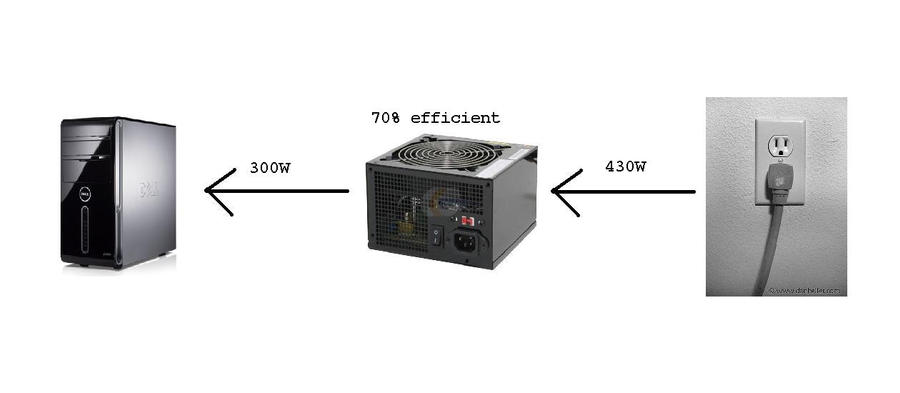
Having a more efficient power supply means that less power is wasted as heat, thus you draw less power from your wall socket. Let's say your PSU is 80% efficient:
P(wall) = 300W / 0.80 = 375W
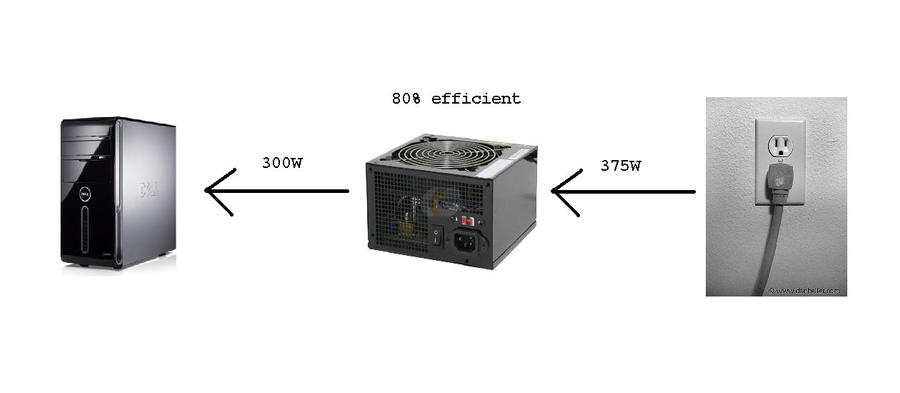
Thus having a more efficient power supply means you draw less power from your wall socket, thus have slightly lower power bills.
But a power supply's efficiency isn't always the same. Efficiency changes with the load being put on the power supply. Efficiency is generally lowest when a PSU is delivering very little power, or when delivering power close to what it's rated for. It's highest in the middle, around 40-60%:
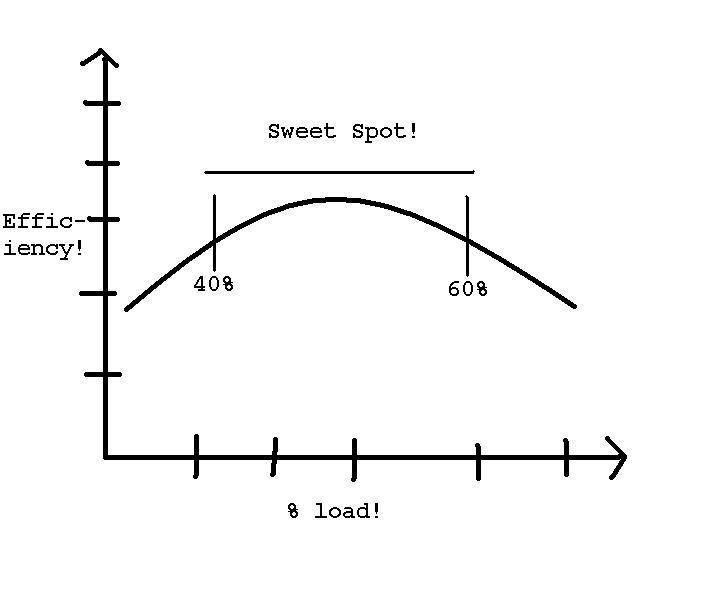
So you should get a PSU the size so that your peak draw is around 50% of the PSU's load, right? FALSE, at least in most cases. Think: 90% of the time your computer will be idling, usually drawing only 75W-200W, depending on the computer. So you want your computer to be very efficient in that power range. Generally you want your idle power draw to fall into ~30%-40% of the PSU's rated wattage, and your peak power draw (think LinX + Furmark + HDTune all at once) to fall into ~70%-80% of the PSU's rated wattage.
The exception is with computers that will be under heavy load all the time, such as folding rigs. These should have the extra headroom anyway; a power supply should be chosen so that the computer is drawing ~60-70% of the PSU's rated wattage under folding power consumption levels. But this does not apply to computers that will be idle most of the time, like 99% are.
So what's this 80+ stuff? 80+ is an organization that tests power supplies for efficiency and a handful of other things (such as power factor correction, which we can ignore for now). 80+ has five certification levels: 80+, 80+ Bronze, 80+ Silver, 80+ Gold, and 80+ Platinum (the latter not yet being attained in modern commercial power supplies). The higher the PSU's efficiency at certain load levels, the higher the certification level.
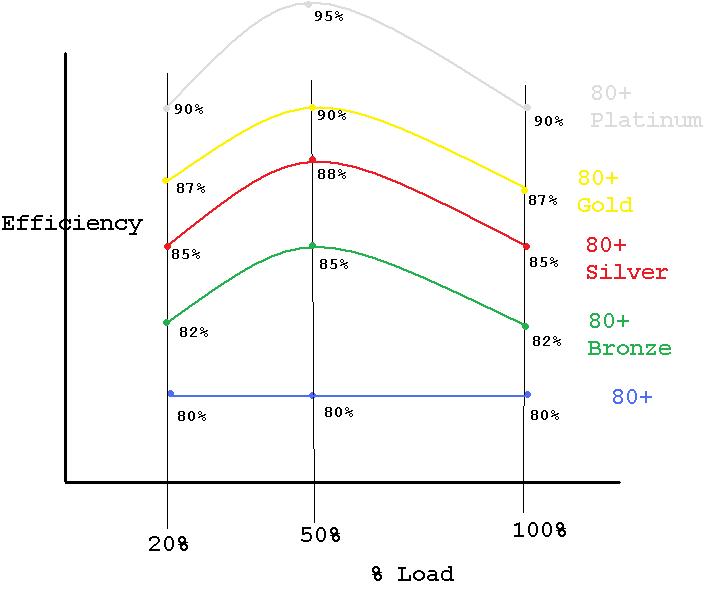
However, 80+ is flawed, for a couple of reasons. First is that it only tests at three load levels: 20%, 50%, and 100%. This leads to power supplies being optimized so that their efficiency is highest in that wattage range. Theoretically, one could make a power supply that was efficient only at those load levels:
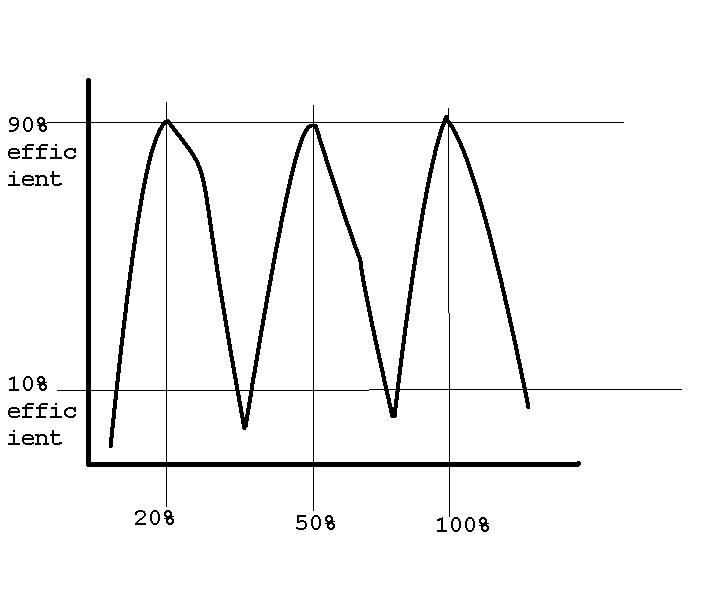
Though this is unlikely and I doubt that there are any PSUs like that on the market.
The second, and more important, problem is that 80+ only tests power supplies at room temperature (23*C, though engineering room temp is 25*C, so why the difference I don't know). A power supply's efficiency goes down as heat goes up, so a power supply that might meet 80+ certification standards at their temperature testing levels, might not achieve those efficiency numbers in real world conditions of 30*C-40*C, or worst case condition levels of 50*C.
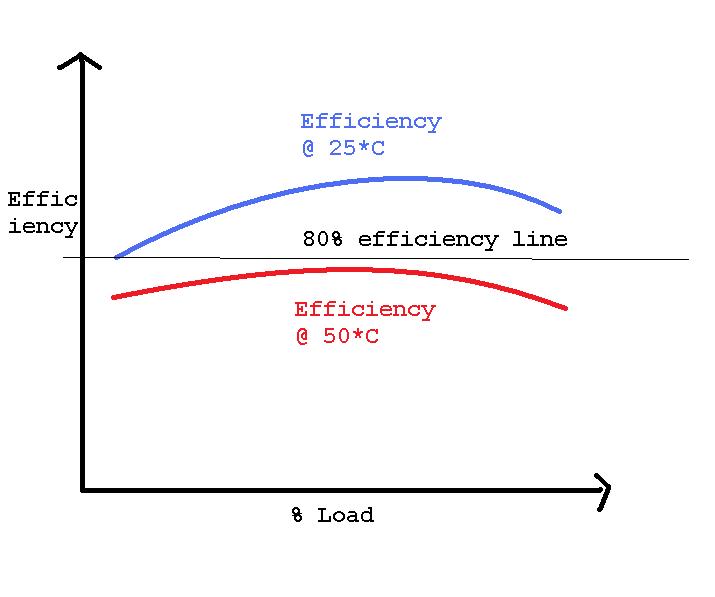
So 80+ doesn't really mean much, even when it comes to efficiency, since it only applies if your power supply is in an unrealistically cool environment.
80+ means even less when it comes to a power supply's overall quality. 80+ does not make a PSU good. Efficiency is just one aspect of PSU quality. While high-end power supplies tend to be fairly efficient, not all efficient power supplies are high-end. Many shoddy manufacturers will sacrifice important things such as ripple suppression, voltage regulation, or build quality in order to make a unit that meets 80+ or higher efficiency levels, so they can slap that big 80+ label on there, because it's good marketing. Efficiency is just icing on the cake; and it doesn't matter how much icing is on there if the cake is made of rusty nails and cyanide.
Take home message? Efficiency and 80+ certification is just one aspect of a power supply's quality, not the be-all, end-all. It's worth taking note of, but you should check reviews to make sure of DC output quality (ripple/noise suppression and voltage regulation) and build quality (capacitor choice and soldering quality), as well as protections sets and aesthetics/functionality.
Thanks for reading.
It's become almost a mantra of PSU recommendations in the past few years. Make sure your power supply is 80+, 80+ Silver, 80+ Gold. But how many know what it really means, and how important it is? If you think you know, odds are you're wrong!
Efficiency is a measure of how much of the power a PSU draws from the wall actually reaches the computer. Thus if a PSU is 80% efficient, and is drawing 375W from the wall, only 300W will reach the computer, and the rest will be given off as heat.
One common misconception, however, is that this means that the computer is getting less power than it needs/wants(?). But this is false. The wording is tricky. The amount of the power the computer needs is the independent variable; that changes on its own and is not affected by the PSU at all. The power drawn from the wall is the dependent variable, and changes in response to the independent, the power the computer is drawing.
The amount of power one draws from the wall is given thusly:
P(wall) = P(comp) / efficiency
So if your computer is demanding 300W from the power supply, which is, say, 70% efficient:
P(wall) = 300W / 0.70 = 430W
(actually it's 428.something, but I'm rounding)
Having a more efficient power supply means that less power is wasted as heat, thus you draw less power from your wall socket. Let's say your PSU is 80% efficient:
P(wall) = 300W / 0.80 = 375W
Thus having a more efficient power supply means you draw less power from your wall socket, thus have slightly lower power bills.
But a power supply's efficiency isn't always the same. Efficiency changes with the load being put on the power supply. Efficiency is generally lowest when a PSU is delivering very little power, or when delivering power close to what it's rated for. It's highest in the middle, around 40-60%:
So you should get a PSU the size so that your peak draw is around 50% of the PSU's load, right? FALSE, at least in most cases. Think: 90% of the time your computer will be idling, usually drawing only 75W-200W, depending on the computer. So you want your computer to be very efficient in that power range. Generally you want your idle power draw to fall into ~30%-40% of the PSU's rated wattage, and your peak power draw (think LinX + Furmark + HDTune all at once) to fall into ~70%-80% of the PSU's rated wattage.
The exception is with computers that will be under heavy load all the time, such as folding rigs. These should have the extra headroom anyway; a power supply should be chosen so that the computer is drawing ~60-70% of the PSU's rated wattage under folding power consumption levels. But this does not apply to computers that will be idle most of the time, like 99% are.
So what's this 80+ stuff? 80+ is an organization that tests power supplies for efficiency and a handful of other things (such as power factor correction, which we can ignore for now). 80+ has five certification levels: 80+, 80+ Bronze, 80+ Silver, 80+ Gold, and 80+ Platinum (the latter not yet being attained in modern commercial power supplies). The higher the PSU's efficiency at certain load levels, the higher the certification level.
However, 80+ is flawed, for a couple of reasons. First is that it only tests at three load levels: 20%, 50%, and 100%. This leads to power supplies being optimized so that their efficiency is highest in that wattage range. Theoretically, one could make a power supply that was efficient only at those load levels:
Though this is unlikely and I doubt that there are any PSUs like that on the market.
The second, and more important, problem is that 80+ only tests power supplies at room temperature (23*C, though engineering room temp is 25*C, so why the difference I don't know). A power supply's efficiency goes down as heat goes up, so a power supply that might meet 80+ certification standards at their temperature testing levels, might not achieve those efficiency numbers in real world conditions of 30*C-40*C, or worst case condition levels of 50*C.
So 80+ doesn't really mean much, even when it comes to efficiency, since it only applies if your power supply is in an unrealistically cool environment.
80+ means even less when it comes to a power supply's overall quality. 80+ does not make a PSU good. Efficiency is just one aspect of PSU quality. While high-end power supplies tend to be fairly efficient, not all efficient power supplies are high-end. Many shoddy manufacturers will sacrifice important things such as ripple suppression, voltage regulation, or build quality in order to make a unit that meets 80+ or higher efficiency levels, so they can slap that big 80+ label on there, because it's good marketing. Efficiency is just icing on the cake; and it doesn't matter how much icing is on there if the cake is made of rusty nails and cyanide.
Take home message? Efficiency and 80+ certification is just one aspect of a power supply's quality, not the be-all, end-all. It's worth taking note of, but you should check reviews to make sure of DC output quality (ripple/noise suppression and voltage regulation) and build quality (capacitor choice and soldering quality), as well as protections sets and aesthetics/functionality.
Thanks for reading.

