• Some users have recently had their accounts hijacked. It seems that the now defunct EVGA forums might have compromised your password there and seems many are using the same PW here. We would suggest you UPDATE YOUR PASSWORD and TURN ON 2FA for your account here to further secure it. None of the compromised accounts had 2FA turned on.
    Once you have enabled 2FA, your account will be updated soon to show a badge, letting other members know that you use 2FA to protect your account. This should be beneficial for everyone that uses FSFT.

It's not the ROP count...!

extide

2[H]4U
Joined
Dec 19, 2008
Messages
3,494
So, a lot of people seem to be thinking that the 64 ROP's is severely hampering Fiji. I think having those ROP's attached to the HBM allows them to operate at a much higher performance level than otherwise, and really the deficiency is geometry, not the ROP's. That's my theory anyways, check it out...

(I posted this post in a different thread, but it really is more appropriate to be here, in it's own thread.)

Take a look at the pixel fill rate graphs on anadtech's review:
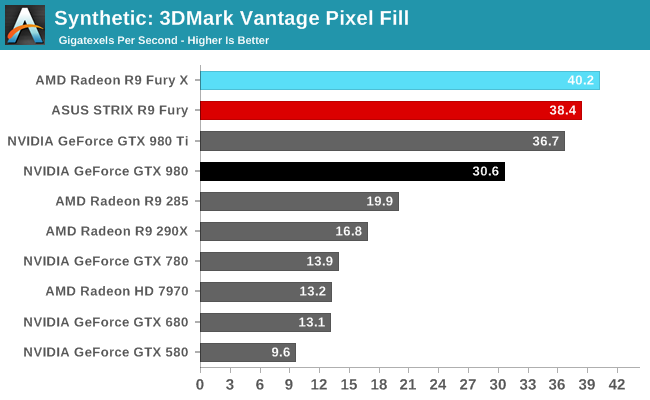
75682.png


Fury tops the charts! If it really were a ROP issue, this would not be the case.

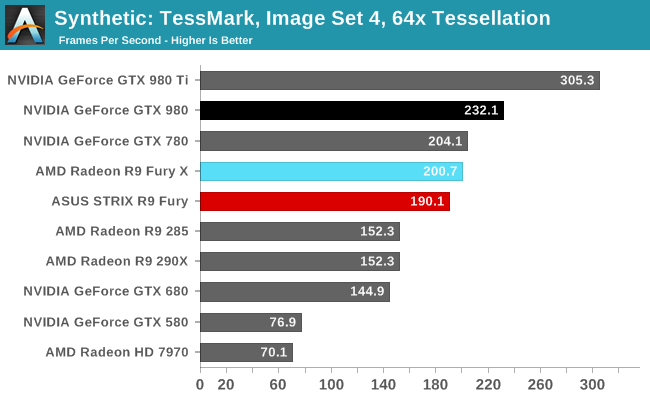
See here, this is tesselation, which is geometry heavy:
75680.png

GTX 780 beats Fury!

I know tessellation isn't purely a geometry test, but it's pretty much the closest thing we have.

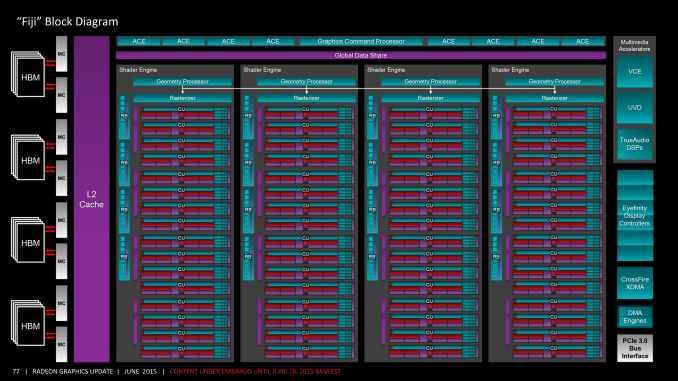
nVidia has historically has way better geometry performance than AMD, but I think AMD carried over pretty much the same geometry stuff from Hawaii straight into Fiji. In fact it seems like it is so crippled that it rarely ever actually gets to really utilize all 4,096 of those shaders. (Note the smaller than expected gap between Fury and Fury X, as well as the fact that 390X performs so close in a lot of cases) Another thing to consider is the fact that the Fury cards tend to do better (vs 980/980ti) at higher resolutions, than lower resolutions, which also indicates that this is not a ROP issue.

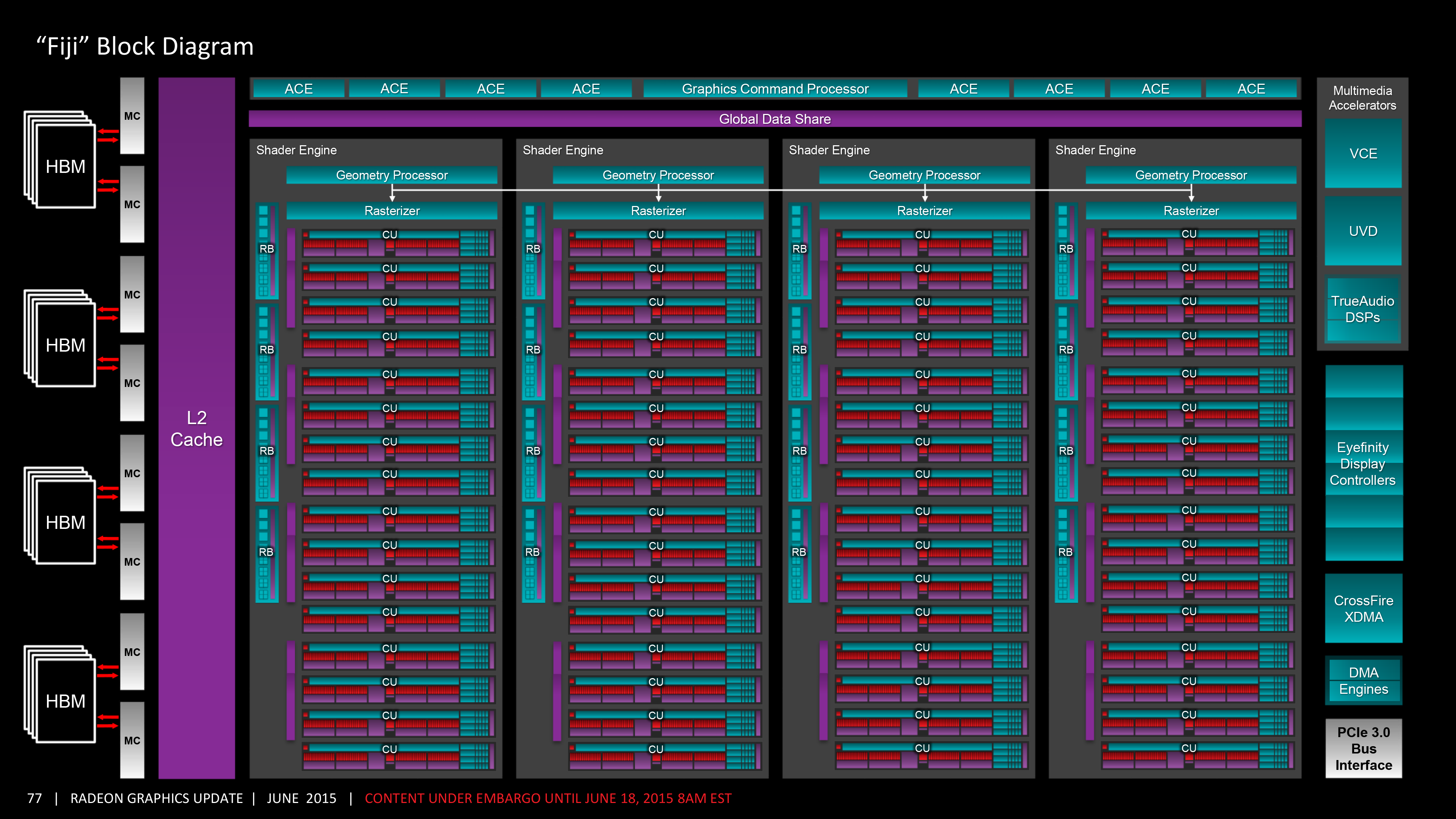
Fiji Block Diagram: (Clickable)

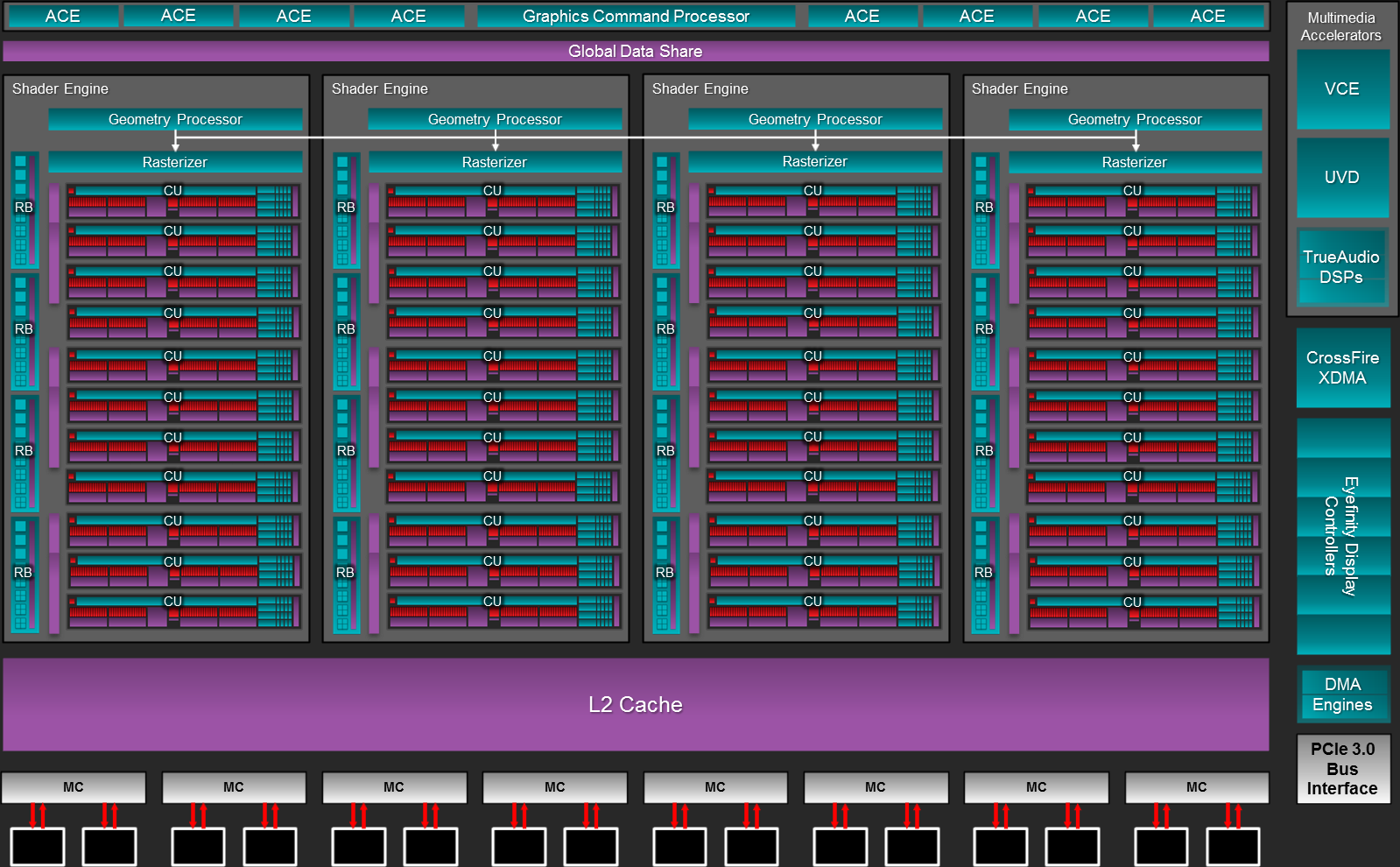
Hawaii Block Diagram: (Clickable)
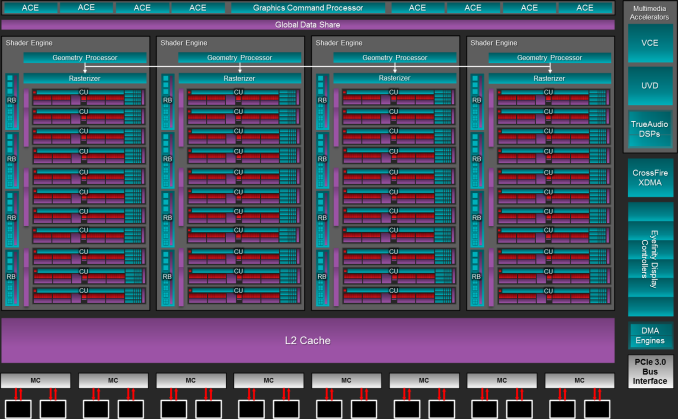

Exact same 4 geometry engines. All they did was strap on a shitload of shaders, and HBM.

HOPEFULLY they fix this in next gen!

Thoughts?
 
Last edited:
The 3DMark test is pushing texels, which involves the backend filtering processors as well. Fiji has more texture units and SMPs than Maxwell. Those combined with the higher memory bandwidth are what is making competitive in texel fillrate. This performance is reflected in the closing gap at higher resolutions between the 980 Ti and Fury X. The performance deficit at 1440p can be as high as 28%, but closes to around 4-8% at 4k. Between the comparitively worse texture performance from NVIDIA and bad triangle performance from AMD, it really comes out in wash.

All I can say is I'm really excited for the next hardware generation on 16nm from both camps.
 
That's pixel fill rate, not texel fill rate. They are separate tests -- see the original review:

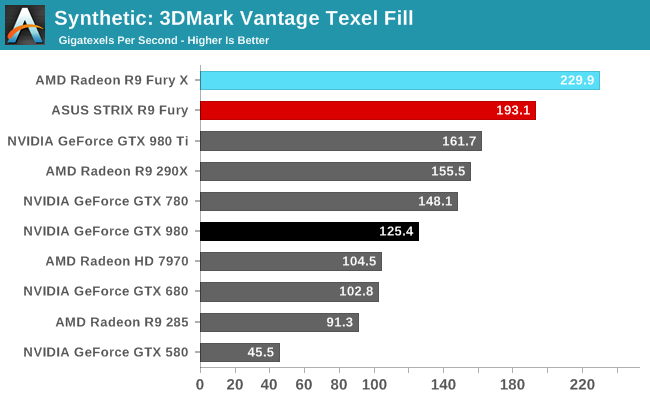
FWIW, here is the texel fill rate chart -- and as you suggested, it scores even higher compared to the other cards here:
75681.png
 
Ever since Unified Shader Model was introduced and GPUs moved from separate pixel/vertex pipelines (heck even then really, ATI liked its pixel shaders) to this new model ATI has always leaned toward a future thinking process that 'shaders rule all.' In that thinking ATI from that point forward pushed shader/pixel performance over geometry/vertex.

ATI felt everything would be shader driven in the future, it was a leap at the time to jump to more shader oriented processing, and ATI took the leap, maybe a bit too early for the games out at the time, and they've kind of been following the same path of 'shaders rule all' since then even after AMD took over.

There has always been a definite lean towards greater shader/pixel potential versus geometry/vertex. Whereas, the opposite is almost true from NVIDIA, it focused very heavily on geometry in the past few generations.

Why can't someone just do both excellent.
 
Ever since Unified Shader Model was introduced and GPUs moved from separate pixel/vertex pipelines (heck even then really, ATI liked its pixel shaders) to this new model ATI has always leaned toward a future thinking process that 'shaders rule all.' In that thinking ATI from that point forward pushed shader/pixel performance over geometry/vertex.

ATI felt everything would be shader driven in the future, it was a leap at the time to jump to more shader oriented processing, and ATI took the leap, maybe a bit too early for the games out at the time, and they've kind of been following the same path of 'shaders rule all' since then even after AMD took over.

There has always been a definite lean towards greater shader/pixel potential versus geometry/vertex. Whereas, the opposite is almost true from NVIDIA, it focused very heavily on geometry in the past few generations.

Why can't someone just do both excellent.


This post made me realize that I, and probably most people, have limited to no idea what these specific aspects of a gpu contribute to visually.

Someone should do a detailed youtube video that goes over specific rendering effects and what areas of the gpu that tends to tax.

I still want to see how different approaches tackle the same styles of effects like hair/fur. More tessellation vs more compute? I have no idea which is better, IS it better to use more geometry? Or more shaders? Am I even asking correct and proper questions? I don't know because this has never been explicitly covered in what I've read/seen. Hence, someone should create a video detailing these things, with game examples and commentary.

Calling on hard forums, or anandtechforums, or beyond3d, someone, somewhere, HELP!

PS, once we get the die shrink I'd imagine we'll be seeing both camps beef up both geometry and shader throughput, but that still begs the question, how much should each be enhanced? What are games and game devs going to want to use more of in upcoming games? What kinds of effects and physics is going to be employed and what areas of the gpu will see the most work? We kind of need to know what game devs want and perhaps what they and the gpu makers wish they would move towards to see what's going to be taxed more.
 
All I see is faster fill rate, no idea how you just jumped to better shader...

Any test shows that? Or performance in certain games?
 
All I see is faster fill rate, no idea how you just jumped to better shader...

Any test shows that? Or performance in certain games?

Brent was talking in general, and I mean you have a few main parts of a GPU. Shader power (compute), geometry/vertex, and then pixel fill rate which is directly related to the ROP's.

AMD has, especially since GCN, had pretty great compute performance, and Fury as we all know has 4,096 shaders which is a TON! I mean AMD has had more shaders than nVidia in their competing designs for quite a while, although they aren't necessarily directly comparable because they are quite a different architecture, but I would say I have to agree with what Brent said.

And I mean that trend is taking place, I mean stuff like SMAA/FXAA is all purely compute, running physics or other general compute is all done on the shaders and doesnt use geometry hardware. I agree that I think they went a little bit too far with it though, especially on the Fiji.
 
You can observe something else using alternative data points -

http://techreport.com/review/28513/amd-radeon-r9-fury-x-graphics-card-reviewed/4

I still want to see how different approaches tackle the same styles of effects like hair/fur. More tessellation vs more compute? I have no idea which is better, IS it better to use more geometry? Or more shaders? Am I even asking correct and proper questions?

The problem with this line of questioning is the assumption that there exists a universal "best way" approach to graphics (once you consider all factors) much less that any of the parties remotely know the answer to that themselves.

There is also the issue of what is academic and what is practical. Basically in the case of the latter, which is real life, you need to work within the constraints what currently exists in reality.
 
You can observe something else using alternative data points -

http://techreport.com/review/28513/amd-radeon-r9-fury-x-graphics-card-reviewed/4


The problem with this line of questioning is the assumption that there exists a universal "best way" approach to graphics (once you consider all factors) much less that any of the parties remotely know the answer to that themselves.

There is also the issue of what is academic and what is practical. Basically in the case of the latter, which is real life, you need to work within the constraints what currently exists in reality.

I'm sure there are multiple ways to skin a cat, but the constant refusal by some game devs/publishers to engineer a best effort to optimize each gpu vendor in terms of performance already rigs the performance game.

On the practical front, we kind of already can look at that. The hair/fur example is useful because we actually have two different methods of achieving a similar graphical effect, producing more realistic hair and fur in games.

One makes more use of tessellation, the other more use of compute. No one is asking game devs to come up with some fancy new rendering technique that no gpu maker has hardware to run. I just want to see someone, just ONCE, try their best effort to create realistic hair/fur using both hairworks and tressfx.

Let's see what the end result looks like using each technique, let's see what performance impacts are had on each others hardware. Let's see more and more titles do the same if they have the capacity for it. If we see over and over that one technique produces better results (some mix of better visuals and or performance for visuals gained) then we can finally say that x vendors preference is generally superior to y vendors preference. We can't see that kind of analysis though because the devs usually use one or the other.

Don't you want to see it? Just out of curiosity? I want to find out what the best techniques are, so those best practices can be propagated (and eventually engineered for in hardware).


It's the difference between wanting to know who the best fighter is vs just looking a who wins a particular fight (where say one of the fighters was poisoned before, or is wearing weights that slow his movements). The game dev world seems filled to bursting with all sorts of caveats that color performance by software design choices that slant things this way or that way. But what we ought to want to know is which methods work better, which fighter is generally better, which team is better. That usually requires at least trying to start them from the same place or giving them both the ability to fight on their best footing, not gimping them through circumstance or software.
 
Last edited:
Brent was talking in general, and I mean you have a few main parts of a GPU. Shader power (compute), geometry/vertex, and then pixel fill rate which is directly related to the ROP's.

AMD has, especially since GCN, had pretty great compute performance, and Fury as we all know has 4,096 shaders which is a TON! I mean AMD has had more shaders than nVidia in their competing designs for quite a while, although they aren't necessarily directly comparable because they are quite a different architecture, but I would say I have to agree with what Brent said.

And I mean that trend is taking place, I mean stuff like SMAA/FXAA is all purely compute, running physics or other general compute is all done on the shaders and doesnt use geometry hardware. I agree that I think they went a little bit too far with it though, especially on the Fiji.

That's the confusing part, we all know Fury X has faster memory so it's faster in some thing like fill rate etc is very understandable and has been shown.

We also know 980 ti is stronger in polygon, so it performs better when it comes to things like heavy tessellation.

But we don't see Fury X being faster in shader such as all the post processing effect does not seems slow down a 980 ti any more than a fury X, in many cases less, because 980 ti is overall a faster card.
 
That's the confusing part, we all know Fury X has faster memory so it's faster in some thing like fill rate etc is very understandable and has been shown.

We also know 980 ti is stronger in polygon, so it performs better when it comes to things like heavy tessellation.

But we don't see Fury X being faster in shader such as all the post processing effect does not seems slow down a 980 ti any more than a fury X, in many cases less, because 980 ti is overall a faster card.

Yeah, it does kinda seem like there may be some other bottleneck that really doesnt allow the Fury X to actually utilize all of those shaders at 100% capacity..
 
Back
Top