• Some users have recently had their accounts hijacked. It seems that the now defunct EVGA forums might have compromised your password there and seems many are using the same PW here. We would suggest you UPDATE YOUR PASSWORD and TURN ON 2FA for your account here to further secure it. None of the compromised accounts had 2FA turned on.
    Once you have enabled 2FA, your account will be updated soon to show a badge, letting other members know that you use 2FA to protect your account. This should be beneficial for everyone that uses FSFT.

Is Intel becoming irrelevant?

Even dGPU sales are trending down.

People have less reason to buy and probably less disposable income overall as well.

Maybe trending down a little compared over the passed several years but GPU sales have been very good the last year or so.

NVIDIA FY 2016 Q2 Results: GPU Sales Are Strong But Write Downs Hurt Bottom Line

What is driving growth right now is its GPU business. Revenue for GeForce GPUs grew 51%, and NVIDIA has continued to see strength in the PC gaming sector.
 
Exactly that. IPC improvements by Intel even with newer architectures is small and even smaller with die-shrinks. Compare that with Penryn to Bloomfield and onwards. From Ivy Bridge and newer architectures and die-shrinks the gains over multiple die-shrinks and architectures have been more focused on features and power consumption than actual IPC improvements.
How much do you actually think they can improve IPC? Do you even know what IPC means? It's instructions per clock and it's already greater than one! The reason IPC used to go up so much between chips is because IPC used to be SUPER low, like the UNIVAC 1 had an IPC of 0.0008, the intel 8086 was 0.066. The 386 went from 0.13 to 0.348 in the 486, a 3 fold increase in IPC alone!

You see back in the day there was only so many transistors to go around and each one had to pull multiple duty so each instruction consisted of setting up the CPU guts to process all or part of a command, then the next cycle would do the processing, and then often times it would have to repeat this process several times re-configuring internal logic pathways then progressing through the command until it had a result. As process nodes shrank and transistors became cheaper they'd dedicate more and more of them to dedicated tasks, multiplication and division units, integrated floating point processors, until each instruction basically has it's own dedicated pathway so when that instruction comes in one quick pump of the clock and everything is done. At this point IPC is basically 1, to get it greater than one they had to add predictive features where the CPU would calculate multiple possibilities for branches in the software and try to best guess what would be next, if it was right, then bonus the next chunk of code was done and you saved a bunch of time, if not, well throw it away and do the right thing. With prediction algorithms and multiple internal pathways processing out the various possibilities for each thread intel has managed to get IPC up to as high as NINE for some tasks.

The problem is how do you effectively go up from there? To get the same performance boost going from the 386 to 486 architectures would require an IPC of 27! Another problem is that hitting that magic point where IPC stopped increasing as much between node cycles due to it being pretty much as high as it could get and requiring multi-core to take its place and the discovery of the physical barrier in silicon due to voltage not dropping as much as it used to and frequency not being able to scale as high all happened within a few years of each other. And all this also happened around the same time AMD stopped being competitive, possibly part of the reason AMD suddenly had such a hard time competing, so now all we hear is "intel isn't trying any more!"

This isn't a service monopoly, people don't HAVE to pay intel every month to keep using their CPU, even if intel had a 100% monopoly on all the CPUs the only way they could get people to buy new shit is to make new shit worth buying. You don't think if they could make a CPU twice as fast and use half the power every 6 months they wouldn't to drive people to upgrade more often instead of the current situation where people are like "eh my 5 year old 2600k is still good enough I'll wait another few years" that they'd sit on what they had? The fact is physics and the abundance of transistors to give each instruction its own chunk of silicon has made any further performance increases for a single thread very difficult. Most IPC improvements tend to be along the lines of analyzing software code and finding common sets of instructions and consolidating them into one instruction such as SIMD.

There's a chart showing the advancement of instructions per second and the relation to total IPC of the CPU and IPC per core here:
Instructions per second - Wikipedia, the free encyclopedia

Seriously if you can figure out a good way to do better than NINE IPC, patent it and retire.
 
How much do you actually think they can improve IPC? Do you even know what IPC means? It's instructions per clock and it's already greater than one! The reason IPC used to go up so much between chips is because IPC used to be SUPER low, like the UNIVAC 1 had an IPC of 0.0008, the intel 8086 was 0.066. The 386 went from 0.13 to 0.348 in the 486, a 3 fold increase in IPC alone!

You see back in the day there was only so many transistors to go around and each one had to pull multiple duty so each instruction consisted of setting up the CPU guts to process all or part of a command, then the next cycle would do the processing, and then often times it would have to repeat this process several times re-configuring internal logic pathways then progressing through the command until it had a result. As process nodes shrank and transistors became cheaper they'd dedicate more and more of them to dedicated tasks, multiplication and division units, integrated floating point processors, until each instruction basically has it's own dedicated pathway so when that instruction comes in one quick pump of the clock and everything is done. At this point IPC is basically 1, to get it greater than one they had to add predictive features where the CPU would calculate multiple possibilities for branches in the software and try to best guess what would be next, if it was right, then bonus the next chunk of code was done and you saved a bunch of time, if not, well throw it away and do the right thing. With prediction algorithms and multiple internal pathways processing out the various possibilities for each thread intel has managed to get IPC up to as high as NINE for some tasks.

The problem is how do you effectively go up from there? To get the same performance boost going from the 386 to 486 architectures would require an IPC of 27! Another problem is that hitting that magic point where IPC stopped increasing as much between node cycles due to it being pretty much as high as it could get and requiring multi-core to take its place and the discovery of the physical barrier in silicon due to voltage not dropping as much as it used to and frequency not being able to scale as high all happened within a few years of each other. And all this also happened around the same time AMD stopped being competitive, possibly part of the reason AMD suddenly had such a hard time competing, so now all we hear is "intel isn't trying any more!"

This isn't a service monopoly, people don't HAVE to pay intel every month to keep using their CPU, even if intel had a 100% monopoly on all the CPUs the only way they could get people to buy new shit is to make new shit worth buying. You don't think if they could make a CPU twice as fast and use half the power every 6 months they wouldn't to drive people to upgrade more often instead of the current situation where people are like "eh my 5 year old 2600k is still good enough I'll wait another few years" that they'd sit on what they had? The fact is physics and the abundance of transistors to give each instruction its own chunk of silicon has made any further performance increases for a single thread very difficult. Most IPC improvements tend to be along the lines of analyzing software code and finding common sets of instructions and consolidating them into one instruction such as SIMD.

There's a chart showing the advancement of instructions per second and the relation to total IPC of the CPU and IPC per core here:
Instructions per second - Wikipedia, the free encyclopedia

Seriously if you can figure out a good way to do better than NINE IPC, patent it and retire.

Interesting, thank you for that bit of information.
 
Intel are in a REALLY difficult place for a multi-billion dollar corporation. When you have that amount of money, and the control over the market Intel has, you can't move and react to the industry very quickly. Take for instance. ARM RISC CPUs are inherently more efficient than Intel's X86 CISC CPUs per cycle, at the same process node. RISC CPUs are just MUCH better for tight, efficient cycles, given that software works for them. But here's the thing: ARM can be licensed and used pretty easily. Samsung, Apple, AMD, Qualcom, everyone licenses and makes different ARM-based silicon.

Why doesn't Intel just license ARM?

Whelp, that's the thing: They cant because they are the big multi-billion-dollar corporation. Licensing ARM would reduce the value of their own X86 technology IP, which they hold all the rights to and sunk trillions of dollars over the years in producing and promoting. They are one of three companies who have a license to x86, and the other companies are a fraction of the size and Intel own the IP. They have secured the market, and nearly ALL PCs and servers run X86 operating systems and hardware because of this. Licensing ARM would mean they enter into a market they don't control, and also give MORE viability to the ARM market. This would mean lower profits for Intel.

So what's the issue?

Well, the X86 market is shrinking. ARM devices are starting to be seen in servers, ARM is almost totally conquered the tablet and phone market, and because its efficient and cheap to license, many MANY companies are producing highly competitive chips with ARM-based OS software taking advantage of them. With Intel being the only real company making X86 chips, the consumer computer market is moving to more competitive (read: cheaper) landscapes, including ARM. This means lower profits for Intel.

Well, why doesn't Intel sell licenses to X86?

Whelp, that's the thing: They cant because they are the big multi-billion-dollar corporation. Selling licenses to other companies would then affect their share of X86 PC market, which is how they generate literally all their profits and investments. The X86 PC market is shrinking rapidly, but Intel CAN'T loose market share in a shrinking market while there is still profit to be made. If they sold licenses for X86, its highly likely other (non AMD) companies would release hardware that competes aggressively with Intel's products, forcing Intel to cut prices to compete. This would mean lower profits for Intel.

Well said, sir.
 
  • Like
Reactions: N4CR
like this
Intel are in a REALLY difficult place for a multi-billion dollar corporation. When you have that amount of money, and the control over the market Intel has, you can't move and react to the industry very quickly. Take for instance. ARM RISC CPUs are inherently more efficient than Intel's X86 CISC CPUs per cycle, at the same process node. RISC CPUs are just MUCH better for tight, efficient cycles, given that software works for them. But here's the thing: ARM can be licensed and used pretty easily. Samsung, Apple, AMD, Qualcom, everyone licenses and makes different ARM-based silicon.

Why doesn't Intel just license ARM?

Whelp, that's the thing: They cant because they are the big multi-billion-dollar corporation. Licensing ARM would reduce the value of their own X86 technology IP, which they hold all the rights to and sunk trillions of dollars over the years in producing and promoting. They are one of three companies who have a license to x86, and the other companies are a fraction of the size and Intel own the IP. They have secured the market, and nearly ALL PCs and servers run X86 operating systems and hardware because of this. Licensing ARM would mean they enter into a market they don't control, and also give MORE viability to the ARM market. This would mean lower profits for Intel.

So what's the issue?

Well, the X86 market is shrinking. ARM devices are starting to be seen in servers, ARM is almost totally conquered the tablet and phone market, and because its efficient and cheap to license, many MANY companies are producing highly competitive chips with ARM-based OS software taking advantage of them. With Intel being the only real company making X86 chips, the consumer computer market is moving to more competitive (read: cheaper) landscapes, including ARM. This means lower profits for Intel.

Well, why doesn't Intel sell licenses to X86?

Whelp, that's the thing: They cant because they are the big multi-billion-dollar corporation. Selling licenses to other companies would then affect their share of X86 PC market, which is how they generate literally all their profits and investments. The X86 PC market is shrinking rapidly, but Intel CAN'T loose market share in a shrinking market while there is still profit to be made. If they sold licenses for X86, its highly likely other (non AMD) companies would release hardware that competes aggressively with Intel's products, forcing Intel to cut prices to compete. This would mean lower profits for Intel.
this isn't entirely true. RISC cpus don't exist anymore. ARM is in between RISC and CISC (IIRC). If you lookat at ARM theya re adding instructions all the time...why? Because instructions are very efficient assuming you actually use them. Surre RISC is better for RAW power but most things are programmed around an instruction because instructions are far better than brute force if you actually use them.
 
Intel are in a REALLY difficult place for a multi-billion dollar corporation. When you have that amount of money, and the control over the market Intel has, you can't move and react to the industry very quickly. Take for instance. ARM RISC CPUs are inherently more efficient than Intel's X86 CISC CPUs per cycle, at the same process node. RISC CPUs are just MUCH better for tight, efficient cycles, given that software works for them. But here's the thing: ARM can be licensed and used pretty easily. Samsung, Apple, AMD, Qualcom, everyone licenses and makes different ARM-based silicon.

Why doesn't Intel just license ARM?
What is this from, 20th century Apple marketing? There has been a blurred distinction between RISC and CISC for many years now. The complexity of mainsteam RISC processors like ARM is similar to the execution engine of modern x86 (which has been executing RISC-like uops since the Pentium Pro days). The main differences are register files (explicit on ARM vs implicit via renaming on x86), instruction coding (fixed length on ARM, variable length on x86) and the decoder which breaks it up (on x86). After going through the decoder on x86, from an execution standpoint, both are similar.

There is no magical pixie dust that ARM has. There are design decisions which affect frequency targets and voltages. ARM is still bound by amount of work it can accomplish using X transistors at Y frequency and at Z voltage. This is the main problem ARM has with scaling up, and to a similar extent the problem Intel has with scaling down. At x86 performance levels, ARM "loses" the advantages it has at lower performance levels since performance/W vs x86 disappears. You can see with Core M and Atom that Intel can make a very fast processor which is faster than top level ARM SoCs using similar amounts of power (this is due to Intel's manufacturing process advantage, being chipped away at by current 14/16nm competing processes).

Also, Intel has been an ARM licensee since it got the XScale team from DEC, and continued even after selling it off to Marvell. Intel uses ARM cores in various products and even owns at least one ARM chip maker (ZiiLabs, purchased from Creative). Intel has been one of ARM's largest licensees for years and even has an ARM architectural license. ARM Holdings - Wikipedia, the free encyclopedia

I agree that Intel has problems being a larger company. I think it has more to do with knowing its strengths and becoming very profitable with that strategy. It has tried entering the consumer Android space without success for years, failing each time. The Android segments it does succeed in are tiny. Intel's failures to push into new markets goes beyond handsets, and it doesn't really have many options due to its business model. It can't compete too much against its customers and the EUC is salivating at any move to extract billions from Intel for entering into any new markets. Computers and servers, as a market, need to succeed for Intel to succeed. It's hard to argue that Intel isn't succeeding in both of those. Particularly in servers, it sells 99.2% of ALL server processors sold (including ARM, AMD, IBM, Oracle and misc).
 
Here's a thought: Intel doesn't need to push Braxton because the upcoming Celeron, Pentium, i3, i5, and i7 processors based on Cannonlake, Icelake, and Tigerlake 10nm to cover the 2017-2020 FYs will bring some serious power-sipping but powerful processors to everything ranging from compact tablets to full blown servers.

7nm in 2020-2021 FYs.

5nm in 2022+ FYs.

...that's not really far off, in the grand scheme of things. We may very well see smartphones sporting Intel x86-64 quad, hexa, and octa core processors that can be docked and used as full-blown desktop solutions at home or in the office. A true AIO computing and communications device...and it's going to be bad-ass.

They will globally profit trillions of dollars over the next couple decades.
 
It does seem like the PC market in general, at least our segment of it, is fading away fast. I know the GPU market is still pretty vibrant but the CPU end is just awful. AMD carries a large chunk of the blame by not being competitive since 2007 but then the ipad is probably the real culprit here. I know more people that have an iPad as their personal computer and dont have a desktop or laptop at all than I do people that have a desktop PC. Hell even I use my Note 4 smartphone for most of the stuff I used to do on a computer.

The CPU market being awful isn't just an issue with AMD. In fact, it's the shift to performance per watt that's the issue. It's much harder to accomplish than simple performance increases. Intel used to use the same architecture for half a decade or more, simply bumping clocks, adding more cash, features and so on. This doesn't work anymore where mobile devices require lower power with high performance. In the server market your usages are a lot different, but you still need performance per watt. In data centers, thousands of processors working in tandem having more efficiency directly impacts operating costs. Additionally parallelism is key as your applications are usually multithreaded, or your running multiple VMs on a single host.

People like the convenience of having their phone or tablet on them and being able to do their social media crap or look at funny cat videos from the comfort of their living room, on the toilet, or the passenger seat of a car. They don't care about how horrible the computing experience is, because it's convenient and comfortable. It makes sense given that portable devices are powerful enough to provide a reasonably good experience in those situations. For non-productivity tasks, it's perfect.

For corporate usage, I don't see desktops anymore. Offices are smaller now with more people working from home or traveling. Thus they get laptops. Again performance per watt is king. I haven't had a desktop machine as a work system in over 10 years. Gaming and content development are the only places where you can disregard performance per watt and given that it's a niche market these days, Intel doesn't invest in it. Their technological developments are on a much more difficult and slower path of progress as a result.
 
The CPU market being awful isn't just an issue with AMD. In fact, it's the shift to performance per watt that's the issue. It's much harder to accomplish than simple performance increases. Intel used to use the same architecture for half a decade or more, simply bumping clocks, adding more cash, features and so on. This doesn't work anymore where mobile devices require lower power with high performance. In the server market your usages are a lot different, but you still need performance per watt. In data centers, thousands of processors working in tandem having more efficiency directly impacts operating costs. Additionally parallelism is key as your applications are usually multithreaded, or your running multiple VMs on a single host.

People like the convenience of having their phone or tablet on them and being able to do their social media crap or look at funny cat videos from the comfort of their living room, on the toilet, or the passenger seat of a car. They don't care about how horrible the computing experience is, because it's convenient and comfortable. It makes sense given that portable devices are powerful enough to provide a reasonably good experience in those situations. For non-productivity tasks, it's perfect.

For corporate usage, I don't see desktops anymore. Offices are smaller now with more people working from home or traveling. Thus they get laptops. Again performance per watt is king. I haven't had a desktop machine as a work system in over 10 years. Gaming and content development are the only places where you can disregard performance per watt and given that it's a niche market these days, Intel doesn't invest in it. Their technological developments are on a much more difficult and slower path of progress as a result.

Agreed. The desktops are CPU market being devoid of competition and innovation for nearly a decade is a factor but I agree it's the mass move to mobile devices that is the main reason.

Most people are like my wife than you and me. She couldn't care less about CPU performance or high end PC's. Her iPhone 6 is pretty much all she needs and the little bookkeeping stuff she does at work is done on ancient XP rigs with Core 2 Duo chips.

Hell the computers we have in our patrol cars are going to be Microsoft tablets from now on. They're more than enough to run NCIC and other programs we use, take up less space and are a lot cheaper.
 
My girlfriend has her gaming PC just off the kitchen at a built in desk at the breakfast nook. She can watch TV from there if she wants. Most of the time she uses her iPad or phone to handle her computer needs from the couch rather than her desktop. She plays games on her desktop and rarely does anything more than that from it.
 
Last edited:
My girlfriend has her gaming PC just off the bitchen at a built in desk at the breakfast nook. She can watch TV from there if she wants. Most of the time she uses her iPad or phone to handle her computer needs from the couch rather than her desktop. She plays games on her desktop and rarely does anything more than that from it.

Haha. This could be a good marketing slogan for Intel to push more home PC's: "The power to clean house. Insist on Intel Inside, Bitch!"
 
Agreed. The desktops are CPU market being devoid of competition and innovation for nearly a decade is a factor but I agree it's the mass move to mobile devices that is the main reason.

Most people are like my wife than you and me. She couldn't care less about CPU performance or high end PC's. Her iPhone 6 is pretty much all she needs and the little bookkeeping stuff she does at work is done on ancient XP rigs with Core 2 Duo chips.

Hell the computers we have in our patrol cars are going to be Microsoft tablets from now on. They're more than enough to run NCIC and other programs we use, take up less space and are a lot cheaper.
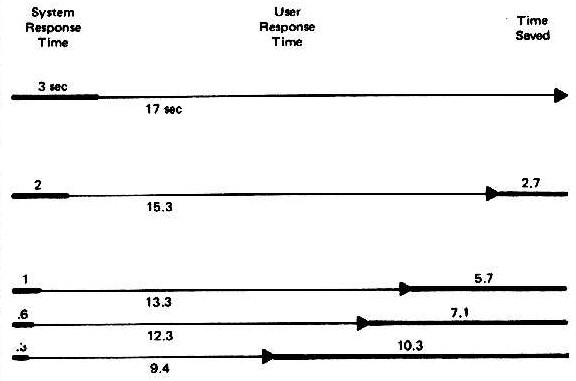
That seriously erks me...people need to understand the concept of a good PC and how it affects user productivity....i will keep harping IBMs 80s study til thee day i die til people actual read it and understand it.
 
  • Like
Reactions: N4CR
like this
That seriously erks me...people need to understand the concept of a good PC and how it affects user productivity....i will keep harping IBMs 80s study til thee day i die til people actual read it and understand it.

Care to elaborate on your point here?
 
Thanks. I've seen this paper before. The question is what is good enough response time. I would kind of pity someone doing much of anything beyond basic web browsing on a CD2, probably mechanical disk based system running XP. And maybe even then basic web browsing.
What it boils down to is Intel can recreate the CPU but it's performance on legacy software isn't going to increase. The real gains are higher parallelism and that's not happening on the consumer side even though we've had cheap 4 core CPUs for more than 5 years.
 
What it boils down to is Intel can recreate the CPU but it's performance on legacy software isn't going to increase. The real gains are higher parallelism and that's not happening on the consumer side even though we've had cheap 4 core CPUs for more than 5 years.

True. But I think the subject is more complex than just raw computing power. For instance, I can't imagine being productive with a single screen or single app on screen at a time environment. The bank I work started to deploy as standard issue for back office workers across the entire bank multiple monitors. I heard that some efficiency firm that was hired to look at cost reductions and productivity improvements recommended that. That's a form of parallelism that doesn't need mass amounts of computing power, but at least some to effectively drive the screens and apps so that everything runs smoothly. A Core 2 Duo running XP probably ain't that kind of system.

At any rate, I can't work without multiple monitors anymore, or at least I wouldn't want to, for an entire work day coding, writings docs and emails and instant messaging. That's my typical workload.
 
Well you are talking about workplace stuff which Intel has covered in spades. But yes even a lowly i3 would drive all three displays fine, that's just the state of computing requirements these days.

Bill gates actually wanted this a long time ago where most computing would happen remotely and the basic computer was a terminal. While not quite that it is getting closer to it.
 
Thanks. I've seen this paper before. The question is what is good enough response time. I would kind of pity someone doing much of anything beyond basic web browsing on a CD2, probably mechanical disk based system running XP. And maybe even then basic web browsing.
Currently studying that as a project. Windows fade is 250ms while no fade is 16-50ms in terms of showing on screen...not counting input lag which i will be measuring too. The fade is painfully slow to me and thats 250ms. It would be nice if they tried faster than 300ms. Granted this was the 80s so its understandable. I see a difference between 1 frame and 3 frames at 60hz which is crazy to me. 17ms vs 50ms -_-
 
Well you are talking about workplace stuff which Intel has covered in spades. But yes even a lowly i3 would drive all three displays fine, that's just the state of computing requirements these days.

Bill gates actually wanted this a long time ago where most computing would happen remotely and the basic computer was a terminal. While not quite that it is getting closer to it.
terminals are terrible as i am seeing and feeling a massive difference from 17ms to 50ms to 250ms in response times for a PC. You add terminal? Hell no. I'll pass. Thats just the display loading image speed and not even input delay so thats not even total load times.
 
terminals are terrible as i am seeing and feeling a massive difference from 17ms to 50ms to 250ms in response times for a PC. You add terminal? Hell no. I'll pass. Thats just the display loading image speed and not even input delay so thats not even total load times.
From a cost perspective and ease of deployment it makes total sense.

Yes there is lag time but if a business can implement it they will. It's becoming wildly popular.
 
From a cost perspective and ease of deployment it makes total sense.

Yes there is lag time but if a business can implement it they will. It's becoming wildly popular.

it depends the difference in responsiveness. 17ms vs 500ms is horrendous in terms of loss productivity (probably more...IBM stopped at 300ms)...go read the IBM study. Also if you turn 1000 clicks from 17ms to 500ms thats horrible thats an easy 30 plus mins a day wasted in terms of productivity! depending on how the task compared to what IBM was studing it could be over an hour of lost productivty and maybe more.

SAP is a prim example...fuck the systems i used in school were epic fails. I know this one medical distributor has a horrible system that should be smashed by a thousand monkeys with hammers.

If you go from 300ms to 2s response times you are seeing an easy 120 mins of lost productivity per day if you have 1000 actions a day.

if you have a 17-50ms system its probably close to 200 mins!

those systems are not economical if they are over 300ms response times and we are assuming there isn't even great impact going from 17-50s to 300ms. 300ms is a bare minimum in responsiveness. If a system is slower than that its total trash.

This has been proven since the 80s!

I highly doubt 300ms is the limit. It should be the bottom threshold and not the goal! Anyone that has used Widnows explorer with fade animation vs no fade and has a fast system like mine can tell you this. 17-50ms vs 250ms is huge!

The fade animation is 250ms...you try without fade and you will see the difference is night and day! I am looking at chrome too and how it responds and loads. I can tell when chrome loads in a couple frame vs several frames. The delay is obnoxious and slows me down. When I research or read news I load as many as 50 tabs. Control W to close and the next tab can very a lot given the complexity of the page and when it takes a quarter to half second its painful and ruins my work flow of reading news.

If you live near Chicago after I build my test rig you can come over and try it if you like. The speed of my current PC vs the others is insane and this test rig for my study is a lot faster. ~20% IIRC for web tasks. SKL has massive IPC increases in terms of web browser performance.

evrrt3.jpg

evrrt7.jpg
 
Last edited:
it depends the difference in responsiveness. 17ms vs 500ms is horrendous in terms of loss productivity (probably more...IBM stopped at 300ms)...go read the IBM study. Also if you turn 1000 clicks from 17ms to 500ms thats horrible thats an easy 30 plus mins a day wasted in terms of productivity! depending on how the task compared to what IBM was studing it could be over an hour of lost productivty and maybe more.

SAP is a prim example...fuck the systems i used in school were epic fails. I know this one medical distributor has a horrible system that should be smashed by a thousand monkeys with hammers.

If you go from 300ms to 2s response times you are seeing an easy 120 mins of lost productivity per day if you have 1000 actions a day.

if you have a 17-50ms system its probably close to 200 mins!

those systems are not economical if they are over 300ms response times and we are assuming there isn't even great impact going from 17-50s to 300ms. 300ms is a bare minimum in responsiveness. If a system is slower than that its total trash.

This has been proven since the 80s!

I highly doubt 300ms is the limit. It should be the bottom threshold and not the goal! Anyone that has used Widnows explorer with fade animation vs no fade and has a fast system like mine can tell you this. 17-50ms vs 250ms is huge!

The fade animation is 250ms...you try without fade and you will see the difference is night and day! I am looking at chrome too and how it responds and loads. I can tell when chrome loads in a couple frame vs several frames. The delay is obnoxious and slows me down. When I research or read news I load as many as 50 tabs. Control W to close and the next tab can very a lot given the complexity of the page and when it takes a quarter to half second its painful and ruins my work flow of reading news.

evrrt3.jpg

evrrt7.jpg

It completely depends on the situation. I work at a pharmaceutical company. I can tell you that productivity is not hampered by a half second delay in opening a file. The general incompetence of management in my company on the other hand...

Additionally, one study does not mean it's an end all be all study. Where are the additional studies? Where is its applicability to other fields? You keep harping on this one study, which may or may not be relevant to fields outside the scope of the study. Additionally, times change, and behavioral patterns may have changed as well.
 
It completely depends on the situation. I work at a pharmaceutical company. I can tell you that productivity is not hampered by a half second delay in opening a file. The general incompetence of management in my company on the other hand...

Additionally, one study does not mean it's an end all be all study. Where are the additional studies? Where is its applicability to other fields? You keep harping on this one study, which may or may not be relevant to fields outside the scope of the study. Additionally, times change, and behavioral patterns may have changed as well.

as i said this depends on actions/transactions. If you do heavy amounts of actions per minute these delays greatly affect how your brain uses its short term memory and muscle memory. Looking up a single item once an hour makes no difference but if you click and enter data constantly like in SAP these delays are horrendous on your productivity. Looking up a single drug facts 10 times an hour doesn't really matter. When you click and open constantly editing order forms and submitting data and you perform 1000s of clicks these delays have exponential amount of lost productivity. Read the study and don't make stuff up.

This directly relates to how ones memory works and how our brains think in regards to high transaction rates. SAP, regular windows use like going through the GUI, programming, coding and so on.

behavior is irrelevant this study directly shows how our brains work and our attention span functions and how our brains queue tasks. This is never going to change as long as the tasks uses the brain in a similar matter, which any high action task does. Don't make stuff up...prove your point with facts.

also read my edits above. I was still editing as ussual :D

BTW as i stated...your response clearly shows you never even bothed to read the study so how about you read it before posting something. It makes you look bad and useless posts are made that way.

If you even bothered to skim the damn study you would see this:
Broad Applicability
The studies described up to this point involved scientists, engineers, and programmers. A test conducted with administrative professionals indicates that the same benefits can be realized with sub-second response time in data base applications. Component forecasters at IBM's Poughkeepsie facility make frequent reference to an online data base when estimating requirements for electronic parts. The work involves the maintenance of part inventories, bills of materials, and timetables of production and delivery, all tasks similar to those handled by production planners in many organizations.
Five component forecasters were provided subsecond response time for a half-day experiment during which their transaction rate productivity was measured. In their normal working environment they had a system response time of five or more seconds and an average individual productivity rate of 99 transactions per hour. During the test they worked at an average of 336 transactions per hour, a productivity increase of 339%.
 
Last edited:
  • Like
Reactions: N4CR
like this
The idea is this works for a majority of the work force, for those who would be hindered would get the right tool for the job (hopefully).
 
I live somewhere with heavily congested rural broadband (New Zealand where they like to fudge the OECD figures..). It's third world at best.
The delay has lead me to adjust my work habits, load tab in background, work on something else. Similar to this study but 20-100x worse delays.

If I wait for shit to load during peak times, my productivity is 20-30% of what it could be...
 
First they laid off 12,000 of their workforce. Now they are cancelling "Braxton," their (previously) upcoming Atom chip and have conceded defeat to ARM in the mobile market. They're apparently bowing out of the PC market as well.

What the hell is happening? Is there something going on within Intel that isn't apparent? I'm confused as to how such a huge multi-billion dollar CPU leader is tucking their tails between their legs and just "giving up" so easily. Is Intel afraid of AMD's Zen CPU?

Seems like with each news story related to Intel, they're falling further behind technologically.
Just making room for AMD. I believe direct x12 and Zen APUs will make Great strides especially in ssf gaming. That's where my money is
 
Back
Top