• Some users have recently had their accounts hijacked. It seems that the now defunct EVGA forums might have compromised your password there and seems many are using the same PW here. We would suggest you UPDATE YOUR PASSWORD and TURN ON 2FA for your account here to further secure it. None of the compromised accounts had 2FA turned on.
    Once you have enabled 2FA, your account will be updated soon to show a badge, letting other members know that you use 2FA to protect your account. This should be beneficial for everyone that uses FSFT.

Bleeding help please!

Joined
Feb 24, 2010
Messages
641
So I moved some parts and put return from cpu to bottom side of res for better bleeding.

I have big problems, first there I can barely fill the res over the top of res as funnel has huge leak, so this is not a problem when pump is running,
however when pump is turn off the water push to funnel leak and all over PSU and little bit on GPU.

sometimes when pump is running air gets inside reservoire and the water goes to funnel even when pump is running, only solution is to tilt case and let water fall to floor otherwise PSU and computer get totaly wet.

So now I have sealed top of reservoir and remove tube + funnel, but now air not get out?!

So I need to keep the funnel and tube and let the pump run, however there is guarantee to be alot of leak and papertowel to use.

Also I have big problem, if I turn pump off then the water push out over PSU as there is bad leak on funnel, so then there is so much air that the water gets pushed to funnel and then power supplie get alot of water on it and the fan is on top so it is not good :(

I now have sealed where tube and funnel was, but judging from my understanding does not work as air can't get out?

Also I have made slightly adjustment to my system as of below picture:
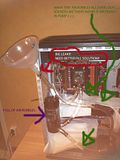


edit--> so even if top tube has no water during bleeding it gets full of water and start leaking over PSU when air goes to res I assume.
 
Don't fill the res to the very brim until you're done bleeding, it should help. I would just close it and gently shake the system and tilt in all directions with the pump running to ensure you get all the bubbles out, then add a little more water to the res if you need it. I have a big syringe I Use for filling my res with, way better than a funnel.
 
Don't fill the res to the very brim until you're done bleeding, it should help. I would just close it and gently shake the system and tilt in all directions with the pump running to ensure you get all the bubbles out, then add a little more water to the res if you need it. I have a big syringe I Use for filling my res with, way better than a funnel.

Thank you for well put answer!

So I imagine with time the air gets collected in top of reservoir?

So then must I fill it with more water because maybe otherwise the air goes back into loop/pump?
 
Just remember the one golden rule that is always true. Air goes to the highest point in the system.
 
Just remember the one golden rule that is always true. Air goes to the highest point in the system.

It does not really do that. Otherwise every 800D or similar would have a rad full of air :p

EDIT: Ofc air rises within a system, but when it passes the reservoir it will rise and stay there, if the loop is configured correctly.
 
Last edited:
The best way is to jumper the PSU so you can turn the pump on without turning the PC on.

I have a similar setup with the radiator being the highest point. I have tilted my PC every which way to get the air out of the radiator. It seems like its working cause the temps keep dropping.

The syringe trick is an excellent way to fill the res.
 
Water should not be going up that fill tube. If it is, then you have a leak somewhere else in the system, where air is getting in. You should also only be filling near the top of the reservoir, no higher.
 
It is true that you will see air in the reservoir that is trapped there, but you will still have air up in the radiator unless you have some point higher than that for the air to go. As soon as you turn the pump off, you no longer have any force to offset gravity. The water will go down to the lowest point and the air will rise to the highest point. The highest point for the air will always be in the section that the air is at. So unless someone has a T-line or reservoir higher than their radiator, they will have some air in their radiator.

Edit. To solve your problem grandpatzer, connect a hose to the top of your reservoir that goes higher than your case. The water level will rise to the height of the top of the radiator when your are filling your system. As the air is circulated into the reservoir it will travel up the hose and out. When you no longer get any air coming out of the hose, you just put a plug in the end of the hose and put inside of your case.
 
It is true that you will see air in the reservoir that is trapped there, but you will still have air up in the radiator unless you have some point higher than that for the air to go. As soon as you turn the pump off, you no longer have any force to offset gravity. The water will go down to the lowest point and the air will rise to the highest point. The highest point for the air will always be in the section that the air is at. So unless someone has a T-line or reservoir higher than their radiator, they will have some air in their radiator.

Edit. To solve your problem grandpatzer, connect a hose to the top of your reservoir that goes higher than your case. The water level will rise to the height of the top of the radiator when your are filling your system. As the air is circulated into the reservoir it will travel up the hose and out. When you no longer get any air coming out of the hose, you just put a plug in the end of the hose and put inside of your case.

Not true. Over time, water moving through the radiator will dislodge air bubbles and carry it out of the radiator. This process usually only takes about 12 hours at most.

Additionally, having a T-line above the radiator doesn't help anything unless the radiator outlets are pointed upwards. The air cannot escape downards through the outlets based on your reasoning, so that won't help anything.

Furthermore, once the water is in the radiator, it's not going to go down unless there's air elsewhere in the loop that can travel up to the radiator. The inlet and outlets of the reservoir are usually completely submerged, so air cannot get into the loop through there.
 
Not true. Over time, water moving through the radiator will dislodge air bubbles and carry it out of the radiator. This process usually only takes about 12 hours at most.

Additionally, having a T-line above the radiator doesn't help anything unless the radiator outlets are pointed upwards. The air cannot escape downards through the outlets based on your reasoning, so that won't help anything.

Furthermore, once the water is in the radiator, it's not going to go down unless there's air elsewhere in the loop that can travel up to the radiator. The inlet and outlets of the reservoir are usually completely submerged, so air cannot get into the loop through there.

Well if that be the case then in your argument you have just supported that there will never be any air in the reservoir if it is 6 inches below the radiator. The water level can never physically go higher than the inlet port. As soon as you open the inlet port you have created a pressure free area. If you have water higher than the inlet port then the water that is higher will push downwards because of gravity, basic laws of physics. The only way you change that fact is if your system is in a vacuum or if you are supplying a vacuum higher up in the system to hold the water there.

When you are bleeding your system you should be turning your computer at some point so the inlet and outlet of the radiator is at the highest point of your radiator. That way you do have all the air out of the system. That is why you are seeing more and more radiators come out with bleeder screws. That way if you do have your radiator ports at the bottom, you can still easily bleed the radiator. You will always have some air in your radiator unless you have the highest point in the radiator open to alllow the air to leave.
 
Well if that be the case then in your argument you have just supported that there will never be any air in the reservoir if it is 6 inches below the radiator. The water level can never physically go higher than the inlet port. As soon as you open the inlet port you have created a pressure free area. If you have water higher than the inlet port then the water that is higher will push downwards because of gravity, basic laws of physics. The only way you change that fact is if your system is in a vacuum or if you are supplying a vacuum higher up in the system to hold the water there.

When you are bleeding your system you should be turning your computer at some point so the inlet and outlet of the radiator is at the highest point of your radiator. That way you do have all the air out of the system. That is why you are seeing more and more radiators come out with bleeder screws. That way if you do have your radiator ports at the bottom, you can still easily bleed the radiator. You will always have some air in your radiator unless you have the highest point in the radiator open to alllow the air to leave.

I never said that, and that is simply not true. The radiator, or anything else for that matter, does not allow air into the loop if its properly sealed. When the loop is full of water, that water is not going anywhere, because there's nothing that can take its place. Air will not magically appear in the radiator, causing the water to flow back into the reservoir and overflow it. It doesn't matter whether the reservoir is 10 feet below the radiator or 10 feet above it.

Sure, it is easier to bleed the loop if the radiator has a bleeder hole. But is it necessary? I have found that it isn't. If companies have a reason to sell a product with a small extra feature for more money at minimal cost to them, you're damned sure they will do it.

My source: personal experience and knowledge of physics.
 
Take the reservoir out of the clips, and lay the case down on its side. That should allow the radiator to more easily burp itself and get trapped air out. Bleeding roof-mounted radiators is tough.

For the future, if you re-do your loop order, switch the inlet and outlet on the radiator... that way, if you lay the case down on its motherboard side, the outlet of the radiator would be at the top, allowing the air to escape/bleed easier.

Other than that, the loop looks fine.
 
well honestly while running the pump I tilted the case and air worms started wandering in tubes, the finally when power off the PSU no more air to be seen besides tiny air bubble in tube and res.

I let it run ~24h with res sealed, after that all tiny air bubbles disappear from tube and only in res.

the reason the water gets pushed up when res open I'm not entirely sure as there is no leak in system.
^^^^ Maybe the airpockets can't get out of res so the press water?

I'm honestly not sure why the water lever in tube/funnel rise when turn pump off, as I said no leak in system either,

here how it look now and it works perfect, can click for bigger picture:


Edit--> also looking at reservoir I can't see water line so res is wery full of water now, also my understanding is that it can have 2-3cm air in top of res no problem.
 
As long as the inlet and outlet are covered with water, your reservoir is full enough.
 
As long as the inlet and outlet are covered with water, your reservoir is full enough.

ok did not know that, also do you think it is possible that when the fill tube had water the reason for the water lever rising when turning pump off was because air in radiator got into reservoir and was not able to got into fill tube because of water in it?

I don't see any leaks on my system.
 
Back
Top